

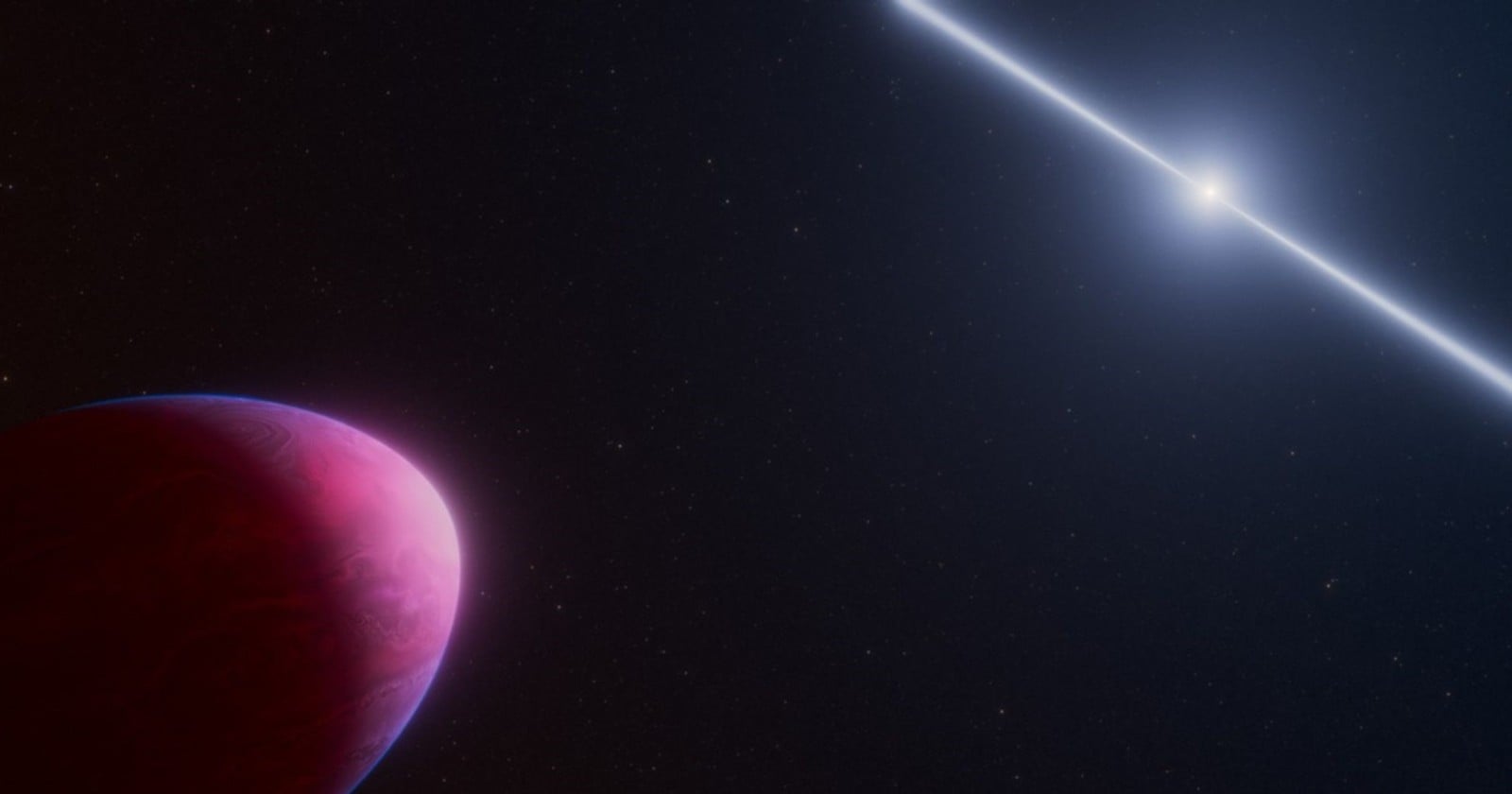
PSR J2322-2650b is strange enough without letting its measurements and models blur together. It is a roughly Jupiter-mass companion racing around a millisecond pulsar every 7.8 hours. Webb detected molecular carbon in its infrared spectrum and found no measurable signatures of water, methane or carbon dioxide. A helium-dominated atmosphere with carbon clouds fits the data, tidal modelling gives the world its lemon-like shape, and carbon physics allows diamonds deeper inside.
Those statements do not all have the same evidential status. The C2 and C3 carbon bands were detected. The bulk helium, graphite-like clouds, distorted geometry and diamonds come from models used to explain the spectrum and orbital light curve. The formation problem is also an interpretation, although a serious one: neither an ordinary giant planet nor a stripped stellar remnant naturally produces such an extreme carbon-rich, oxygen-poor and nitrogen-poor composition.
There is one more wrinkle. The widely repeated distance of 750 light-years is the older discovery-era estimate. The Webb paper used an updated distance of 630 parsecs, about 2,050 light-years. The planet did not move. Radio timing improved the parallax.
The system has acquired more than one distance
When PSR J2322-2650 and its companion were described in 2017, pulsar timing gave a parallax of 4.4 plus or minus 1.2 milliarcseconds. The discovery paper converted that to 230 parsecs, with a broad uncertainty of minus 50 and plus 90 parsecs. Rounded into light-years, 230 parsecs became the familiar figure of about 750.
Longer timing baselines changed the estimate. A 2024 MeerKAT timing study reported roughly 0.8 kiloparsecs, much closer to an earlier dispersion-measure estimate than to 230 parsecs. The team behind the Webb analysis then used new radio timing in its appendix and adopted 630 parsecs. That is roughly 2,050 light-years.
Distance matters because the telescope measures flux at Earth. Converting that flux into the companion’s emitted power and brightness temperature requires a distance and an assumed radius. The headline retains the older value, but the atmospheric analysis rests on the newer one.
Webb could see the companion because the pulsar stayed dark
The host is a neutron star with about the mass of the Sun compressed into an object the size of a city. It spins once every 3.5 milliseconds and sweeps radio pulses across Earth. Its high-energy output heats the companion, yet the pulsar itself contributes little infrared light in Webb’s NIRSpec band.
That unusual contrast gave astronomers a cleaner measurement than is possible for most exoplanets. An ordinary star can outshine its planet by thousands or millions to one in the same wavelength range. Here Webb followed the companion’s own emission through an entire orbit while the host was effectively invisible to the instrument.
The single-object study, led by Michael Zhang, used both low-resolution prism spectra and higher-resolution grating observations. The carbon signal shifted back and forth with the companion’s orbital velocity. That motion helped confirm that the absorption belonged to PSR J2322-2650b rather than the detector, foreground material or an unrelated background source.
Molecular carbon is the direct atmospheric result
The firm chemical detections are C2 and C3, molecules made from two and three carbon atoms. The team reported C2 at high significance in the velocity analysis, while the broad dayside spectrum showed strong absorption consistent with both forms. Webb did not find the usual water, methane or carbon dioxide features seen in many hot-planet spectra.
“No detectable” is an instrumental statement, not a declaration of literal absence. It means those molecules did not produce features above the sensitivity and modelling limits of these observations. Hidden material could remain deeper than the pressures Webb probes, below an opaque cloud layer or at abundances too low to measure.
Helium sits on the model side of the ledger. Helium has weak spectral features at these temperatures and wavelengths, so Webb did not identify it with a clean absorption band comparable to C2 or C3. A bottom-heated, helium-dominated atmosphere containing small amounts of molecular carbon and an extended graphite dust layer reproduced the main spectrum. In that solution, carbon outnumbers oxygen by more than 100 to one and nitrogen by more than 10,000 to one.
NASA’s summary of the result notes that molecular carbon has not been detected in the other roughly 150 planetary atmospheres studied inside and outside the solar system. The unusual part is not merely that carbon exists. It is that carbon remains bonded to carbon instead of preferentially combining with oxygen, nitrogen or hydrogen.
The lemon is a tidal model, not a resolved photograph
PSR J2322-2650b orbits only about 1.6 million kilometres from the pulsar. The separation is roughly one hundredth of the Earth-Sun distance, and the companion completes a year in 7.8 hours. Across a body the size of Jupiter, the pulsar’s gravitational pull changes enough from the near side to the far side to distort the planet.
The Webb phase curve is consistent with a companion that nearly fills its Roche lobe, the teardrop-shaped gravitational boundary inside which material remains attached to it. Models of the changing infrared brightness constrain the inclination, radius and heated geometry, producing the pronounced lemon shape used in NASA’s artist’s concept.
Webb did not take a resolved picture of that outline. The object is far too small and distant. The shape is an inference from gravity and the orbital light curve, supported by a system so compact that material may be close to flowing from the companion towards the pulsar.
Soot clouds and diamonds are one physical interpretation
The graphite cloud layer in the spectral model is the basis for the soot description. At the cooler parts of the atmosphere, carbon particles could condense and darken the nightside. Deeper inside, rising pressure changes the stable form of carbon. Under suitable conditions, carbon that begins as graphite-like material can crystallise as diamond.
No diamond spectral feature was reported, and Webb did not see crystals falling through the atmosphere. Diamonds are a predicted consequence of the inferred composition and interior conditions. The model is plausible enough to investigate, but it is not an observation on the same footing as the C2 and C3 bands.
SpaceDaily’s earlier diamond-focused account makes this distinction central: carbon chemistry motivates the prediction, while the diamonds themselves remain unseen.
Both familiar formation routes leave the wrong elements
A normal gas giant forms in a protoplanetary disc and retains large amounts of hydrogen and helium plus trace molecules carrying oxygen, nitrogen and carbon. Nothing in standard planet formation naturally filters that mixture into an atmosphere with carbon-to-oxygen and carbon-to-nitrogen ratios this extreme.
The usual black-widow explanation also struggles. In these binaries, a pulsar was spun up by taking material from a stellar companion and later stripped that companion with radiation and a particle wind. A remnant peeled down towards a helium or carbon-oxygen core can reach planetary mass, but nuclear burning and stellar structure should leave a broader elemental mixture than the one inferred here.
Study co-author Roger Romani proposed that carbon and oxygen could crystallise as the companion cooled, with pure carbon crystals floating upwards and mixing into helium. That might supply atmospheric carbon, but it does not yet explain where the oxygen and nitrogen went. It is a possible mechanism with a missing separation process, not a completed origin story.
A useful anomaly still rests on one world
SpaceDaily’s first full report on the system described how the chemistry challenges every established formation route. The claim should remain proportional to the evidence. It means no current model satisfactorily reproduces this object, not that every possible physical history has been disproved.
More Webb observations could test whether the spectral features repeat across different orbits and extend the wavelength range used to search for oxygen-, nitrogen- and hydrogen-bearing species. Better radio timing would narrow the distance, inclination and mass. Comparable spectra of other black-widow companions would show whether PSR J2322-2650b is unique or the first member of a carbon-rich class.
For now, the hierarchy is clear. Webb directly measured an orbit-changing spectrum rich in C2 and C3. A helium atmosphere with graphite clouds explains it. Tidal models stretch the companion into a lemon. Interior models permit diamonds. The two familiar formation stories fail to supply the measured chemistry. None of those caveats makes the object ordinary. They show precisely which parts of this extraordinary world are data, and which parts remain a theory waiting to be tested.