
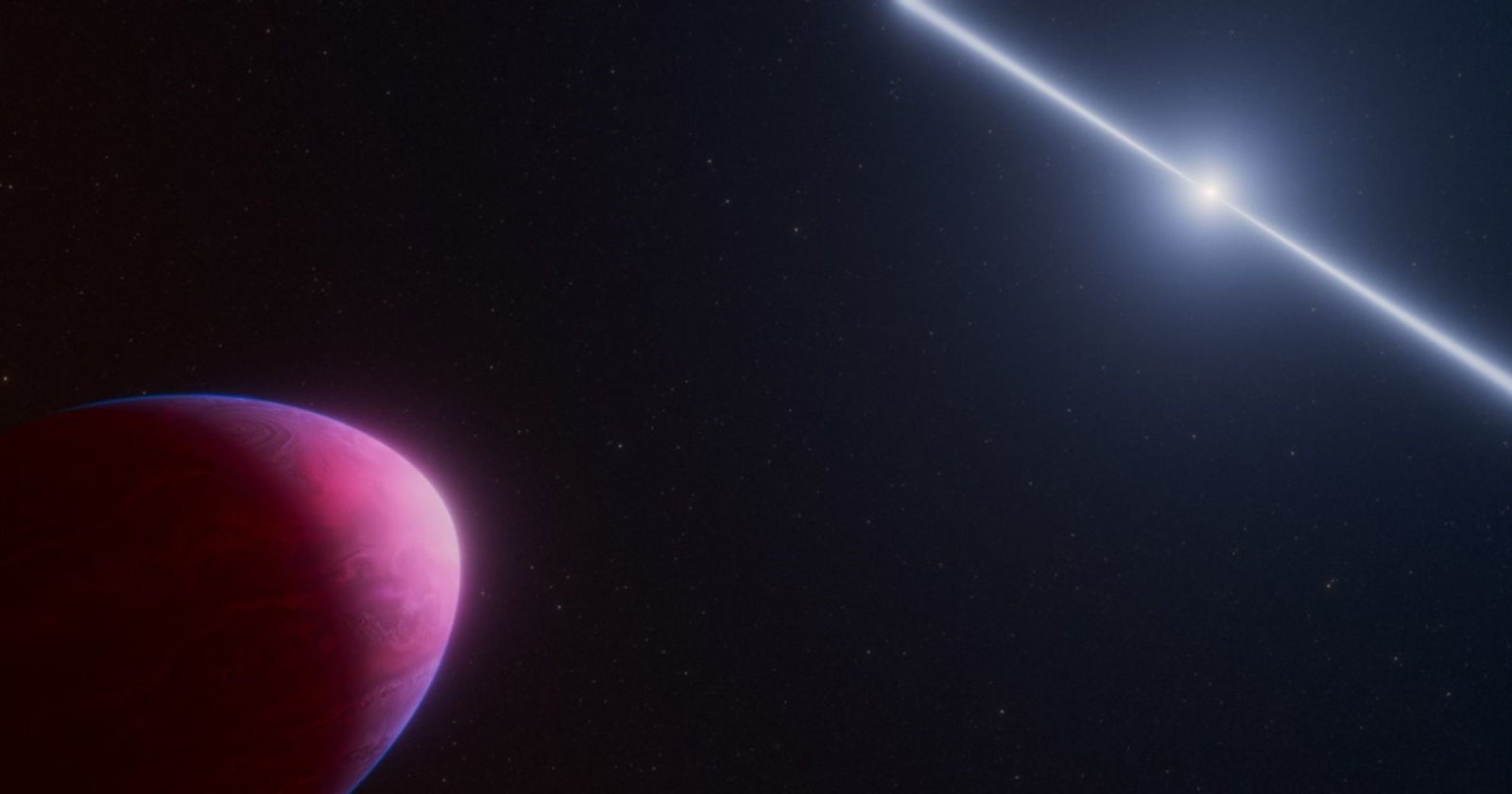
Astronomers using the James Webb Space Telescope have found a Jupiter-mass world orbiting a dead star, with an atmosphere so strange that its clouds appear to be soot condensing into diamond, and a composition that fits no known way of building a planet. The object is called PSR J2322-2650b, and on current evidence it is unlike anything else yet found.
Two parts of that description are firm measurements. The diamond rain is an inference drawn from them. And the formation problem is a real puzzle rather than a slogan.
A world around a dead star
The dead star is a pulsar, PSR J2322-2650, the collapsed core left behind when a massive star exploded. What remains is a city-sized ball of neutron-packed matter, spinning hundreds of times a second and sweeping the sky with beams of radio waves. It is about as far from a living, shining star as an object can be.
Around it orbits a companion roughly the mass of Jupiter, found in 2017 through the tiny regularities its gravity imposes on the timing of the pulsar’s radio pulses. Systems like this are sometimes called black widows, because the pulsar gradually strips and consumes the smaller body beside it. What no one could see, until recently, was what that body is actually made of.
Webb changed that.
An atmosphere of almost pure carbon
By watching the faint glow of the companion across a full orbit, the telescope was able to read its atmosphere. The result, published in the Astrophysical Journal Letters in 2025, was an atmosphere dominated by helium and carbon, including carbon in its molecular forms, and conspicuously missing the nitrogen and oxygen that colour the atmospheres of other worlds.
The rest of the object is as odd as its chemistry. It sits at an equilibrium temperature of around 1,900 kelvin, is locked with one face permanently toward the pulsar, is stretched by that star’s gravity into the shape of a lemon, and is wrapped in strong winds. The researchers described its atmosphere as unlike any other exoplanet’s yet observed.
Where the diamonds come in
The diamonds follow from the carbon. In an atmosphere this rich in carbon and this hot, the carbon can gather into clouds of soot, and under the right heat and pressure soot is precisely the material that hardens into diamond.
This is where care is needed. No one has photographed diamonds falling on PSR J2322-2650b. The diamond rain is what the measured chemistry implies should happen, a consequence drawn from the composition rather than a thing directly seen. It is a reasonable inference, and a striking one, but it is an inference.
A composition no theory explains
The hardest part is not the diamonds.
It is how the object came to be made of what it is made of. The ordinary way to build a Jupiter-mass world, out of a disc of gas and dust around a young star, does not yield a body of nearly pure carbon. The usual explanation for the low-mass companions of pulsars, that they are the stripped-down cores of former stars, does not fit either, because such a remnant should carry a broader mix of elements rather than this carbon-dominated, nitrogen-free, oxygen-free composition. One of the researchers involved put it plainly, saying the object seems to rule out every known formation mechanism.
That is not a claim that it cannot exist, since plainly it does. It is a statement that, at present, no established process accounts for it. It even blurs the usual line between a planet and the corpse of a star, because it is not obvious which of the two the thing should be called.
Why it matters
An object this anomalous is useful precisely because it breaks the models. A theory that explains every case it was built from tells you little; one that meets something it cannot explain is being shown where it is incomplete. PSR J2322-2650b hands astronomers exactly that kind of problem, in the physics of how pulsar companions and carbon-rich worlds come to be at all.
It is also a demonstration of reach. Taking the spectrum of a small, dim companion orbiting a dead star, and pulling the chemistry out of its light, is a measurement that was not possible before Webb. For years the object was known only as a faint gravitational tug on a pulsar’s clock. Now its air can be read.
What to watch
The next steps are to firm up the composition with further observations, and to test whether the diamond-forming chemistry really behaves as the models suggest it should. On the theory side, the task is to find a formation path that could produce such a world, or to establish that something genuinely new is needed to explain it.
Then there is the wider question of whether PSR J2322-2650b is one of a kind or the first of a type. Only more pulsar companions, examined the same way, will settle that. For now it stands as a single object that no current theory can quite account for, which is often where the interesting physics begins.