

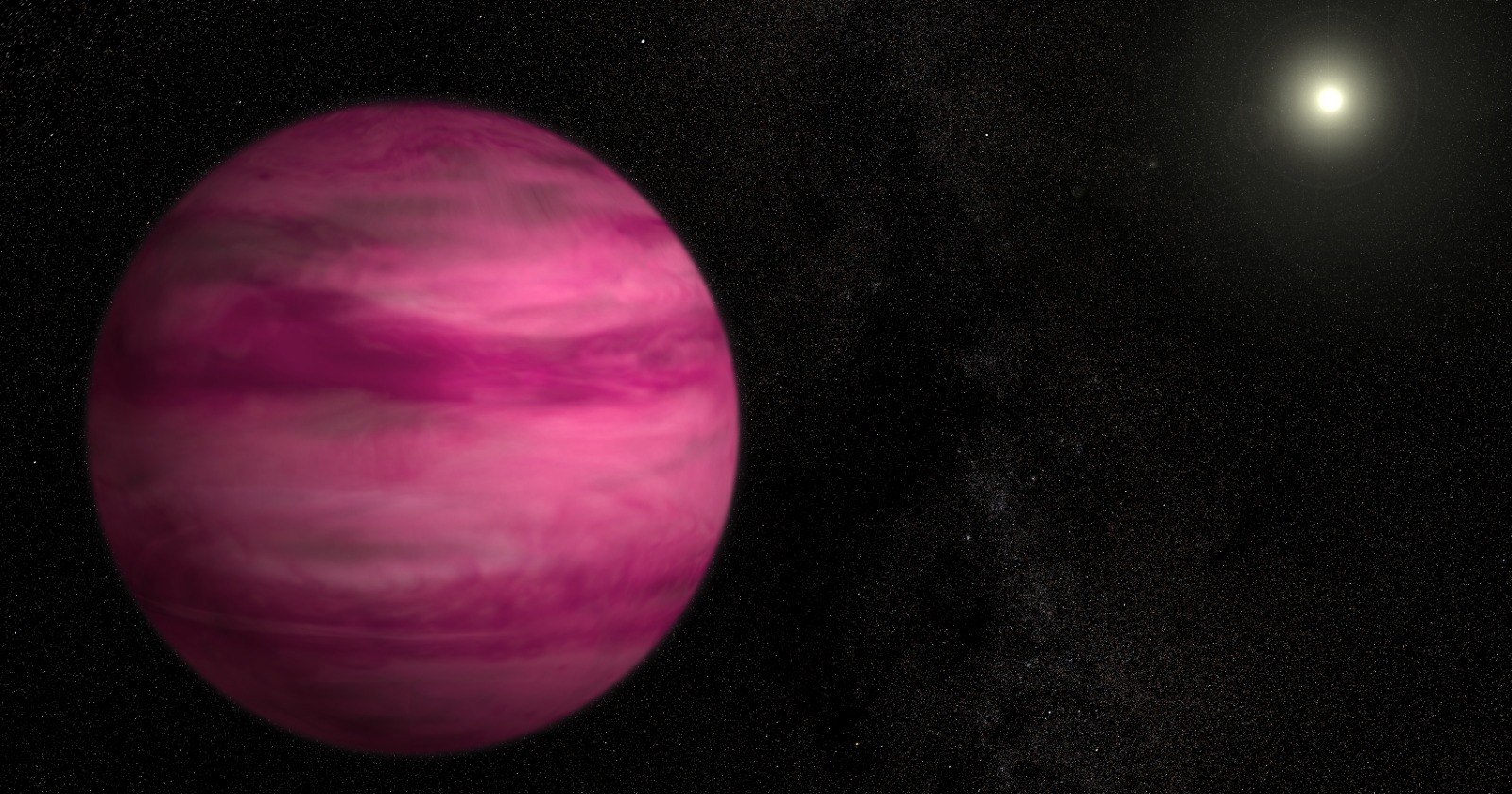
GJ 504 b is famous for two things that astronomers have not quite established. Nobody has measured it as pink in visible light, and nobody can yet say with confidence that it is a planet.
The first description came from models suggesting that the cold companion might resemble a dark cherry blossom or dull magenta. The second became uncertain when later estimates made the system much older, and the companion much more massive, than researchers initially thought.
What the James Webb Space Telescope has measured is less picturesque and more useful: the first direct spectrum of this faint object. That spectrum did not contain a neat absorption line labelled “salt”. Instead, it presented a modelling problem. The measured light could be fitted without clouds only by giving the atmosphere a thermal structure that did not make physical sense.
Clouds fixed the problem. Of the alternatives tested, clouds containing potassium chloride and zinc sulphide produced the most coherent atmosphere. The distinction is essential. Webb supplied the spectrum; the salt emerged from the model needed to explain it.
The observation came thirteen years after discovery
GJ 504 b was announced in 2013 after the Subaru Telescope imaged it beside the Sun-like star GJ 504. The system lies about 57 light-years away. The companion appears roughly 43 astronomical units from its star, close to nine times Jupiter’s distance from the Sun.
That separation made direct imaging possible, but the object was exceptionally cold and faint. Most companions found through direct imaging are young enough to retain substantial heat from formation. GJ 504 b has an effective temperature near 564 kelvin, about 291 degrees Celsius. That is hot by human standards but cool for a self-luminous object of this class.
Large ground-based telescopes could recover individual brightness measurements through selected filters. They could not disperse enough of the companion’s light into a useful spectrum. One observing attempt spent an entire night on the target without detecting it spectroscopically.
Webb’s NIRSpec instrument needed roughly two and a half hours. Its position above Earth’s atmosphere and its sensitivity in the infrared turned a handful of photometric points into continuous coverage from 2.9 to 5.3 micrometres.
Removing the star was part of the measurement
GJ 504 b is not transiting its star, so the researchers were not reading starlight filtered through a planetary limb. They measured the companion’s own thermal radiation while it sat beside a much brighter source.
The team used forward modelling to separate the companion’s signal from the host star’s point-spread function. This produced a detection with a signal-to-noise ratio above 300. A second analysis applied angular differential imaging to the NIRSpec data cube, allowing the sky to rotate relative to the telescope’s instrumental pattern and revealing the companion at lower but independent significance.
The resulting Astronomical Journal study, published on 18 June 2026, reported strong signatures from water, carbon monoxide, methane, carbon dioxide, ammonia and hydrogen sulphide. It also identified rarer isotopic forms of carbon monoxide and evidence that vertical mixing keeps the chemistry away from simple equilibrium.
Those molecular detections were the beginning of the interpretation, not its end. A spectrum says how much light emerges at each wavelength. Turning that curve into temperature, gravity, composition and clouds requires a retrieval model that tests which atmospheres could have produced it.
The cloud-free answer had a physical kink
A retrieval is allowed to explore many combinations of atmospheric properties. That flexibility can be both a strength and a warning. A model may trace the measured spectrum while choosing a temperature structure that a real atmosphere would struggle to maintain.
That is what happened when the team first assumed a clear atmosphere. The retrieved pressure-temperature profile developed an almost isothermal section between roughly 0.1 and one bar. It departed from radiative-convective equilibrium models, which balance the movement of energy by radiation and convection through the atmosphere.
The odd profile did not mean the data were wrong. It suggested that the clear model was compensating for missing opacity. Something was preventing radiation from deeper layers from reaching Webb, and the retrieval was bending the temperature profile to imitate that obstruction.
As the Northwestern-led team explained, adding clouds made the unusual characteristics disappear. The cloudy atmosphere could match the spectrum while remaining much closer to the thermal behaviour expected for a cold giant world.
Why salts fit the temperature
Clouds are not made only from liquid water. Any substance can form cloud particles if local temperature and pressure allow its vapour to condense. Earth’s atmosphere offers water droplets and ice. Jupiter adds ammonia. Hot brown dwarfs can carry condensates made from iron and silicate minerals.
GJ 504 b is too cool for those refractory clouds to dominate the observable atmosphere. At its temperature, potassium chloride and sulphide compounds become plausible condensates. Northwestern described the broad phenomenon as theorised more than fifteen years before the 2026 result. A concrete 2012 modelling study calculated how KCl, ZnS, sodium sulphide and related clouds should influence cool T- and Y-dwarf spectra.
The 2026 retrieval tested three cloud prescriptions. The salt-cloud option fitted best. Its most consequential component was a potassium-chloride cloud deck near one bar, which reduced the contribution of light emerging from deeper, molecule-rich layers. Once that deeper radiation was veiled, the inferred molecular abundances and temperature profile became physically more plausible.
Zinc sulphide was included in the preferred model, but it should not be described with equal confidence. The retrieval poorly constrained both the amount of ZnS and the pressure of its cloud base. Its contribution to the emerging spectrum appeared modest compared with the KCl layer.
Nor does “salt” mean that the atmosphere contains drifting grains of ordinary sodium-chloride table salt. Potassium chloride is a related ionic compound; zinc sulphide is another condensable solid under the relevant conditions. The proposed clouds would consist of small particles suspended in a hydrogen-rich atmosphere, with their scientific importance coming from how they absorb and scatter radiation.
“Salt clouds” remains an inference
SpaceDaily’s first report on the result drew the crucial boundary: nobody photographed a salt cloud. The claim rests on the atmosphere becoming coherent when cloud opacity is included, and on salt condensates fitting the relevant temperature-pressure region better than the other tested options.
A later SETI Institute discussion with lead author Aneesh Baburaj made the uncertainty even plainer. Future Webb observations are needed to determine whether the proposed clouds are actually present. In the present data, the salts do not contribute a unique, sharp spectral fingerprint that excludes every other conceivable cloud model.
“First” is therefore narrow here. Salt and sulphide clouds have been predicted for years and have helped explain broad colours and muted spectra in other cold objects. The GJ 504 b team describes this as the first case in which salt clouds proved critical to explaining a directly measured spectrum without forcing the retrieved atmosphere into implausible behaviour.
That is not the same as collecting a crystal or imaging a cloud bank. It is still meaningful evidence. Much of exoplanet science advances by comparing models that make different predictions and asking which explanation survives contact with several kinds of measurement.
The atmosphere hints at an origin but does not settle it
The retrieval placed GJ 504 b at 564 ± 4 kelvin and estimated a surface gravity corresponding to a mass of about 25 Jupiter masses, with substantial uncertainty. Evolutionary models gave a broadly consistent range of 19 to 27 Jupiter masses and an age between roughly 2.5 and 4 billion years.
That mass straddles an unhelpfully fuzzy boundary. Brown dwarfs form through star-like collapse, while giant planets are generally assembled in discs around stars. Mass alone does not reveal which route produced an individual object, and nature has no obligation to respect a clean naming threshold.
The spectrum suggests an atmosphere enriched in elements heavier than hydrogen and helium. Such enrichment can favour planet-like formation because planets often accumulate solids as they grow. Yet the host star is itself metal-rich, and uncertainties in the comparison are large. The paper calls the planetary interpretation tentative and does not exclude a star-like origin.
The Pink Planet may not look pink
The familiar magenta portrait is an artist’s concept. GJ 504 b has not been detected at visible wavelengths, so astronomers do not possess a colour photograph of it. The nickname arose from early temperature estimates and modelled appearance, not from a measurement of the light a human eye would see.
Baburaj later used the atmospheric model to estimate a possible visible colour, but the result remained inconclusive. Calling the object pink is convenient and evocative. Treating the colour as an observation would cross the same line that turns an inferred cloud deck into a photographed weather system.
This concern is not pedantry. Recent SpaceDaily coverage of GJ 486 b showed how even a real water-shaped feature can have two locations: in a planet’s atmosphere or in cooler patches on its star. Spectra become reliable physical stories only after competing sources and models are tested.
A model failure became the discovery
The deepest result from GJ 504 b is not that an exotic material was added to an inventory. It is that a model failed in an informative way. The clear atmosphere could reproduce the light only by distorting its thermal structure. A physically motivated cloud layer removed the distortion and explained why deeper molecular signatures were subdued.
That chain of reasoning is less immediate than a picture of pink clouds, but it is closer to what Webb accomplished. The telescope transformed a dim point into a detailed spectrum. The retrieval exposed a missing source of opacity. Condensation chemistry identified salt clouds as the best tested explanation.
More wavelengths and repeated observations may strengthen that interpretation or force another revision. For now, GJ 504 b remains an object whose name, colour and formation route are unsettled, while its atmosphere has become sharply measurable. The salt is not visible. The need for something behaving like it is.
The method also reaches beyond this one companion. Colder planets emit less light, while their cloud decks can hide the gases observers hope to measure. Learning where a physically incomplete retrieval bends itself around missing opacity is preparation for interpreting worlds closer to the temperatures of Jupiter and Saturn. On GJ 504 b, the model’s discomfort was not an inconvenience to be smoothed away. It was the signal that the clear sky was probably the wrong sky.