

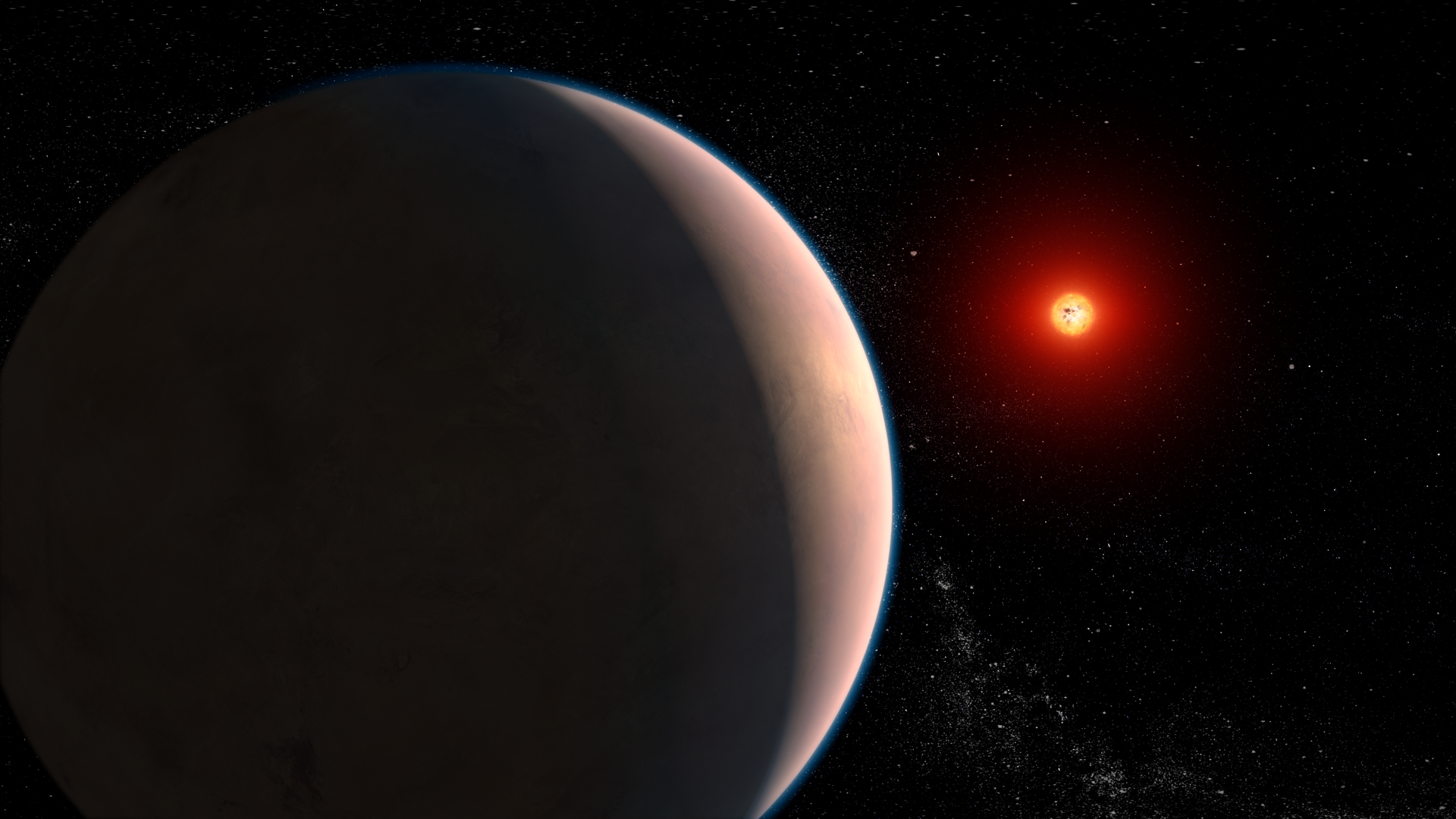
GJ 486 b offered two readings of the same small rise in a spectrum. In one, water vapour surrounded a hot rocky planet, implying that an atmosphere had survived or been replenished despite intense irradiation. In the other, the planet was bare and the water belonged to cooler regions on the face of its star.
The first James Webb observations could not choose between them. Two later observations approached the system from the other side of the orbit, measuring the planet’s heat as it disappeared behind the star. That thermal result, published in The Astrophysical Journal Letters by Megan Weiner Mansfield and colleagues, is inconsistent with the thick, water-rich interpretation and is best explained by a mostly airless world.
“Probably” still matters. The data allow a thin atmosphere and do not prove that the planet has no gas at all. What changed is the balance between two explanations. A once-plausible steam envelope now has to survive a dayside temperature and a featureless mid-infrared spectrum that look much more like exposed rock.
A nearby planet built for difficult measurements
GJ 486 b lies about 26 light-years away in Virgo. It is roughly 1.3 times Earth’s radius and close to three Earth masses, placing it among the compact worlds generally described as rocky super-Earths. The planet crosses its small red host star every 1.47 days, an alignment that makes both transits and secondary eclipses observable.
Those convenient measurements do not make the planet temperate. It circles only a few million kilometres from its star, receives around 40 times Earth’s insolation and is expected to keep the same hemisphere facing the star. Its equilibrium temperature is near 700 kelvin, while the directly heated dayside is hotter.
The planet is therefore not a possible second Earth. Its importance is methodological. Small red stars make the silhouettes of small planets easier to measure, and nearby systems provide more photons. If JWST cannot distinguish an atmosphere on a target this favourable, the reasons will shape how astronomers approach cooler and smaller worlds.
NASA’s exoplanet catalogue records the planet’s discovery in 2021. Its size, mass and short orbit made it an early test of whether rocky planets around red dwarfs can retain secondary atmospheres after their original hydrogen and helium envelopes have escaped.
The transit spectrum contained a real water-shaped signal
During a transit, a planet blocks part of its star. If the planet has an atmosphere, a small additional fraction of starlight passes through gas around its edge. Molecules absorb particular wavelengths, changing the apparent size of the planet by a tiny amount across the spectrum.
Sarah Moran and colleagues observed two GJ 486 b transits with JWST’s Near-Infrared Spectrograph from 2.8 to 5.2 micrometres. Three independent reduction methods produced a broadly flat transmission spectrum with a rise toward the shortest measured wavelengths. Depending on the reduction and comparison, the departure from a flat line was modest, roughly 2.2 to 3.3 standard deviations.
Water was the molecule that best reproduced the shape. A retrieval allowing a planetary atmosphere could fit the data with an atmosphere dominated by water vapour. That was a surprising but physically interpretable possibility: volcanic outgassing might continually replace steam lost under the star’s heat and ultraviolet radiation.
The 2023 paper, titled “High Tide or Riptide on the Cosmic Shoreline?”, did not announce an atmosphere. It gave the planetary and stellar models comparable weight. SpaceDaily’s report at the time likewise asked whether Webb had found water around the planet or on its star, and identified the MIRI observation as the next major test.
A transit measures an uneven star as well as a planet
The misleading alternative does not require the planet to cross a visible spot. It requires the strip of stellar surface hidden during transit to have a different spectrum from the rest of the visible star.
Imagine an unspotted chord across a star whose remaining face contains cooler patches. Astronomers estimate the blocked light by comparing the in-transit star with the full star immediately before and after. If water molecules are more abundant in the cool patches, the out-of-transit reference carries deeper water absorption than the chord the planet actually covers. The ratio can imprint a water-shaped slope on the calculated planetary spectrum.
This is called the transit light source effect. On a cool M dwarf, relatively small temperature differences can change which molecules survive in the stellar photosphere. Water can exist in the cooler material even though the same molecule is being sought in the atmosphere of the planet.
The problem is broader than GJ 486 b. SpaceDaily’s coverage of HAT-P-18 b and its spotted host showed how wider wavelength coverage can help separate stellar patches from planetary haze and gas. GJ 486 b is harder because the atmospheric signal of a rocky planet is much smaller and the two competing models overlapped through much of the original NIRSpec range.
The secondary eclipse asks a different question
A secondary eclipse occurs when the planet passes behind its star. Just before disappearance, the telescope receives light from the star plus thermal radiation from the planet’s dayside. During the eclipse it sees the star alone. Subtracting the two reveals the planet’s infrared emission.
Weiner Mansfield’s team observed two secondary eclipses with JWST’s Mid-Infrared Instrument between 5 and 12 micrometres. Instead of relying on starlight filtered through a narrow planetary limb, this geometry measured how hot the dayside was and searched for gases shaping the planet’s own thermal spectrum.
The measured dayside temperature was 865 ± 14 kelvin. The researchers compared it with the hottest expected surface for a zero-albedo bare planet that transports no energy to its night side. The observed-to-maximum temperature ratio was 0.97 ± 0.01, close to the bare-rock limit.
An atmosphere thick enough to support the earlier water-rich interpretation should alter that result. It could absorb and emit within the MIRI band, reflect some incoming energy or carry heat away from the substellar region. The measured spectrum showed no clear molecular absorption or emission feature, and the dayside remained almost as hot as a dark surface radiating directly to space.
What the MIRI result rules out, and what it leaves open
The observations are inconsistent with an Earth-like or Venus-like atmosphere in the model grid. They also disfavor the thick steam envelope that fit the NIRSpec transit. In the paper’s tests, an atmosphere containing substantial water or carbon dioxide would have changed the thermal spectrum or cooled the observed dayside beyond what MIRI measured.
The data do not demand a perfectly naked rock. An airless surface with a small non-zero reflectivity fits, as do some thin atmospheres with weak infrared absorbers. The authors describe viable examples containing less than one percent water vapour or less than one part per million carbon dioxide, depending on pressure and composition.
Those limits are model-dependent. Surface minerals can change albedo and emissivity, and an atmosphere with an untested composition or vertical structure might behave differently. Two eclipses also cannot map winds, surface variation or the full orbit. “No thick atmosphere” is the direct result; “probably airless” is the team’s interpretation after combining the thermal spectrum with the system’s age and irradiation history.
A similar distinction appears in SpaceDaily’s recent report on JWST observations of LHS 3844 b. Thermal emission can strongly favour a bare surface while leaving questions about mineral composition, traces of gas and geological history unresolved.
An old red-dwarf system has had time to lose its air
The host star is at least about 6.6 billion years old according to the age analysis used by the MIRI team. GJ 486 b has therefore spent billions of years on an orbit so tight that one year lasts less than a day and a half.
Red dwarfs can remain magnetically active for long periods, especially early in their lives. X-ray and extreme-ultraviolet radiation heat upper atmospheres and help drive gas into space. Flares and particle events add variability. A massive rocky planet has stronger gravity than Earth, but gravity alone does not guarantee retention under sustained irradiation.
A steam atmosphere would face an additional feedback. Ultraviolet light splits water, light hydrogen escapes readily, and the remaining oxygen can be removed by the surface or lost through other processes. Maintaining a water-rich envelope on this orbit would probably require substantial continuing outgassing.
The hot, nearly unredistributed dayside now suggests that such replacement did not keep pace with loss, if it occurred at all. This does not mean every rocky planet around a red dwarf ends bare. Distance, stellar history, mass, volatile inventory and magnetic environment all differ. GJ 486 b marks one point on the proposed cosmic shoreline between worlds that retain atmospheres and those that do not.
Other planets show why one template is not enough
GJ 9827 d provides a useful contrast. SpaceDaily reported that combined Hubble and JWST observations supported a water-rich atmosphere on that larger planet. The result did not depend on a single slope alone, and the planet’s greater size and lower density place it in a different physical class from GJ 486 b.
LHS 1140 b occupies another part of the problem. It is cooler, lies in its star’s habitable zone and orbits a comparatively quiet red dwarf. SpaceDaily’s recent examination of evidence for an atmosphere around LHS 1140 b emphasised that an atmosphere and a modelled ocean are different claims, even when the overall case for retained gas is strong.
These comparisons are not a ladder from failure to success. They show that “rocky exoplanet” covers worlds with different masses, temperatures and histories. A method reliable for a large steam world may struggle near the noise floor for a smaller body. A calm star can be as valuable as a large telescope because it reduces the foreground that must be subtracted.
The false positive is part of the measurement
The story of GJ 486 b is not that JWST detected water and then withdrew the detection. Water probably did shape the original spectrum. The unresolved question was where that water sat. The first team stated the ambiguity, and the follow-up used a different orbital geometry and wavelength range to test it.
The answer is also not final in every detail. Shorter-wavelength transit observations could constrain spot coverage, while additional eclipses or a phase curve could test surface reflectivity and heat transport. A sufficiently thin atmosphere may remain beyond current sensitivity.
What has become difficult to sustain is the dramatic version: a thick steam atmosphere wrapped around a scorching rock. MIRI saw a hot, nearly featureless dayside consistent with direct exposure to space. That makes unocculted cool regions on the star the more coherent source of the earlier water signature.
For rocky exoplanet astronomy, this is useful progress. Transit spectra, eclipse spectra, stellar monitoring and thermal phase curves answer different questions and fail in different ways. Atmospheres at the limit of detection will be established not by the most suggestive single feature, but by independent observations that continue to agree after the star, surface and orbital geometry have each been allowed to imitate them.