

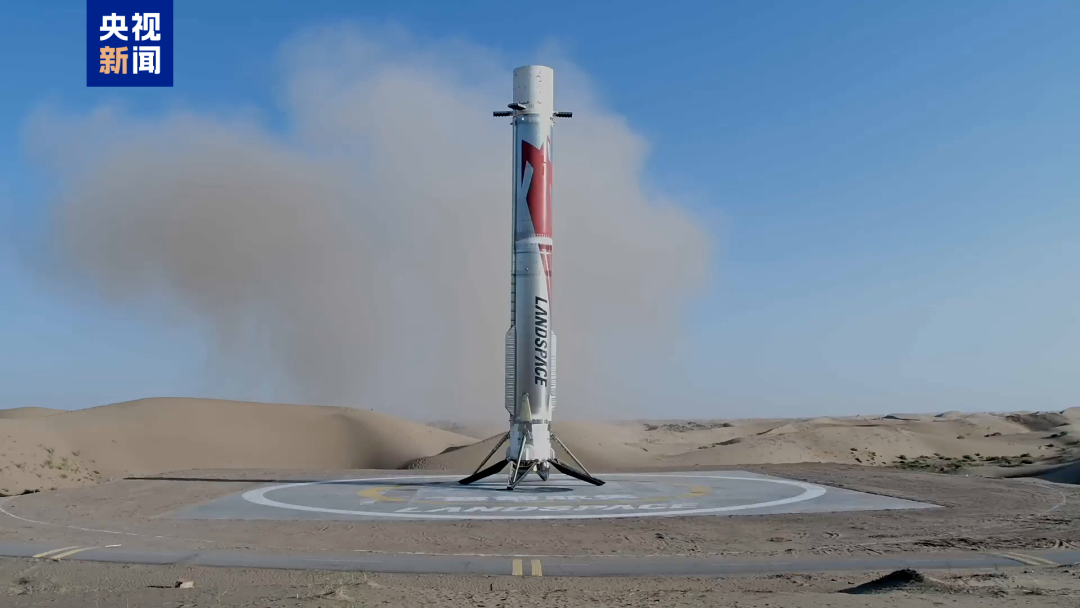
For several hours on 19 August, LandSpace appeared to have achieved exactly the image China’s commercial launch industry had been chasing: a 66-metre stainless-steel orbital booster standing upright on four legs in the Gobi Desert.
The flight itself had gone remarkably well. Zhuque-3 Y2 lifted off at 7:35 am Beijing time from the Dongfeng commercial space innovation zone adjoining Jiuquan, placed the Honghu-03 satellite into orbit and sent its first stage toward a prepared landing pad in Minqin County, Gansu Province.
About 390 kilometres downrange, the booster relit its engines, deployed its landing legs and settled vertically onto the pad. Official footage showed it close to the centre of the recovery area. LandSpace’s post-flight statement, quoted by Spaceflight Now, called the flight and recovery a complete success.
Then the tidy ending came apart. Video from the recovery site showed fire around the base and the stage leaning as its support appeared to weaken. Images circulated later showed the booster lying on its side.
The two facts are not mutually exclusive. Zhuque-3 accomplished a controlled upright touchdown after an orbital launch. It subsequently failed to remain upright through the post-landing phase needed to make the stage safe and recover it for inspection or flight.
That split result matters. Landing a booster is one of the hardest parts of reusable launch. It is not the last part.
The orbital mission succeeded before the booster turned around
Zhuque-3 Y2 carried Honghu-03, a prototype low-Earth-orbit communications satellite developed by Hongqing Technology, a company associated with LandSpace. The second stage delivered it to the planned orbit.
The reusable first stage separated about 137 seconds after launch. It then reoriented itself, conducted powered deceleration, used grid fins and attitude-control thrusters to steer through the atmosphere, and prepared for a terminal burn at the Minqin landing site.
The pad lay roughly 390 kilometres from the launch point. That downrange arrangement avoids the extra fuel needed to reverse the booster’s horizontal motion and return to the launch site. The trade is that LandSpace must operate a separate recovery zone and transport the stage back overland.
Four legs opened near the ground. The remaining engine thrust and guidance system reduced the stage’s speed until it made a soft, upright touchdown. Chinese public reports placed the landing around 7:41 to 7:43 am, depending on how each account marked the event.
This was not a short vertical hop. It followed a real orbital launch in which the upper stage and satellite continued to space. The booster endured ascent loads, stage separation, hypersonic return, atmospheric heating and a powered landing.
By that flight definition, the landing milestone was genuine. It was China’s first land recovery of an orbital-class first stage using deployable legs.
What is known about the fire and topple
The public record becomes less complete after touchdown. LandSpace’s initial statement and the Chinese state-media reports built from it ended with the booster standing upright. They did not describe its later fall.
Available post-landing media showed small fires around the engine section, followed by a larger fire during or near the operation to remove residual liquid methane and liquid oxygen. The vehicle could be seen leaning as part of its landing support appeared to give way.
A detailed account by the specialist publication China in Space concluded from the imagery that the legs and their attachment pistons appeared to weaken before the stage fell. It reported that satellite imagery showed the booster standing for at least four hours after touchdown.
That timing is important. The rocket did not touch down and immediately crash. It achieved a stable-looking landing, remained on the pad, and then entered a hazardous safing and propellant-removal period.
The fire-damaged-leg explanation remains an interpretation of imagery, not a published LandSpace failure finding. The company had not released a detailed post-flight sequence or root cause when this article was prepared.
There is another possibility. If engineers judged the leaning stage too dangerous for crews or recovery machinery to approach, they may have allowed it to fall or brought it down deliberately. Reports from the scene suggested a slow fall, and later images appeared to show the stage oriented toward a prepared ground covering. That possibility has not been confirmed either.
The narrow, defensible statement is that Zhuque-3 landed upright, later toppled after a post-landing fire and apparent loss of leg support, and did not finish the recovery campaign in a condition ready for routine transport.
December’s fireball explains why August still counts
Zhuque-3 Y2 was only the vehicle’s second orbital mission. The first flight in December 2025 also sent its upper stage to orbit, but its recovery attempt ended very differently.
During that Y1 descent, abnormal combustion developed in the landing phase. The first stage broke apart near the edge of the recovery pad instead of touching down. SpaceDaily’s earlier report followed LandSpace’s review of the lost Y1 booster and the flight data gathered before the failure.
For Y2, the company changed the landing sequence using information from that first attempt. A Chinese technical account published after the flight said engineers reduced the number of engines used during landing ignition, simplified the propulsion plan, revised the return-control strategy and added more autonomous handling of the predicted touchdown point.
The difference was visible. Y1 reached the recovery zone but was destroyed before landing. Y2 crossed the last metres under control and put its weight onto the legs. The later topple does not undo the guidance, propulsion and control improvements demonstrated in flight.
It does expose a new failure phase. The first attempt ended before touchdown. The second survived touchdown and failed during the work that followed.
A rocket is not safe when its engines stop
An upright booster can look inert while remaining full of hazards. Cryogenic propellants are still trapped in tanks, feed lines, valves and engine plumbing. As liquid oxygen and methane warm, they boil into gas and increase pressure.
Recovery crews need to vent, drain or burn off residual propellant, make electrical systems safe and verify that the structure is stable before people can work beside it. This is part of the recovery system even though it happens after the cinematic part of the flight.
Small flames immediately after engine shutdown do not necessarily mean a vehicle is lost. Residual propellant can burn in and around hot nozzles. The engineering question is whether the fire remains contained and whether heat reaches structures that were designed mainly for mechanical load.
A landing leg must first absorb touchdown energy. After that moment it must keep a tall, partly fuelled cylinder stable against wind, pad slope, thermal movement and propellant slosh. Loads shift as tanks drain and the structure cools.
Zhuque-3’s four legs use metal structures and attachment pistons. If one loses stiffness or its joint weakens under heat, the booster does not need to lean far before its centre of mass passes outside the support footprint. Gravity then turns a local leg problem into a whole-vehicle fall.
The booster is built largely from stainless steel, which can tolerate substantial heat and deformation. That may leave valuable hardware available for examination. It does not mean a 66.1-metre stage can fall sideways without damage.
Recovery, refurbishment and reflight are different milestones
Reusable-rocket discussions often compress four separate achievements into one word.
First, a stage must survive atmospheric return. Second, it must reach a landing or capture point under control. Third, the recovery team must safe and transport it without losing the hardware. Fourth, the operator must inspect, refurbish and fly it again at a cost and pace better than replacing it.
Zhuque-3 Y2 clearly demonstrated the first two. It reached the third milestone only partially. The topple makes a straightforward reflight of the complete Y2 booster highly unlikely, although LandSpace had not issued a final disposition.
Engine nozzles, the interstage, propellant tanks and grid fins may have taken impact or fire damage. Even components that look intact need inspection for hidden deformation, heat effects and cracks.
Useful work can still come from the stage. Engineers can dismantle tanks, inspect welds, examine thermal protection and measure how the nine engines survived two burns and atmospheric re-entry. Undamaged engines, avionics or grid fins could potentially be bench-tested or used in a later programme.
That is valuable development data, but it is not reuse. Only another launch of flown hardware proves reflight.
What Zhuque-3 is built to become
The Y2 rocket measured 66.1 metres in length and 4.5 metres across its main stages, with a liftoff mass of roughly 570 tonnes. Nine TQ-12A engines generated about 7,542 kilonewtons of thrust on the first stage.
Those engines burn liquid oxygen and methane. Methane produces less soot than rocket-grade kerosene, a useful property when engine plumbing is meant to be inspected and fired again. It can also be produced and handled at scale. It remains cryogenic, flammable and demanding.
The stainless-steel structure is relatively inexpensive, weldable and tolerant of the thermal environment encountered during re-entry. Four grid fins provide atmospheric steering, while reaction-control thrusters orient the booster where thin air gives the fins little authority.
LandSpace has described the first stage as designed for at least 20 uses. The company has also said the first stage represents more than 70 percent of the rocket’s manufacturing cost. Those numbers explain the commercial objective, not the present flight record.
A design can be reusable on paper when its margins, materials and components support repeated flight. An operational booster becomes reusable when the same hardware returns to the launch manifest. Zhuque-3 has not reached that point yet.
China is now testing two very different recovery systems
LandSpace’s touchdown came only 40 days after a state-developed Long March 10B first stage was recovered at sea. That stage did not land on legs. It descended into a cable-net system installed on a ship.
SpaceDaily’s account of the Long March 10B net recovery examined the trade: capture hardware adds complexity to the ship but allows the rocket to avoid carrying heavy landing legs.
Zhuque-3 takes the more familiar Falcon 9 route. The booster brings its own support structure and can land on a prepared pad without aligning hooks to a moving ship. The mass of those legs comes out of payload or propellant capacity, and their deployment and stability become flight-critical.
Neither route is automatically superior. A net must capture precisely and survive marine operations. Legs must deploy reliably, absorb an imperfect touchdown and support the vehicle through safing. China’s programmes are now generating orbital-flight data on both choices.
The Long March 10B team has discussed reflying its recovered stage. Zhuque-3’s topple means LandSpace is unlikely to win China’s first whole-booster reflight with Y2. Its next vehicle can still demonstrate that the landing result was repeatable and that the post-landing problem has been contained.
One landing does not create Falcon 9 economics
The attraction of reusability is often described as avoiding the cost of throwing away a rocket. That is correct but incomplete. A reusable system also carries extra hardware, reserves propellant for descent, operates a recovery site and pays for inspection and refurbishment.
The economic gain appears when recovered stages fly often, with limited work between missions. SpaceX needed years of failed landings, design changes and recovery experience before Falcon 9 reuse became routine.
SpaceDaily’s earlier feature on why landing changed the economics of launch made the same distinction. The useful metric is not the number of boosters photographed upright. It is the cost and time required to place a flown booster back on the pad.
LandSpace still has to establish inspection limits, acceptable fire and heat exposure, engine life, leg refurbishment, tank-cycle margins and a reliable ground-recovery process. A 20-flight design goal becomes economically meaningful only when turnaround records show how much maintenance each cycle consumes.
The Y2 fall is therefore awkward rather than fatal. It probably removes one airframe from the path to reflight. It also identifies a ground-phase problem while the programme is still flying test missions rather than maintaining a commercial cadence.
The launch and the topple should both remain in the record
There is a temptation to force the mission into one of two clean stories. In the celebratory version, China landed a privately developed orbital booster and entered the reusable-launch era. In the dismissive version, the rocket fell over and the recovery was a failure.
Neither is complete.
LandSpace advanced from a December booster that broke apart during final descent to an August booster that navigated 390 kilometres downrange and touched down upright on its intended pad. That is a large improvement in one flight.
The stage then failed to remain safely supported through the operations needed to recover it as reusable hardware. Until LandSpace publishes a post-flight account, the precise contribution of fire, leg damage and any deliberate action by the recovery team remains uncertain.
The fairest verdict is a successful landing followed by an incomplete recovery. Guidance got Zhuque-3 home. Propulsion slowed it. The legs caught it. The ground operation did not preserve the whole booster for an ordinary path to reflight.
That sequence is more informative than either a victory slogan or a failure clip. Reusability begins with returning a rocket from the sky. It becomes real only when the same hardware is made safe, carried away and launched again.