

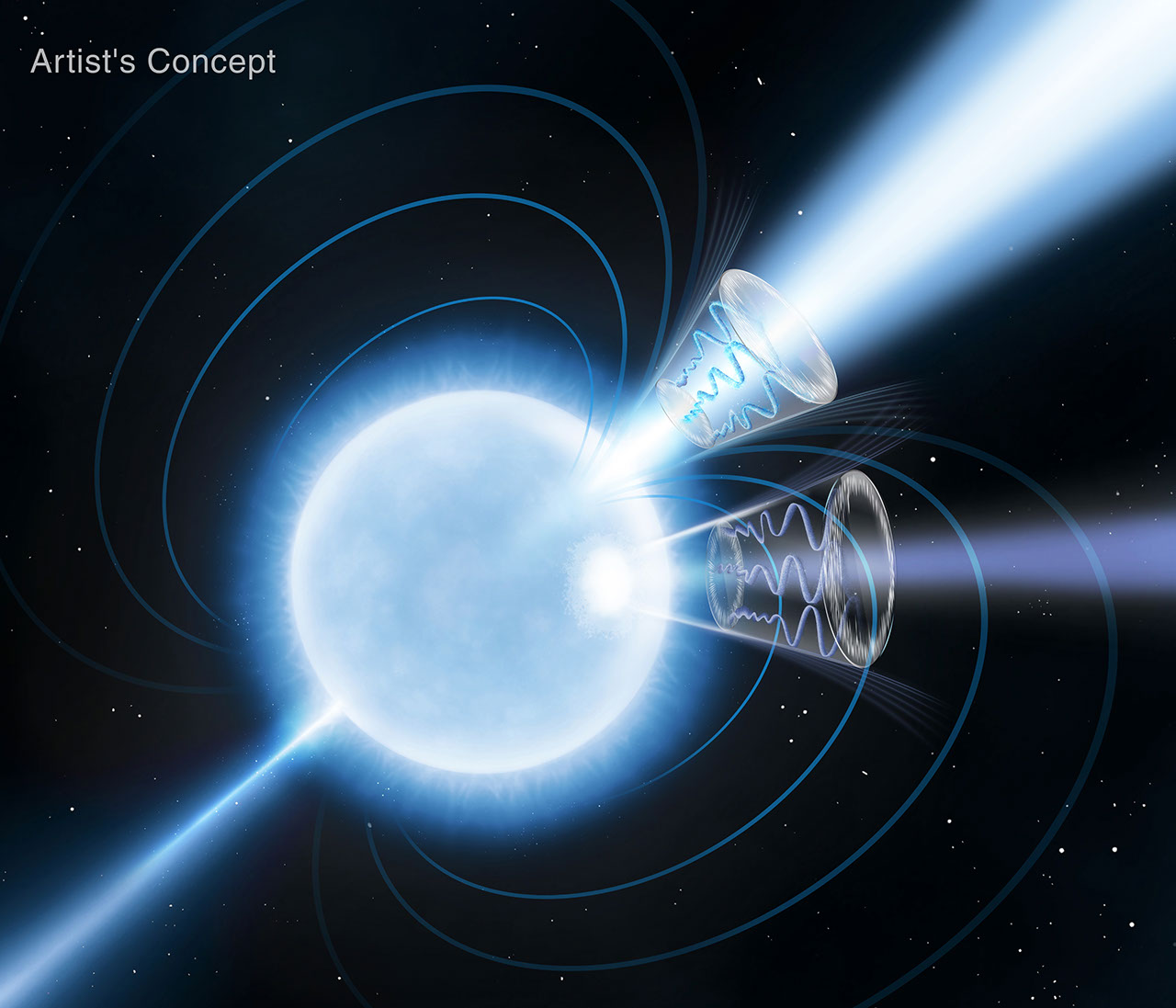
About 13,000 light-years away, give or take the spread in astronomical distance estimates, a stellar remnant is turning once every 2.09 seconds. It is only about the size of a city, yet it carries more mass than the Sun and a magnetic field so strong that familiar descriptions begin to fail.
That object, the magnetar 1E 1547.0−5408, has now supplied what an international team describes as compelling evidence for vacuum birefringence. This is the long-predicted effect in which a powerful magnetic field makes the quantum vacuum respond differently to different polarizations of light.
The plain-language version is that empty space appears to act a little like a birefringent crystal. The careful version matters more: the vacuum is not a substance, the telescope did not see a ray split in two, and the result is an inference built from X-ray and radio polarization plus detailed models. Within those boundaries, it is still an unusually strong test of an idea first worked out in 1936.
The measurement in one sentence
NASA’s Imaging X-ray Polarimetry Explorer, or IXPE, found that soft X-rays from 1E 1547.0−5408 remained far more strongly and coherently polarized across the star’s rotation than standard surface-emission models could explain when the light was allowed to travel through an ordinary, non-refractive vacuum.
When the team added the vacuum response predicted by quantum electrodynamics, the X-ray pattern became reproducible. Simultaneous radio polarization from Murriyang, the Parkes telescope in Australia, independently restricted the orientation of the star and its magnetic field. That radio information is a large part of why this case is stronger than earlier hints.
The work was published in Nature on 5 August 2026 by Rachael Stewart, Hoa Dinh Thi and colleagues. An open version of the full analysis provides the numerical results and modelling details.
What IXPE actually measured
IXPE did not measure the speed of one polarized X-ray and compare it with another. It measured polarization statistically. When an X-ray is absorbed in one of IXPE’s gas detectors, it ejects an electron. The preferred direction of many such electron tracks contains information about the electric-field orientations of the incoming photons.
From those tracks, researchers reconstruct the Stokes parameters used to describe polarization. Polarization degree tells them how orderly the orientations are. Polarization angle tells them the dominant direction on the sky.
The observatory watched 1E 1547.0−5408 for more than 140 hours between late March and early April 2025. NASA’s NICER telescope supplied supporting X-ray timing and spectral data, while Murriyang observed the radio pulses. It was the first coordinated radio and X-ray polarimetry campaign on a magnetar, according to NASA’s account of the result.
Across IXPE’s 2–8 kiloelectronvolt band, the phase-averaged X-rays were polarized by 46 ± 4 percent. In a direct estimate for the softer 2–3 keV band, the degree reached 59 ± 5 percent. A joint spectral model placed the thermal component at 65 ± 8 percent polarization at 2 keV.
The signal became even stronger when sorted by the star’s rotational phase. In the 2–3 keV data it peaked at 82 ± 15 percent and had a measured minimum of 42 ± 12 percent. The central values are striking, but the uncertainties belong beside them. “Nearly 80 percent” is a sound summary; treating 82 as an exact property of the star would not be.
The radio observation closed an important loophole
A high polarization percentage alone would not be a clean detection of vacuum birefringence. Radiation leaving a strongly magnetized neutron-star atmosphere can already be highly polarized. A small hot region can also produce a different net signal from an entire glowing surface.
The difficult part is geometry. The final polarization received at Earth depends on where the hot region lies, how the magnetic and rotation axes are tilted, how our line of sight crosses them, and what happens to the photons on their way out.
1E 1547.0−5408 is unusually useful because it is a persistent radio pulsar as well as a bright X-ray source. Its broad, strongly polarized radio pulse traces the projected direction of the large-scale magnetic field as the star turns. This is described with the rotating-vector model, which produces a characteristic sweep in polarization angle.
The X-ray angle made a similar smooth sweep. Its shape and amplitude resembled the radio pattern, although the two were offset in rotational phase and differed modestly in their reference angles. Twisted field lines or different radio and X-ray emission heights could account for some of that difference.
Most importantly, the radio data stopped the model from choosing any convenient viewing angle solely to save an X-ray fit. The team’s best models with vacuum birefringence reproduced the intensity and polarization while remaining broadly compatible with a nearly aligned magnetic geometry. With the effect switched off, the polarization fits were much worse, or the preferred geometry conflicted with the radio constraints.
This “dead” star is not quiet
A neutron star is called a dead star because ordinary nuclear burning has ended. That shorthand should not be mistaken for inactivity. The core left by a massive star’s explosion can rotate, quake, radiate and rearrange an immense reservoir of magnetic energy.
Magnetars are the most magnetic members of the neutron-star family. Their field decay powers persistent high-energy light and occasional violent flares. SpaceDaily’s earlier account of the 2004 giant flare from SGR 1806−20 described a different consequence of this stored magnetic energy: a fraction-of-a-second outburst strong enough to disturb Earth’s ionosphere from across the Milky Way.
1E 1547.0−5408 is not being studied here during an equivalent giant flare. Its persistent X-ray hot region and radio beam make it valuable precisely because observers can follow a repeated 2.09-second cycle and ask how polarization changes at each phase.
Distance estimates are never engraved on the sky. The new analysis adopts 4.5 kiloparsecs, about 14,700 light-years, for calculations involving emitting area. The source is also commonly described at the rough scale of 13,000 light-years. Nothing in the vacuum-birefringence inference turns on choosing one rounded description over the other.
How strong is the magnetic field?
The Nature paper gives an equatorial surface field near 2.2 × 10¹⁴ gauss. In tesla, that is 2.2 × 10¹⁰, or 22 billion tesla. A dipole field at the magnetic pole would be stronger still.
The comparison in the headline follows directly from that equatorial estimate. The National High Magnetic Field Laboratory’s steady hybrid magnet produces 45 tesla. Dividing 22 billion by 45 gives roughly 490 million. Pulsed and destructive experiments can briefly exceed the steady-field record, but they remain many orders of magnitude short of a magnetar.
Compared with Earth’s surface field, the ratio is vastly larger, on the order of hundreds of trillions. Different popular comparisons produce different spectacular numbers because a refrigerator magnet, a permanent laboratory magnet, a sustained research field and Earth’s field are not the same benchmark.
A more physically useful scale is the QED critical field, about 4.4 × 10¹³ gauss. At that field, the energy spacing imposed on an electron by magnetism becomes comparable with the electron’s rest energy. The equatorial field inferred for 1E 1547.0−5408 is about five times this threshold.
SpaceDaily described this same critical scale years ago in its report on a model of magnetar X-ray emission. What has changed is not the expectation that exotic QED effects should matter. It is the ability to measure the polarization pattern sharply enough, and constrain the geometry independently enough, to isolate one of them.
What physicists mean by the quantum vacuum
“Empty space is not empty” is useful up to a point. In quantum field theory, a vacuum is the lowest-energy state of the fields that fill space. It is not classical nothingness, because those fields have irreducible quantum fluctuations and can respond to external conditions.
One common explanation pictures short-lived virtual electron-positron pairs appearing and disappearing. That image captures part of the calculation’s intuition, but virtual particles should not be treated as tiny observable objects permanently crowding a container. They are features of the mathematical description of interactions, not a hidden gas waiting to be bottled.
The more restrained claim is also the more interesting one. In QED, electromagnetic fields interact indirectly through charged quantum fields. Put the vacuum in a sufficiently strong background magnetic field and its response becomes nonlinear. A passing photon then encounters an effective refractive index that depends on how its electric field is oriented relative to the background field.
No energy is being created, and no ordinary material medium has appeared. The vacuum state has electromagnetic properties that classical Maxwell theory, used by itself, does not contain.
What Heisenberg and Euler predicted in 1936
Werner Heisenberg and Hans Heinrich Euler published their calculation in 1936, before the modern formulation of quantum electrodynamics was complete. Their Heisenberg-Euler effective theory described how a strong electromagnetic background changes the behaviour of light through quantum corrections.
Julian Schwinger later placed vacuum polarization on the firmer foundation of renormalized QED. The underlying result survived: at field strengths far below the threshold for producing real electron-positron pairs, the vacuum can still mediate tiny nonlinear interactions among electromagnetic fields.
Vacuum birefringence is one consequence. The two natural linear polarization modes have slightly different refractive indices. A tiny difference accumulated across a sufficiently strong and extended field can change the phase relation and evolution of the light.
The prediction is 90 years old, but age is not evidence. It remained hard to verify because even the strongest sustained terrestrial fields produce an extremely small optical effect over laboratory distances. Nature built a larger field. The challenge was finding a way to read what it did to the light.
Birefringence without a crystal
Calcite is the familiar analogy. A birefringent crystal can split an image because two polarization components propagate with different refractive indices through its ordered lattice. Rotate polarized sunglasses in front of a screen and the changing brightness gives another everyday reminder that polarization affects which light passes.
The magnetar case has no crystal lattice. The field itself defines a preferred direction. For a photon travelling with momentum k through a magnetic field B, physicists describe an ordinary mode whose electric field lies approximately in the k–B plane, and an extraordinary mode oriented perpendicular to it.
QED predicts different indices for those modes. Saying they travel at different speeds is acceptable when understood as different phase velocities in the magnetized vacuum. It does not mean information outruns light or relativity is violated.
The transparent lenses in NASA’s artist concept are therefore a visual metaphor. There are no glass discs circling 1E 1547.0−5408. Nor did IXPE resolve two spatially separated beams. It recorded the polarization state that survived after the X-rays crossed the star’s magnetosphere and travelled thousands of light-years to Earth.
How the vacuum keeps polarization aligned
The central effect is subtler than simply splitting light. A thermal hot region contains many emitting patches, each with its own local field direction. General relativity bends some rays around the compact star, allowing an observer to receive light from more of the surface than flat-space intuition suggests.
If every photon’s polarization direction froze as soon as it left its local patch, the unresolved telescope would add together many differently oriented contributions. Much of their linear polarization could cancel.
In a birefringent magnetosphere, the two polarization eigenmodes remain decoupled and their orientations follow the changing local magnetic field adiabatically as the photons move outward. For the conditions considered in the paper, this continues to a polarization-limiting radius tens to hundreds of stellar radii from the surface.
By that distance, adjacent rays sample a larger-scale magnetic geometry whose directions are more coherent than the patchwork at the surface. Their polarization vectors become effectively fixed only after this alignment has been preserved. IXPE then sees a much larger net polarization.
The vacuum has not generated additional polarized photons. It has carried an ordered imprint of the magnetic field out through a region where ordinary propagation would allow the unresolved directions to wash one another out.
Why a surface-only explanation fell short
The researchers did not compare the data with a cartoon. They used a Monte Carlo radiative-transfer model for a strongly magnetized neutron-star atmosphere, incorporated relativistic light bending and redshift, and tested multiple hot-region shapes and viewing geometries.
Locally, the model atmosphere can produce more than 80 percent polarization. The issue is whether the integrated intensity, phase changes and Stokes parameters arriving from the whole unresolved hot region match the data.
With magnetospheric vacuum birefringence switched on, an offset, wedge-shaped hot region gave the best combined description within the tested framework. When the effect was switched off for the same configuration, the predicted Stokes parameters varied far more strongly than the observations and fit poorly.
The team also searched for the best case among its vacuum-off models. A pole-centred circular hot spot did better than other no-birefringence cases, but it still did not adequately reproduce the polarization and required a viewing geometry inconsistent with the radio inference.
This is why the radio campaign is so valuable. Surface models have enough freedom that an X-ray-only fit might find an implausible corner of parameter space. The radio beam supplies an external geometric test.
Why “strongest evidence” is not “final proof”
The observations are direct. The interpretation is necessarily model-mediated. IXPE directly measured a strong, phase-dependent X-ray polarization signal. It did not place two clocks beside the star and measure separate refractive indices for the two modes.
The inference rests on a chain: the radio polarization constrains the large-scale geometry; atmosphere models predict the surface emission; general relativity sets the ray paths; magnetospheric calculations determine how polarization evolves; and the resulting Stokes parameters are compared with IXPE.
That chain is physically motivated and the vacuum-on models perform substantially better. It is also not the final possible description of a magnetar. Surface composition remains uncertain. The emitting region may be more complicated than the tested shapes. The field can contain higher-order structure and twists. Plasma also has birefringent effects, while conversion between photon modes can occur deeper in the atmosphere.
The best-fit geometries inferred by different parts of the analysis are not identical. The authors discuss possible non-dipolar structure and different emission altitudes, and say the discrepancy deserves more study. This does not erase the result; it shows where the present model is still an approximation.
NASA’s own headline said IXPE “may have” demonstrated the theory. The Nature paper calls the findings a marked advance and says vacuum-birefringence-governed propagation can naturally explain the signal. Those are appropriately strong statements. “Strongest evidence yet” respects them better than “proof.”
Earlier clues in space
This search did not begin with 1E 1547.0−5408. In 2017, astronomers reported unusually high optical polarization from the isolated neutron star RX J1856.5−3754. Their analysis found it difficult to reconcile with surface models unless vacuum birefringence preserved the polarization, but the star’s geometry and optical emission were not known precisely enough to remove every alternative.
IXPE then made the first soft X-ray polarization measurement of a magnetar, 4U 0142+61, reported in 2022. Its energy-dependent polarization carried signs of a condensed surface and a QED vacuum-resonance effect. Other magnetars added detections and diversity rather than one universal pattern.
That history helps explain why the new work emphasizes geometry, rotational phase and energy at once. A large average percentage is informative. A coherent angle sweep tied to the magnetic field, a high value maintained through the radio beam crossing, and a model comparison constrained by the radio data make a much harder combination to imitate.
IXPE’s usefulness is broader than magnetars. SpaceDaily previously covered the mission’s first polarization study of a white dwarf, where the same basic observable helped infer an accretion-column geometry too small to image. Polarimetry does not make a conventional picture. It exposes orientation and order that intensity alone hides.
The laboratory history needs a careful footnote
There have also been serious terrestrial searches. Experiments such as PVLAS send polarized laser light through strong laboratory magnets and look for an extraordinarily small rotation or ellipticity. The available path lengths and field strengths make the expected QED signal difficult to isolate.
In 2021, the STAR collaboration at the Relativistic Heavy Ion Collider reported polarization-dependent electron-positron production in the intense electromagnetic fields surrounding near-miss gold-ion collisions. SpaceDaily’s report at the time described it as an Earth-based observation connected with vacuum birefringence.
The new Nature authors cite that work as indirect laboratory evidence. This is not simply a dispute over who arrived first. The experiments probe related strong-field QED physics through different observables. STAR measured angular and momentum distributions in pair production. The magnetar study infers polarization-dependent refractive propagation across an astrophysical magnetic field.
That distinction is why careful summaries differ. One can recognize the importance of the collider measurement while still saying a clean measurement of the vacuum’s differing refractive indices has remained elusive.
What would make the case firmer
More photons are the first requirement. Above about 4 keV, the existing data become sparse and the polarization uncertainties widen. A deeper exposure could show whether a second emission component changes the degree or angle in the harder band.
Repetition matters too. The same phase-resolved pattern at another epoch would argue that the signal tracks stable geometry rather than a temporary magnetospheric state. If the pattern changes, simultaneous radio observations could reveal whether the field or emitting region changed with it.
Other radio magnetars would provide the strongest comparison. A single star can always be unusually configured. Reproducing the predicted relationship among radio geometry, X-ray angle sweeps and high soft-X-ray polarization across several objects would turn an impressive case into a population test.
Theory has work left as well. Models can explore more surface compositions, multipolar and twisted fields, plasma propagation, vacuum resonance within the atmosphere, and hot regions more complex than circles or wedges. The goal is not merely to add knobs. It is to find predictions that remain different when plausible astrophysical uncertainty is allowed.
What the result does and does not say about reality
It does not say space is filled with an ether. It does not give a way to extract unlimited energy from nothing. It does not show that classical optics is wrong in the environments where classical optics has always worked.
It says the vacuum state of quantum fields can have a measurable, polarization-dependent electromagnetic response when immersed in an extreme magnetic field. QED predicts that response. The 2025 campaign found the X-ray signature expected when it operates, while radio data removed much of the geometric freedom that weakened previous astrophysical claims.
Quantum electrodynamics is already among the most precisely tested theories in science. What is new here is the regime. Laboratory tests are clean but their sustained magnetic fields are modest by magnetar standards. Magnetars supply the field, but they also supply atmosphere, gravity, plasma, uncertain geometry and all the complications of an unresolved object thousands of light-years away.
The achievement is to make that messy natural laboratory precise enough to ask a question about the vacuum. IXPE did not look into nothingness and photograph its contents. It watched polarized X-rays from a rotating dead star, while a radio telescope kept track of the magnetic geometry, and found that the light made the most sense if apparently empty space had refracted its two polarization modes differently.
That is a more modest claim than saying physicists have finally seen the vacuum itself. It is also, in its way, more remarkable. A correction written down by Heisenberg and Euler before the Second World War may have left a readable pattern in X-rays that began their journey across the Milky Way long before there were humans to measure them.