

On 27 December 2004, a giant flare from the magnetar SGR 1806-20 crossed the Solar System and registered on instruments built for far more ordinary high-energy events. The first fraction of a second was enough to saturate detectors, bounce radiation from the Moon, and disturb Earth’s upper atmosphere.
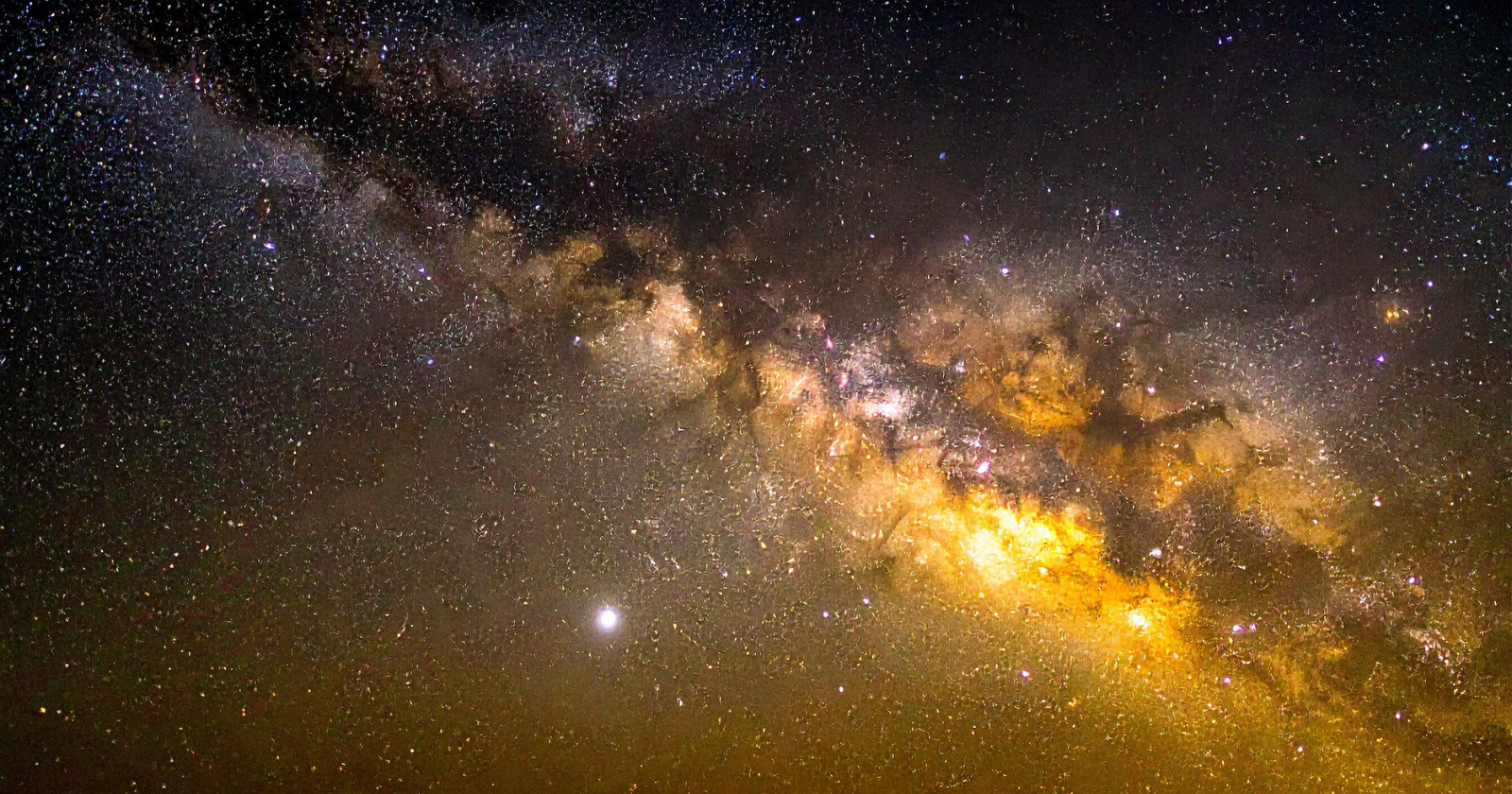
The flare came from a neutron star in Sagittarius, on the far side of the Milky Way by the distance estimates used in the initial reporting. Later radio work revised the likely distance downward, but the object remains tens of thousands of light-years away. That is the useful scale: not nearby by any ordinary astronomical standard, yet close enough for a magnetar flare to leave a measurable mark at Earth.
The headline figure comes from a Nature paper led by K. Hurley, which reported that in the first 0.2 seconds the flare released energy comparable to what the Sun radiates in a quarter of a million years. The number is not a casual analogy. It is tied to the observed gamma-ray signal, the assumed distance to SGR 1806-20, and the model used to turn the measured fluence at Earth into an energy release at the source.
What the satellites actually saw
SGR 1806-20 belongs to the class of soft gamma repeaters, objects generally interpreted as magnetars: neutron stars whose high-energy activity is powered by the decay and rearrangement of extreme magnetic fields. NASA’s 18 February 2005 account of the event described a flash from across the Galaxy that was detected by NASA and European spacecraft, along with radio telescopes that followed the aftermath.
The first pulse was the part that overwhelmed instruments. In a separate Astrophysical Journal study led by Steven E. Boggs, the authors noted that RHESSI, a satellite designed to observe bright solar flares, was saturated for roughly half a second after the main peak began. The paper used RHESSI data together with other spacecraft measurements to reconstruct what could still be recovered from a signal that had exceeded the normal operating range of the detector.
INTEGRAL also recorded the flare. A team led by S. Mereghetti reported in The Astrophysical Journal Letters that the SPI Anti-Coincidence Shield saw a strong initial pulse, followed by a roughly 400-second tail modulated at the neutron star’s 7.56-second rotation period. That tail matters because it links the brief flash to the rotating magnetar rather than to a one-off unidentified burst elsewhere in the sky.
Why Earth noticed it
The event was not dangerous at Earth, but it was measurable here. NASA reported that the flash lit up the upper atmosphere, and that amateur observers detected the associated disturbance in Earth’s ionosphere. That detail is easy to overstate. The flare did not scorch the atmosphere or produce a visible sky event for ordinary observers. It altered the ionisation state of part of the upper atmosphere for instruments sensitive enough to see it.
That is still an unusually direct connection between a compact object elsewhere in the Galaxy and conditions around Earth. Gamma rays and hard X-rays from the flare reached the planet after travelling for many thousands of years. When they arrived, they briefly changed the electrical environment through which some radio signals propagate.
The useful lesson is not that magnetars are an immediate terrestrial hazard. It is that high-energy astrophysics does not always remain an abstract signal on a spacecraft plot. In this case, the same pulse that saturated orbiting detectors also produced a detectable atmospheric response.
The energy estimate depends on distance
The quarter-million-years comparison is supported by the Hurley paper, but it should be read with the usual astrophysical caution. Energy estimates for distant transients depend strongly on distance. If the object is closer than first assumed, the implied energy falls; if farther, it rises.
That is why the later radio counterpart work is relevant. A Nature paper led by P. B. Cameron reported a fading radio source after the flare and used a 21-centimetre hydrogen absorption spectrum to estimate the distance to SGR 1806-20. The authors argued for a distance greater than 6.4 kiloparsecs and nearer than 9.8 kiloparsecs, lower than the roughly 15-kiloparsec distance used in some early energy estimates.
This does not erase the original event. It narrows how strongly the numbers should be stated. NASA’s 2005 release gave a solar-output comparison of more than 150,000 years, while Hurley’s Nature paper used the quarter-million-years figure for the first 0.2 seconds. Both are ways of communicating the same broad point: the flare was an unusually large release of energy from a magnetar, compressed into less than a second at its peak.
What a magnetar flare can explain
One reason the 2004 flare drew such attention was its possible connection to short-duration gamma-ray bursts. Hurley and colleagues argued that, if seen from a great distance, the initial pulse from SGR 1806-20 would resemble a short, hard gamma-ray burst. That does not mean every short gamma-ray burst comes from a magnetar. It means some extragalactic magnetar flares could be confused with that population unless distance, host galaxy, afterglow behaviour, and other clues are available.
The distinction matters more now than it did in 2005. Since then, the association between at least some short gamma-ray bursts and neutron-star mergers has become much firmer, especially after the 2017 gravitational-wave event GW170817 and its gamma-ray counterpart. The SGR 1806-20 flare sits in a different category: a Galactic magnetar event that helped show how a compact object can imitate part of the short-burst phenomenology when viewed without enough context.
In other words, the flare is not a complete answer to the short gamma-ray burst problem. It is a boundary case that tells observers what magnetars can do.
What remains open
The physical picture favoured in the Hurley paper involved a catastrophic instability in the magnetar, with crust failure and magnetic reconnection releasing stored magnetic energy. Mereghetti’s INTEGRAL work and Boggs’s RHESSI analysis added detail on the flare’s timing, energy range, and long pulsating tail. Cameron’s radio observations added a view of the material and emission that followed the gamma-ray flash.
Taken together, those studies make the 2004 SGR 1806-20 flare one of the best documented magnetar giant flares. They do not make magnetar flare physics simple. The event saturated instruments, required reconstruction from partial data, and depends on distance estimates that have been debated through follow-up observations.
That is the more careful reading of the event. A magnetar on the far side of the Milky Way released, in a fraction of a second, energy on a scale usually reserved for comparisons with hundreds of thousands of years of sunlight. Earth noticed it not as damage, but as a brief disturbance in the ionosphere. The remaining question is not whether the flare was large. It is how often magnetars produce events like this, and how many similar flashes in nearby galaxies have already been filed under another name.