

Every drop in Earth’s oceans contains material with a history older than the planet. The oxygen was forged in earlier stars. Much of the hydrogen reaches back to the early universe. The harder question is how those elements came together here in such abundance.
For decades, a common answer began with a dry inner Solar System. Earth assembled too close to the young Sun for volatile-rich material to survive, then water-bearing asteroids from colder regions struck the growing planet and supplied what its original rocks lacked.
A rare meteorite from Antarctica complicates that sequence. In an open-access Icarus study, Thomas Barrett and James Bryson of the University of Oxford and Kalotina Geraki of Diamond Light Source found hydrogen chemically bound to sulphur throughout material resembling some of Earth’s original building blocks.
The result does not show that asteroids contributed nothing. Nor did the researchers find liquid water inside the rock. It supports a narrower and consequential proposition: the feedstock from which Earth grew may already have held enough hydrogen to account for the planet’s present water inventory, making late delivery optional rather than essential.
LAR 12252 is a sample of an otherwise vanished beginning
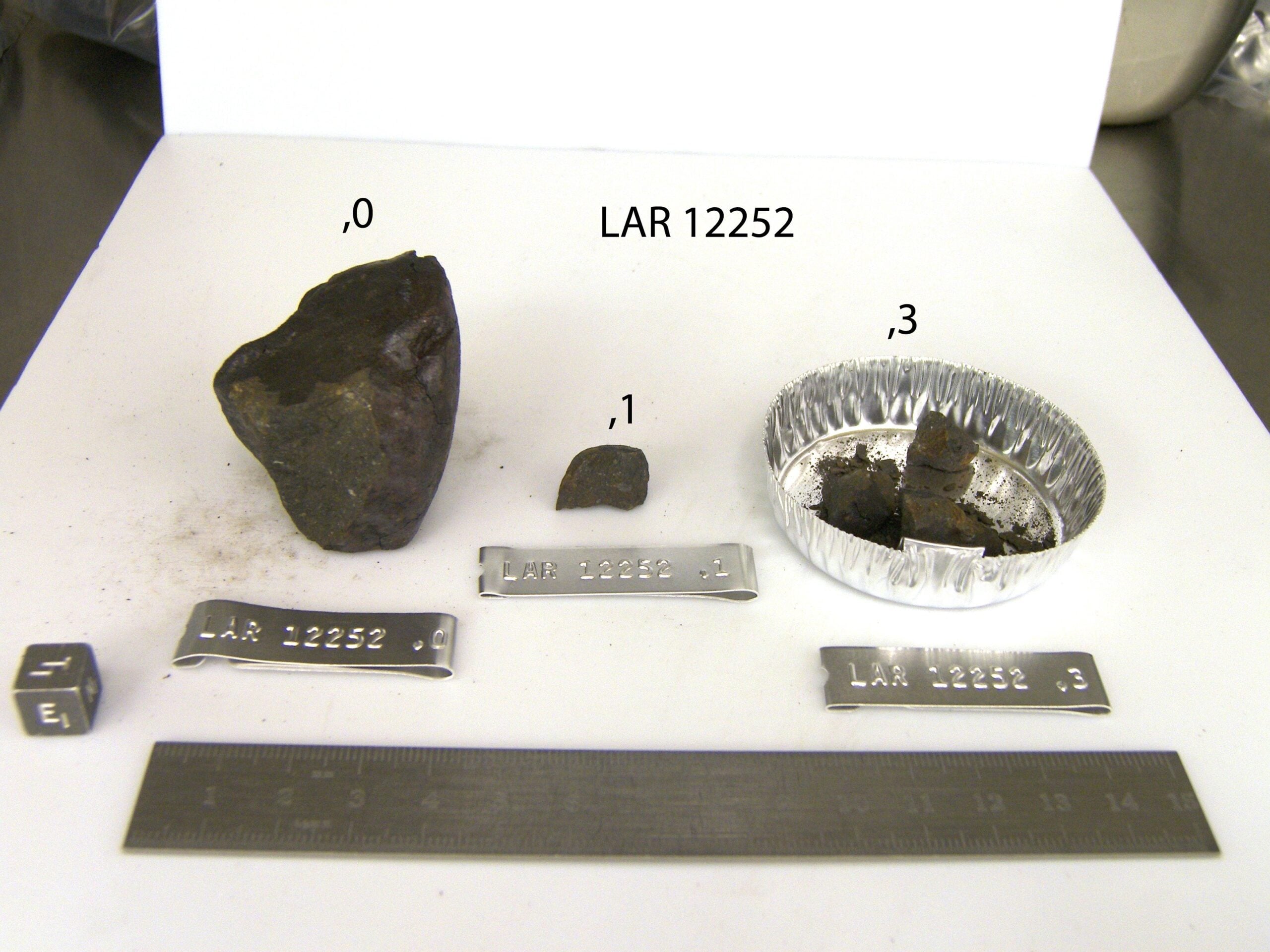
The meteorite is Larkman Nunatak 12252, shortened to LAR 12252. It was recovered in Antarctica in 2012 and is classified in the Meteoritical Bulletin as an EH3 enstatite chondrite. The “3” indicates a comparatively primitive rock whose original components escaped the stronger thermal reworking seen in higher petrologic grades.
Enstatite chondrites formed in the hot, chemically reducing inner Solar System. They are dominated by minerals described as nominally anhydrous, meaning water is not an essential part of their ideal crystal structures. That mineralogy helped create their reputation as dry planetary material.
Yet their isotope ratios for several non-volatile elements closely resemble terrestrial rocks. Planetary scientists therefore use enstatite chondrites, or material chemically similar to them, as important analogues for the solids that built Earth. An analogue is not a surviving brick chipped directly from the proto-Earth, but it preserves a kind of material that no longer exists as an accessible planet-forming disk.
The distinction matters. Finding hydrogen in LAR 12252 shows that one primitive EH3 meteorite carried it. Extending that result to Earth requires the additional inference that a substantial fraction of our planet accreted from comparable inner-Solar-System material.
The hidden ingredient was hydrogen, not water
Water is H2O, but the Oxford team searched for hydrogen attached to sulphur. Earlier measurements had found hydrogen in organic matter and in the glassy, non-crystalline mesostasis inside millimetre-scale chondrules. Most of the meteorites’ bulk hydrogen remained without an identified host.
The researchers suspected that sulphide-rich material might hold the missing fraction. They used sulphur X-ray absorption near-edge structure spectroscopy, or S-XANES, at beamline I18 of the Diamond Light Source synchrotron. Sulphur atoms absorb X-rays at subtly different energies depending on their oxidation state and chemical neighbours, producing a spectrum that can distinguish bonds hidden at microscopic scales.
The team mapped an area just 470 by 480 micrometres across with a five-micrometre beam and five-micrometre steps. That grid generated 9,024 spectra. They also measured 15 separate spots in the mesostasis of six chondrules and sampled cracks containing visible terrestrial weathering products.
A spectral peak near 2,473.2 electron volts appeared throughout fine matrix and mesostasis. After comparing its position and shape with reference materials and the other sulphur features, the authors assigned it to H-S bonds. Their preferred physical picture is hydrogen sulphide trapped in silica-rich glass surrounding tiny grains of the iron sulphide pyrrhotite.
This is not water waiting in a microscopic reservoir. It is stored hydrogen that a forming planet could convert into water through later chemical reactions with oxygen-bearing material. The headline’s “native hydrogen” refers to the meteorite’s pre-Earth chemistry, not hydrogen manufactured while the sample sat on Antarctic ice.
The finest material carried the strongest signal
The meteorite is a mixture of chondrules, mineral and metal grains, sulphides, fragments and fine matrix. The fine matrix is the sub-five-micrometre material packed between larger components. It makes up only a minority of the rock, but it proved disproportionately important.
Individual matrix points ranged from no resolvable H-S peak to roughly 40 times the average mesostasis signal. After excluding the more weathered spectra, fine matrix contained an average 9.8 ± 3.1 times as much H-S as chondrule mesostasis.
The authors then estimated what that enrichment could mean for the whole meteorite. Because the necessary matrix proportions have not been measured directly for LAR 12252, they borrowed density and component data from two well-studied EH3 meteorites, Sahara 97072 and Sahara 97096.
In that calculation, fine matrix represented about 4.8 per cent of meteorite mass, around half the 9.3 per cent attributed to chondrule mesostasis. Multiplying the smaller mass fraction by its much larger H-S signal suggests fine matrix contributes about five times more hydrogen than mesostasis and could be the dominant source of hydrogen in EH3 chondrites.
This chain is why the study is stronger than a surprising bright pixel but not a direct bulk assay of Earth’s oceans. It combines microscopic mapping in one meteorite with bulk hydrogen measurements and component proportions from related specimens.
Antarctic contamination produced the wrong pattern
Any hydrogen measurement in a meteorite recovered from ice faces an immediate problem. Enstatite chondrites contain reactive sulphides that can combine with atmospheric moisture after landing. Rust, hydrated sulphates and water in cracks could imitate primordial hydrogen.
LAR 12252 was chosen partly because it has a low weathering grade, but modest alteration is still visible. The researchers therefore used oxidised sulphur, S6+, as a marker of terrestrial weathering. The strongest S6+ signals appeared in rust-bearing cracks, just where an Earth-derived contribution should be easiest to find.
Those crack spectra contained either no resolvable H-S peak or one that was tiny relative to the weathering signal. Across the mapped area, the extent of alteration varied sharply. The team restricted its abundance analysis to spectra with a low S6+-to-iron-sulphide ratio.
The inverse relationship is the important clue. If Antarctic water had created the detected H-S, the most weathered areas should have been enriched rather than depleted. The pattern cannot prove that every hydrogen atom is untouched, but it strongly supports the authors’ conclusion that the principal H-S reservoir predates the fall to Earth.
Fourteen oceans is an upper mass balance, not a measurement here
The phrase “enough hydrogen to explain Earth’s water” comes from combining this carrier identification with earlier bulk analyses. A 2020 Science study of enstatite chondrites reported hydrogen equivalent to roughly 0.08 to 0.54 per cent water by mass. Scaled to the material that formed Earth, the upper end could represent about 14 times the mass of the present oceans.
The Oxford experiment did not measure 14 oceans inside LAR 12252. It found where a large previously unexplained share of native hydrogen may reside and proposed a route by which it formed. The high total comes from other meteorites and a planet-scale extrapolation.
There is another missing step between inventory and ocean. Earth endured energetic impacts, global melting, separation of metal into its core and extensive degassing. The fraction of original hydrogen that survived those processes is uncertain. Some could have escaped to space, some entered the deep mantle and core, and some emerged as water vapour before condensing at the surface.
That survival problem connects naturally with SpaceDaily’s earlier report on bridgmanite retaining an ocean-scale reservoir as molten Earth cooled. One study addresses whether the starting material contained hydrogen; the other examines how a young planet might keep it through a stage when escape seemed likely.
Water-rich asteroids still have a place in the story
Carbonaceous chondrites formed farther from the Sun and carry abundant hydrated minerals and organic material. Their hydrogen and nitrogen isotope patterns have long made them plausible contributors to Earth’s surface volatiles. The Oxford paper itself says those surface signatures indicate a carbonaceous contribution.
Its argument is that bombardment need not supply the bulk water budget. Inner-Solar-System material could provide most hydrogen, while a smaller outer-Solar-System addition adjusted the isotopic mixture seen in the oceans and atmosphere. “Did not need” is different from “did not receive.”
The wider debate also remains active. A November 2025 Nature Communications model of hydrogen and carbon partitioning during core formation concluded that Earth’s building blocks do not match enstatite chondrites in water abundance and require a carbonaceous contribution. That study still allowed non-carbonaceous material to supply up to 53 per cent of Earth’s hydrogen.
These approaches ask different questions. LAR 12252 reveals a microscopic hydrogen carrier in a primitive meteorite. Core-formation models test whether proposed mixtures survive the constraints imposed by Earth’s mantle, core, total mass and isotope ratios. A complete origin story has to satisfy both.
SpaceDaily has also followed the problem beyond Earth. Some sub-Neptunes may manufacture oceans through reactions between hydrogen atmospheres and molten rock. The chemistry differs, but the broader lesson is the same: water does not always need to arrive as pre-made ice.
A natural outcome is not the same as an inevitable ocean
The proposed hydrogen-storage mechanism begins in the solar nebula. In a sulphur-rich environment, submicrometre grains of iron sulphide could transform into pyrrhotite. When later flash heating exposed pyrrhotite to nebular hydrogen, the sulphide could catalyse production of H2S. Molten silica-rich dust around the grain then trapped that H2S as it cooled into glass.
Repeated across innumerable dust grains and planetesimals, this chemistry offers a systematic way to place hydrogen into nominally dry inner-Solar-System rocks. Mars, Mercury and perhaps Venus may have accreted related feedstock, so native hydrogen could be a common starting condition for rocky planets rather than a singular terrestrial accident.
That does not guarantee blue worlds. A planet must retain its volatiles, cool into the right pressure and temperature range, build an atmosphere and avoid losing too much water to space or its interior. Venus and Mars show how differently similar beginnings can end.
Even the water now in a glass has more than one history. As SpaceDaily previously explained, some hydrogen-bearing water survived from before the Sun, while other molecules were broken apart and rebuilt during planetary formation. Material can be ancient even when its present molecular arrangement is new.
LAR 12252 does not close the case on Earth’s oceans. It removes one reason the planet had to begin dry. Hidden in sulphide and glass, the hydrogen needed for water may have been part of Earth’s inheritance from the start.