
A pelvis is easy to mistake for a single object with a single job. In reality, it is a crowded piece of evolutionary engineering: a ring that transfers body weight into the legs, anchors large muscles, stabilises the trunk and, in females, forms the bony passage for childbirth. Change one part and the consequences travel through the rest.
That is why a new comparison of fossil and living pelvises is more interesting than its apparently startling sex comparison. In a study published in Scientific Reports on 31 July 2026, Yoel Rak and five colleagues found that two male Neanderthal-lineage pelvises fell much closer to modern women than modern men when analysed using nine measurements selected for their biomechanical importance.
This is one study, not settled consensus. There are only two nearly complete male fossils in its main comparison, and the proposed walking advantage is a mechanical hypothesis rather than a result measured in living bodies. Read carefully, however, the paper does something valuable. It stops treating the modern male pelvis as the neutral human template and asks whether that pelvis is actually the evolutionary special case.
Two exceptionally rare fossils carry the comparison
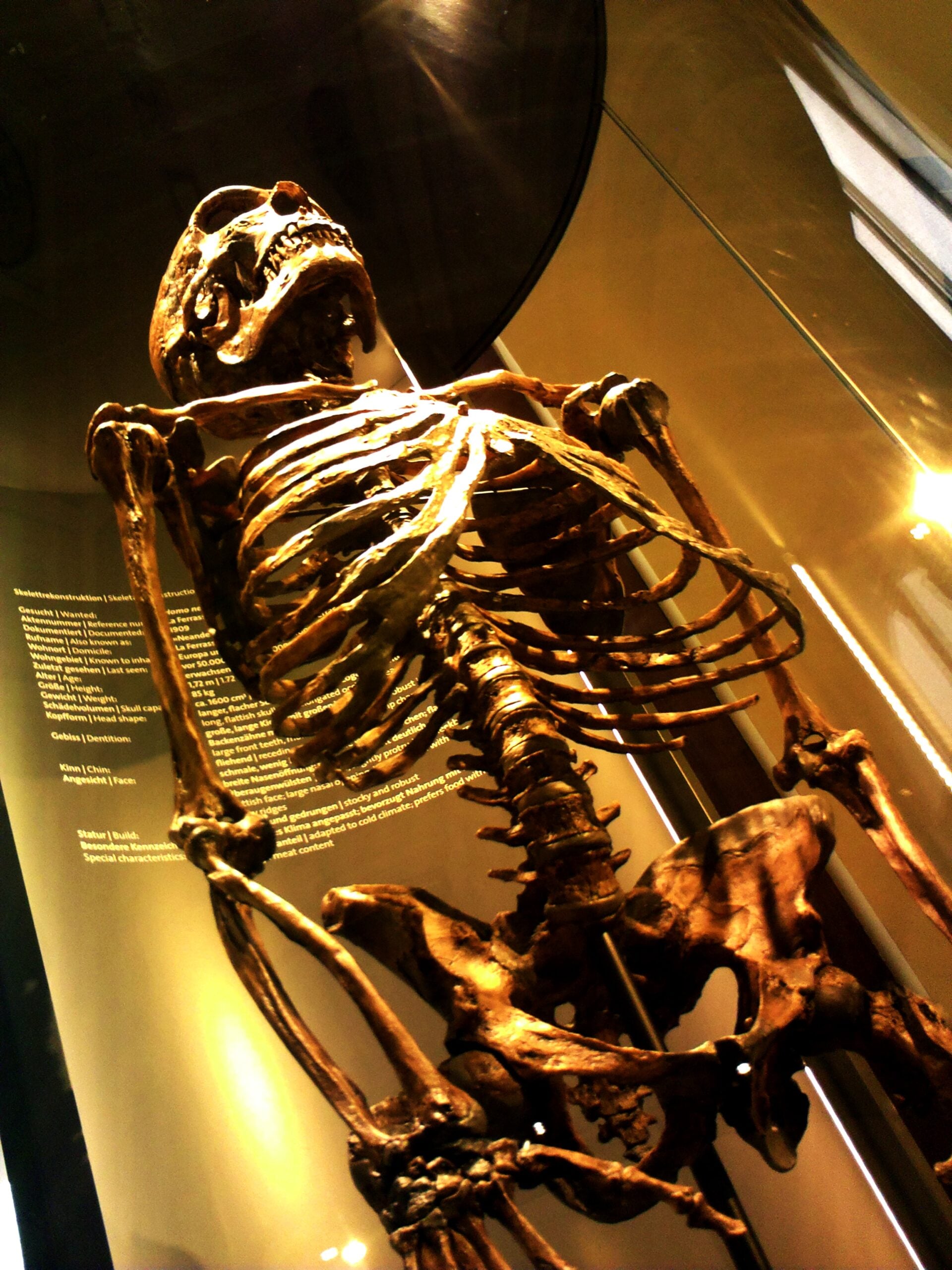
One fossil is Kebara 2, the pelvis of a male who lived around 55,000 years ago near what is now Israel’s Mount Carmel. Its discovery in the early 1980s gave researchers the first nearly complete Neanderthal pelvic inlet. The other is Pelvis 1 from Sima de los Huesos in northern Spain. Reported in a 1999 Nature paper, it belonged to a large male from an approximately 430,000-year-old population on the Neanderthal lineage.
A Tel Aviv University account of the new work describes the two fossils as the unusually complete foundation for a comparison that would otherwise have to depend on scattered pelvic fragments. The rarity is important: the analysis is detailed, but the ancient sample cannot represent all the variation that once existed.
The new study treated those fossils as unknown cases against measurements from 63 modern male and 28 modern female pelvises drawn from geographically varied collections. Some measurements from the incomplete male La Ferrassie 1 fossil were also available. That is a respectable modern comparison but an unavoidable fossil bottleneck: two nearly complete ancient males must bear much of the argument.
The fossils share a conspicuously long, slender superior pubic ramus, the bar of bone running from the hip socket toward the joint at the front of the pelvis. Modern male pelvises generally have a shorter, thicker ramus. On this feature and several linked proportions, the fossils lie closer to modern women.
Newer fossil fragments continue to refine the picture. A 2025 analysis of a partial hip bone from El Sidrón, for example, added detail without solving the basic shortage of complete pelvises. Pelvic bone is not often preserved well enough for a clean population-level comparison across tens of thousands of years.
What “resembles modern women” actually means
The study did not place every contour of a Neanderthal male pelvis beside every contour of a modern female pelvis and declare them identical. It chose nine variables that the authors considered important to biomechanics, then adjusted the measurements using the horizontal diameter of the hip socket so that body-size differences would not dominate the result.
Three principal components captured 89.8 per cent of the measured variation. In a discriminant analysis using those components, both fossils were assigned to the modern female group with a probability above 99 per cent. Their statistical distance from the centre of the female cluster was about half their distance from the male centre.
That is a striking outcome, but the paper itself supplies the best warning against oversimplifying it. A separate geometric-morphometric analysis based on overall pelvic shape put reconstructed Neanderthal males with modern males, although near the female shape space. The result changes because the question changes. Broad shape captures features associated with sex as well as locomotion; Rak’s selected variables concentrate on relationships that his team thinks carry mechanical meaning.
There are also obvious differences that remain. The greater sciatic notch in the male fossils is extremely narrow, narrower even than it usually is in modern men, while the notch in modern women is wide. “Closer on these biomechanical proportions” is therefore accurate. “The same pelvis” would not be.
The consequential shift is at the hip socket
The acetabulum is the cup-shaped socket into which the head of the femur fits. The team’s central argument is that both sockets sit farther forward around the pelvic ring in modern men than they do in modern women or the male fossils.
Move that socket forward and several familiar differences follow. The distance from the acetabulum to the pubic symphysis becomes shorter, so the superior pubic ramus is shorter. The ischiopubic frame becomes taller. The ramus grows thicker and rounder, while attached muscles pull along a more vertical line. What once looked like a list of unrelated male traits begins to look like one connected structure.
After scaling the fossil pelvis to the size of a modern male pelvis, the researchers calculated that the Neanderthal socket would sit 2.6 centimetres farther back. That would place it nearer the body’s line of gravity. In the authors’ model, a modern man’s more forward socket increases the horizontal separation between the weight acting behind the hip and the ground reaction force travelling upward through it.
The hip then behaves as a fulcrum. Body weight creates a turning moment on one side; muscles attached to the front of the pelvis must oppose it on the other. A thicker pubic ramus may be the bone’s response to those larger repeated forces.
How a pelvis might behave like a spring
At heel strike, the body’s centre of mass drops and the pelvis tilts. Rak and colleagues propose that the increased lever arm in modern men allows muscles and tendons at the front of the pelvis, including part of the thigh-flexor and adductor system, to stretch together. In their analogy, those tissues act like a spring.
The stretch could do two things. First, it could cushion the downward movement of the body’s mass, reducing the instantaneous load passed through joints. Second, it could store elastic energy and return some of it as the centre of mass rises again. The pelvis would not literally bounce like a separate object. It would be one part of a muscle-bone-tendon system moderating each step.
A 2017 review of pelvic structure and gait describes how the pelvis rotates in all three planes during walking and how those motions help smooth the path of the centre of mass. It also documents average differences between male and female pelvic motion. That wider literature makes the proposed mechanism plausible enough to test, but it does not by itself demonstrate that anterior socket position provides the energetic benefit claimed here.
The authors are direct about that boundary. They did not measure ancient gait, and they did not recruit modern participants with different pelvic geometries for a metabolic trial. Their model also predicts a trade-off: orienting the adductors more vertically may improve shock absorption in the direction of travel while reducing their capacity to stabilise side-to-side motion. Whether the exchange produces a net advantage in long-distance walking, they write, requires empirical testing.
Why retaining an older form does not mean “less evolved”
Evolution has no anatomical finish line. A feature described as ancestral has simply persisted from an earlier shared configuration; it has not failed to climb toward a superior design. Modern women, modern men and Neanderthals all carried mosaics of retained and newly modified traits.
SpaceDaily has previously covered the broader reason that rankings of this kind fail in its report on why Neanderthals should not be treated as inferior versions of modern humans. The new pelvis paper offers a particularly clean anatomical example. On the authors’ interpretation, Neanderthal males and modern women retain the older hip-joint arrangement, while modern men acquired a derived configuration after the modern-human and Neanderthal lineages separated.
The paper proposes that obstetric demands limited how far the female pelvis could follow the same route. Moving the sockets forward, narrowing the inlet and deepening other parts of the true pelvis could compromise the space and geometry required for birth. A detailed 2021 review of the obstetrical-dilemma hypothesis emphasises that human pelvic evolution involves several interacting pressures, including locomotion, pelvic-floor stability, body size, fetal growth, metabolism, ecology and variation among individuals.
That complexity matters. The new study’s obstetric explanation is an evolutionary interpretation, not a direct experiment showing that childbirth alone preserved the posterior socket position in women. Nor is it evidence that one sex walks well and the other badly. Humans of every pelvic configuration routinely cover long distances. At most, the paper proposes different mechanical emphases within a highly capable bipedal body.
The fossils do not reveal a complete Neanderthal gait
No comparably complete female Neanderthal pelvis anchors the other half of the ancient comparison. The fragmentary female Tabun C1 pelvis suggests that Neanderthal pelvic differences between the sexes may have been smaller than they are in modern humans, but that remains an inference from incomplete material.
The ancestral argument also relies partly on fragments from earlier hominins. Narrow sciatic notches, pronounced bone above the socket and the orientation of surviving muscle-attachment areas can imply that the missing acetabulum sat farther back. Those clues are informative, but reconstructing an entire functional system from a partial bone remains different from observing a complete skeleton.
Even the word “Neanderthal” covers time and variation. Kebara 2 and the much older Sima pelvis did not belong to one local population. Treating their shared geometry as a stable lineage feature is reasonable evidence, not a census of every Neanderthal body that existed.
The safest conclusion is consequently narrower than the most shareable version of the finding. Two rare male fossils lack the suite of forward-shifted hip-joint traits found in modern men. Across the study’s chosen mechanical measurements, they resemble the modern female configuration. The researchers propose that the male modern-human pattern arose later as a specialised system for cushioning and recycling energy during repeated walking.
The modern male pelvis is no longer the silent baseline
For decades, the long Neanderthal pubic ramus demanded an explanation. Was it evidence of a much larger birth canal, longer pregnancies or powerful trunk twisting? Kebara 2 undermined some of those ideas because a male pelvis could possess the long ramus without childbirth explaining it.
The new paper reverses the direction of the puzzle. Instead of asking why the Neanderthal bone is so long, it asks why the modern male bone became short. Instead of treating a forward hip socket as unremarkable human anatomy, it asks what mechanical problem that shift might have solved and what new stresses it created.
That reversal may outlast the proposed spring mechanism. Fossils are useful not only because they show extinct bodies. They also make living anatomy look contingent. A structure common among modern men can feel like the default only because it is familiar.
Two ancient pelvises cannot tell us how efficiently every Neanderthal crossed a landscape, and a bone cannot preserve the forces of a vanished step. What they can do is remove modern men from the centre of the comparison. The male pelvis then becomes one evolutionary outcome among several: specialised, mechanically interesting and no more entitled than any other to define what the human body is supposed to be.