

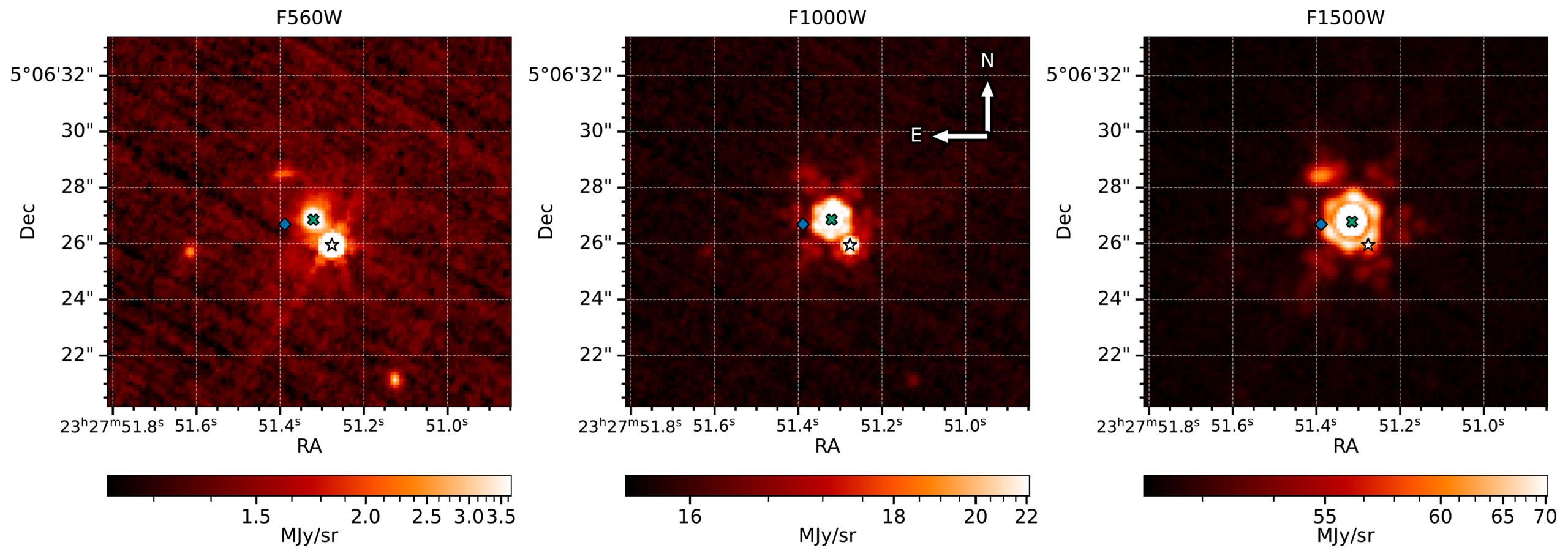
Two points of light that once looked like stars radiating far too much infrared energy have become four objects under the sharper eye of the James Webb Space Telescope.
In each case, a nearby red dwarf sits almost directly in front of a much more distant, dust-filled galaxy. NASA’s Wide-field Infrared Survey Explorer could not separate the pairs at the wavelengths where the galaxies shine most strongly. Its catalogue therefore attached the galaxies’ infrared light to the stars.
That chance alignment created two of the seven anomalies selected by Project Hephaistos as possible Dyson-sphere candidates.
The Webb follow-up was posted as a preprint in July 2026 and has not yet completed peer review. Its imaging and spectra nevertheless provide direct, testable astrophysical explanations for candidates D and E. Five of the original seven still lack confirmation at this level, but that does not make them five surviving detections of alien technology.
It means the telescope work is unfinished.
Why astronomers search for waste heat
Physicist Freeman Dyson’s 1960 proposal began with thermodynamics rather than a literal rigid shell.
A civilisation using energy on a stellar scale might place a swarm of collectors around its star. The structures could intercept some fraction of the visible and ultraviolet light, use part of it to perform work, and eventually release the energy as heat.
The star would then appear fainter at shorter wavelengths while the combined system produced an infrared excess. The temperature of that waste heat and the fraction of starlight intercepted would determine its location across infrared survey bands.
The difficulty is that nature moves energy into the infrared with great efficiency. Dust around a young star, debris created by colliding planetary bodies, a cool companion and a galaxy in the background can all absorb shorter-wavelength radiation and reradiate it as heat.
A Dyson-sphere search therefore does not identify artificial structures directly. It identifies sources that resemble a deliberately simple waste-heat model, then asks whether ordinary astrophysics can break the resemblance.
Seven survivors from five million sources
Project Hephaistos combined positions and optical measurements from Gaia Data Release 3, near-infrared data from 2MASS and mid-infrared photometry from WISE for about five million sources.
Its 2024 peer-reviewed search in Monthly Notices of the Royal Astronomical Society compared the observed light with millions of partial-Dyson-sphere models. Those models varied the temperature of the reradiated heat and the covering factor, the share of the star’s output supposedly intercepted.
The pipeline removed stars already known to have infrared excesses, variable sources, objects in nebulosity and images likely to contain blends. A convolutional neural network helped flag confused WISE fields. Visual inspection then examined 368 late survivors and classified 328 as blends, 29 as irregular, and four as nebular.
Seven objects remained free of obvious catalogue or image problems. All appeared to be M dwarfs, the small, cool red stars that dominate the Milky Way’s stellar population, and all lay within roughly 300 parsecs, or about 980 light-years.
Their inferred infrared output was large. The original modelling attributed about 7% to 17% of the total luminosity to the anomalous component. That range could imitate a partial collector swarm, but it would also qualify as unusually extreme circumstellar dust.
The original team was explicit about the status: seven candidates for follow-up, not seven discoveries of engineering.
Why the red dwarfs remained interesting
Warm debris disks occur when dust produced by collisions absorbs starlight. Very young stars can retain richer primordial or transitional disks. Both can create the rising infrared signal that a waste-heat survey seeks.
The seven red dwarfs did not fit those common versions neatly. Optical follow-up found ordinary main-sequence stellar properties. The stars with spectra did not show the strong hydrogen-alpha emission expected from gas accretion in a young disk.
Extreme debris systems are known around brighter Sun-like stars, but comparable examples around mature M dwarfs are scarce. The candidates’ infrared colours resembled transitional disks in some respects, while their lack of youth made that interpretation uncomfortable.
Uncomfortable is not impossible. It simply left several hypotheses open: an unusual disk, an unseen source along the line of sight, a photometric problem, or the deliberately exotic scenario that motivated the search.
As SpaceDaily’s earlier look at red and white dwarfs as waste-heat targets emphasised, an infrared excess is the beginning of the investigation. Position, motion and spectral shape must all survive before technology belongs near the front of the explanation list.
WISE saw one source where Webb saw two
WISE was built to map the whole sky, not to separate every object in a crowded line of sight. Its point-spread width is roughly six arcseconds in the W3 band near 12 micrometres and about 12 arcseconds in W4 near 22 micrometres.
A red galaxy sitting only one arcsecond from a star is swallowed into the same WISE source. At optical wavelengths the foreground star dominates, while at longer infrared wavelengths the dusty galaxy can take over. Combined in one catalogue entry, the pair looks like a star acquiring an enormous infrared excess.
Candidates D and E were observed with Webb on 28 July and 9 September 2025 under programme GO 7199. The Mid-Infrared Instrument, MIRI, imaged each field at central wavelengths of about 5.6, 10 and 15 micrometres. Its medium-resolution spectrograph covered approximately 4.9 to 24 micrometres.
At 5.6 micrometres, each M dwarf is prominent. At 10 and 15 micrometres, a neighbouring red source becomes dominant.
The positions tell the story. Candidate D’s WISE W3 centroid was displaced by 0.75 ± 0.22 arcsecond from the Gaia position of the star, toward the red object. For E, the displacement was 1.50 ± 0.24 arcseconds.
Those shifts had been difficult to interpret in the lower-resolution survey. Webb resolved them into separate sources about one arcsecond apart.
Candidate D concealed a buried galactic engine
The background object beside candidate D appears dominated by an unresolved point source. Emission features in its MIRI spectrum give a redshift of 0.922 ± 0.002, proving that the infrared light comes from far beyond the Milky Way rather than from material orbiting the nearby red dwarf.
Its colours, compact appearance and spectrum are consistent with a Hot Dust-Obscured Galaxy, usually shortened to Hot DOG.
Despite the name, Hot DOGs are galaxies in which dust hides an intensely accreting active galactic nucleus. The central power source is a feeding supermassive black hole. Dust absorbs much of the radiation emerging around that nucleus and returns it in the infrared, making the galaxy faint at shorter wavelengths yet conspicuous to WISE and MIRI.
The researchers stop short of claiming a complete physical inventory for this faint example. They lack far-infrared detections needed to fix its total luminosity, and their estimate remains an upper limit. But D’s MIRI spectrum and point-like morphology indicate an active nucleus, and its measured infrared light does not originate from the red dwarf.
Candidate E concealed a dusty stellar nursery
The source beside E is different. Its spectral lines yield a redshift of 0.4104 ± 0.0003. Webb shows an extended galaxy with several bright knots rather than one dominant compact point.
Its spectrum contains strong polycyclic aromatic hydrocarbon features associated with dust illuminated in star-forming regions. On the diagnostic used by the team, it falls in a starburst-dominated class.
An active galactic nucleus could still exist inside the galaxy, but the data indicate that it is subdominant if present. The mid-infrared output is better explained by vigorous star formation heating dust.
Two different kinds of background galaxy therefore produced almost the same catalogue-level illusion: a point-like obscured galactic nucleus for D and a clumpy dusty starburst for E.
Webb measurements of the foreground stars also align with ordinary stellar-atmosphere models wherever the components can be separated. The team found no significant intrinsic mid-infrared excess attached to either M dwarf.
Why one arcsecond is enough to rule out the spheres
A partial Dyson swarm hot enough to generate the modelled 180-kelvin emission would occupy scales comparable to a planetary system. At distances beyond 200 parsecs, that region would span less than about 0.01 arcsecond.
An extreme debris disk would likewise remain centred on the star and unresolved by MIRI. Neither could appear as a second source about one arcsecond away, carrying emission lines whose redshift places it at a cosmological distance.
The conclusion for D and E is therefore firmer than saying a galaxy is merely plausible. Webb located the excess away from the stars, measured extragalactic redshifts and recovered foreground-star fluxes without the excess.
This echoes an older pattern in technosignature work. SpaceDaily reported how dust provided a natural account of much of Tabby’s Star’s enigmatic dimming. The scientific value came from forcing natural models to explain an observation strange enough to invite a more exotic possibility.
Five unexplained does not mean five promoted
The simple arithmetic leaves five of the original seven without this kind of decisive Webb result. Their infrared excesses have not yet been spatially and spectroscopically assigned to identified background galaxies.
That statement needs an immediate qualification. Evidence already leans strongly in the same direction.
Radio observations have found compact sources near some Project Hephaistos candidates. A high-resolution study of one associated radio source concluded that it was consistent with an obscured background active galactic nucleus. More recent comparisons of optical, near-infrared and WISE positions have also found wavelength-dependent centroid shifts and background objects near several targets.
A separate 2026 characterization preprint examined the seven original stars plus three similar additions. It confirmed that the visible objects are main-sequence M dwarfs and found no clear stellar explanation for their apparent infrared excess. After incorporating radio, centroid and Webb follow-up, however, its authors identified red background galaxies as the leading hypothesis for the group.
The five are unresolved in the strict sense that their excesses have not all been assigned to a specific source with Webb-quality proof. They are not five cases in which natural explanations have failed every follow-up test.
Additional MIRI imaging and spectroscopy could separate any close galaxy from its foreground star. ALMA could test colder dust emission for some candidates. Proper-motion baselines offer another route: the nearby star moves measurably across the sky while a distant galaxy remains effectively fixed.
A successful rejection improves the search
Finding two false positives does not invalidate a search built to reject false positives. It exposes a contaminant that future pipelines can handle earlier.
The original team had already removed hundreds of obvious blends. Candidate D passed those archival checks especially well; one centroid method found no evidence of contamination, while E showed only marginal evidence. That failure is informative because it defines what WISE alone cannot reliably resolve.
With five million starting stars, even very rare alignments become expected. The Webb team explored crude surface-density estimates and showed why the number depends sensitively on brightness, angular separation and every earlier selection cut. The important point is not a single contamination probability. It is that an infrared-bright galaxy one arcsecond from a nearby star can survive sophisticated catalogue filtering.
Future waste-heat searches can demand optical-to-infrared centroid consistency, use higher-resolution surveys where available and rank candidates for spatially resolved follow-up before interpreting a smooth infrared fit.
The rejected candidates also delivered an unexpected return. The two background galaxies are unusually red, infrared-bright systems at redshifts below one and fainter than the Hot DOG populations commonly studied. The foreground red dwarfs may even serve as natural guide stars for future adaptive-optics observations of the galaxies behind them.
That is how a careful technosignature search should work. It starts with a physically motivated artificial signature, keeps the candidate language provisional, and gives ordinary astrophysics repeated chances to win.
For candidates D and E, Webb has done more than lower the odds of Dyson spheres. It has shown exactly where the misleading heat came from. The remaining five are still requests for better data, not evidence that alien structures survived the test.