
An object that looks unusually cold and faint on a map of the stars need not be a star at all. In one speculative case, it could be the infrared glow of a vast system built to intercept a star’s light and use its energy.
A study published in the journal Universe calculates where such objects would sit on the Hertzsprung-Russell diagram, the familiar plot that arranges stars by temperature and luminosity. The paper finds that hypothetical energy collectors around red dwarfs and white dwarfs could occupy a sparse, cold part of that diagram and radiate mainly at infrared wavelengths.
This is a theoretical result, not evidence that any alien megastructure exists. The study contains no observations and identifies no candidates. It models what a fully enclosing Dyson sphere would look like if a technological civilisation had built one around two kinds of low-luminosity star.
A Dyson sphere is better imagined as a swarm
Physicist Freeman Dyson proposed the observational idea in 1960. A civilisation using energy on a stellar scale might deploy enough collectors to intercept a large fraction of its star’s output. Dyson did not insist on a rigid shell. A swarm of independent orbiting structures is the more physically plausible version of the concept.
The important part for astronomers is thermodynamics. Collectors could turn some captured starlight into useful work, but the energy would ultimately leave as heat. A system dark in visible light could therefore remain bright in the infrared. Dyson’s original proposal in Science was framed as a search for artificial stellar sources of infrared radiation.
For a complete enclosure radiating equally in all directions, the total power does not disappear. It remains equal to the luminosity of the hidden star. What changes is the effective temperature and the wavelength at which the power emerges. Spread the same energy over a larger radiating area and the surface becomes cooler, moving its peak emission deeper into the infrared.
That distinction makes “cold, dim star” useful shorthand but incomplete physics. A Dyson sphere around a dim red or white dwarf would be low in total luminosity because its host is low in luminosity. The enclosure would look far cooler than the star it hides, but it would not destroy the star’s bolometric output. It would redistribute that output across wavelengths.
The new paper puts the idea on the stellar map
Amirnezam Amiri’s study, “Dyson Spheres on H-R Diagram”, uses radiative-equilibrium calculations for representative M-type red dwarfs and white dwarfs. It assumes a complete sphere that intercepts all stellar radiation and re-emits it as a blackbody.
The relationship is straightforward. The modelled sphere’s temperature falls with the inverse square root of its radius. A larger enclosure is cooler, while its total luminosity remains set by the star inside. In the paper’s examples, structures extending from fractions of an astronomical unit to several astronomical units could have temperatures ranging from roughly 150 kelvin down to a few tens of kelvin, depending on the host and radius.
At temperatures between about 50 and 300 kelvin, thermal emission peaks from roughly 10 to 60 micrometres. That range extends across the mid-infrared bands observed by instruments including NASA’s Wide-field Infrared Survey Explorer and the Mid-Infrared Instrument on the James Webb Space Telescope. Still colder configurations would peak at longer wavelengths and become harder for Webb to detect.
Placed on a Hertzsprung-Russell diagram, these model objects move away from the ordinary stellar sequence towards low effective temperatures. The study argues that the emptiest parts of that map provide a way to rank unusual infrared sources for closer examination.
Why red dwarfs make attractive hypothetical hosts
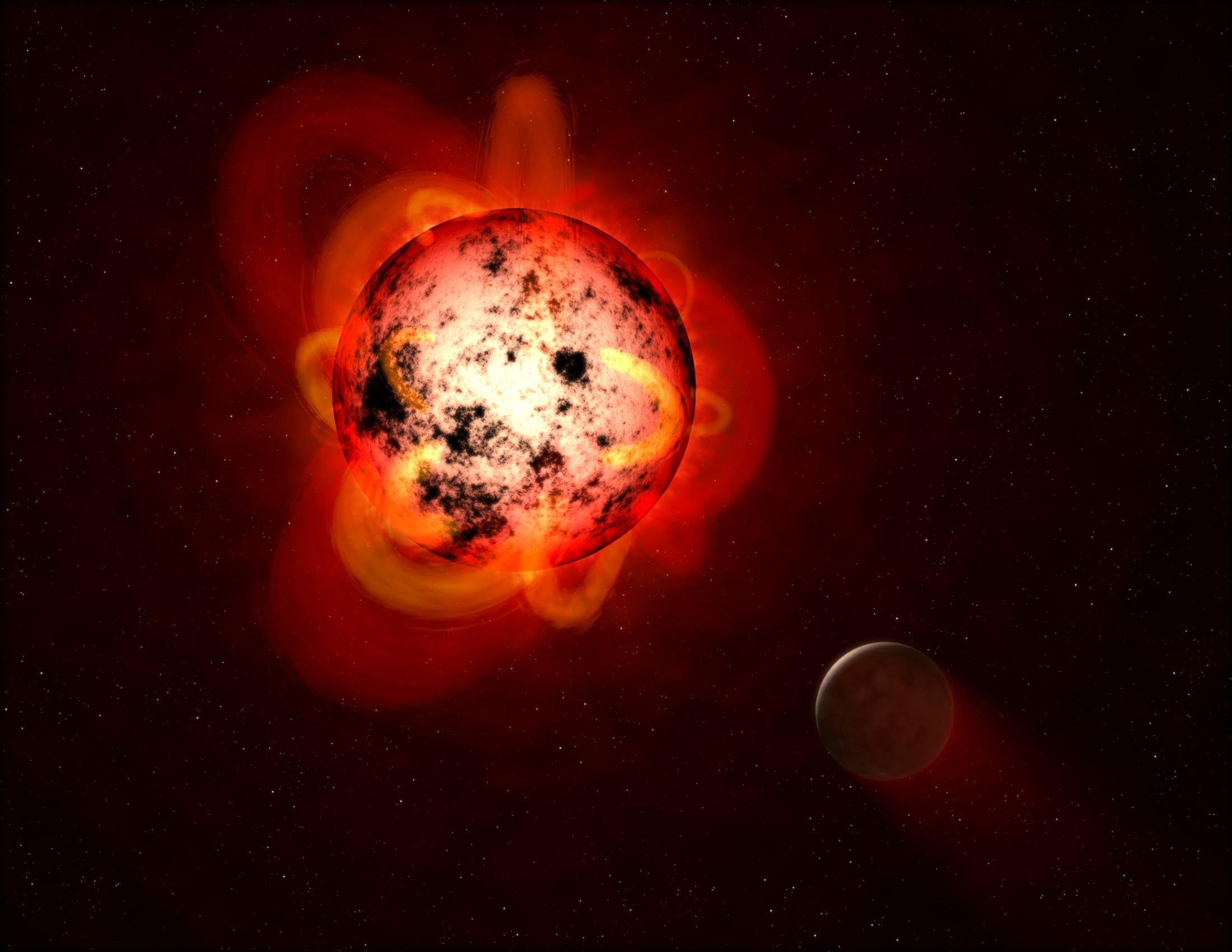
Red dwarfs are the most common stars in the Milky Way. They burn fuel slowly and can remain stable for trillions of years, far longer than the universe has existed so far. Their low luminosity also means that a structure designed to operate at a given temperature could sit much closer to the star than an equivalent structure around the Sun.
A smaller orbital scale reduces the area and material required to intercept a large share of the light. The paper points to distances of roughly 0.05 to 0.3 astronomical units as a useful compact scale around some red dwarfs. That does not make construction practical by human standards. It only makes the material problem less severe than enclosing a brighter star at a larger radius.
Red dwarfs also make good survey targets because they are numerous and nearby examples are well catalogued. In 2024, Project Hephaistos examined about five million sources using optical observations from Gaia, near-infrared measurements from 2MASS and mid-infrared data from WISE. Its search published in Monthly Notices of the Royal Astronomical Society selected seven M dwarfs with infrared excesses that deserved follow-up.
The authors did not claim they had found alien technology. An infrared excess only means more infrared light is associated with a target than a simple stellar model predicts. Warm dust, a companion, a background galaxy, crowded imagery or a measurement problem can produce the same first-pass signal.
White dwarfs offer a cleaner spectrum, with a dusty complication
White dwarfs are the compact remnants left after stars like the Sun shed their outer layers. They are roughly Earth-sized and gradually cool over billions of years. Their small radii and modest luminosities allow a hypothetical collector swarm to be compact, while their comparatively simple cooling spectra make unexpected infrared light easier to notice.
That is the clean-target argument in the new paper. A white dwarf model predicts how the bare stellar remnant should look. Radiation above that prediction can be flagged. Earlier work by astronomer Ben Zuckerman examined this possibility in detail, including the optical transits and infrared emission that artificial structures might produce. His white-dwarf detectability study also makes the central natural complication explicit: orbiting dust is the usual cause of infrared excess around white dwarfs.
Many white dwarfs contain heavy elements in their atmospheres, evidence that they are accreting disrupted planetary material. Dust from that material absorbs starlight and reradiates it in the infrared, doing naturally what a search expects an artificial collector to do. Cool stellar or substellar companions can add infrared light as well.
Webb has just demonstrated the false-positive problem
Astronomers have already begun following up the seven Project Hephaistos targets. A preprint posted on 10 July 2026 reports Webb mid-infrared imaging and spectroscopy of two of them, candidates D and E. Webb separated the infrared sources from the foreground M dwarfs and found that both were background galaxies projected within about one arcsecond of the stars.
One source was consistent with a hot, dust-obscured galaxy at a redshift of about 0.9. The other appeared to be a dusty starburst galaxy at a redshift near 0.4. The Project Hephaistos Webb analysis is a preprint and has not yet passed peer review, but its spatially resolved observations show that those two infrared excesses did not come from structures around the red dwarfs.
This is precisely why a point on an infrared diagram can only begin the investigation. WISE surveyed the whole sky, but its resolution at longer wavelengths blends light from sources separated by several arcseconds. A distant dusty galaxy can therefore appear attached to a much nearer star until a sharper telescope resolves the scene.
What would make a candidate difficult to dismiss
A persuasive technosignature would need several tests to agree. The infrared source would have to share the star’s position and motion. Its spectrum would need to resemble smooth thermal waste heat without the spectral features expected from dust, gas or a galaxy. The optical dimming and total energy budget would have to match the fraction of starlight supposedly intercepted. Repeated observations would need to rule out variability, image artefacts and chance alignment.
Even that would identify an anomaly, not establish its builder. The search strategy works by finding sources that natural models initially fail to explain, then trying harder to explain them naturally. Alien engineering remains a last hypothesis, not the default interpretation of an infrared excess.
The new calculations sharpen one part of that process. Red dwarfs offer abundance, longevity and comparatively compact construction scales. White dwarfs offer predictable stellar emission and strong contrast, though planetary dust remains a persistent mimic. Neither class has yielded a confirmed megastructure. What they provide is a more clearly defined place to look, and a set of infrared expectations that observations can attempt to disprove.