

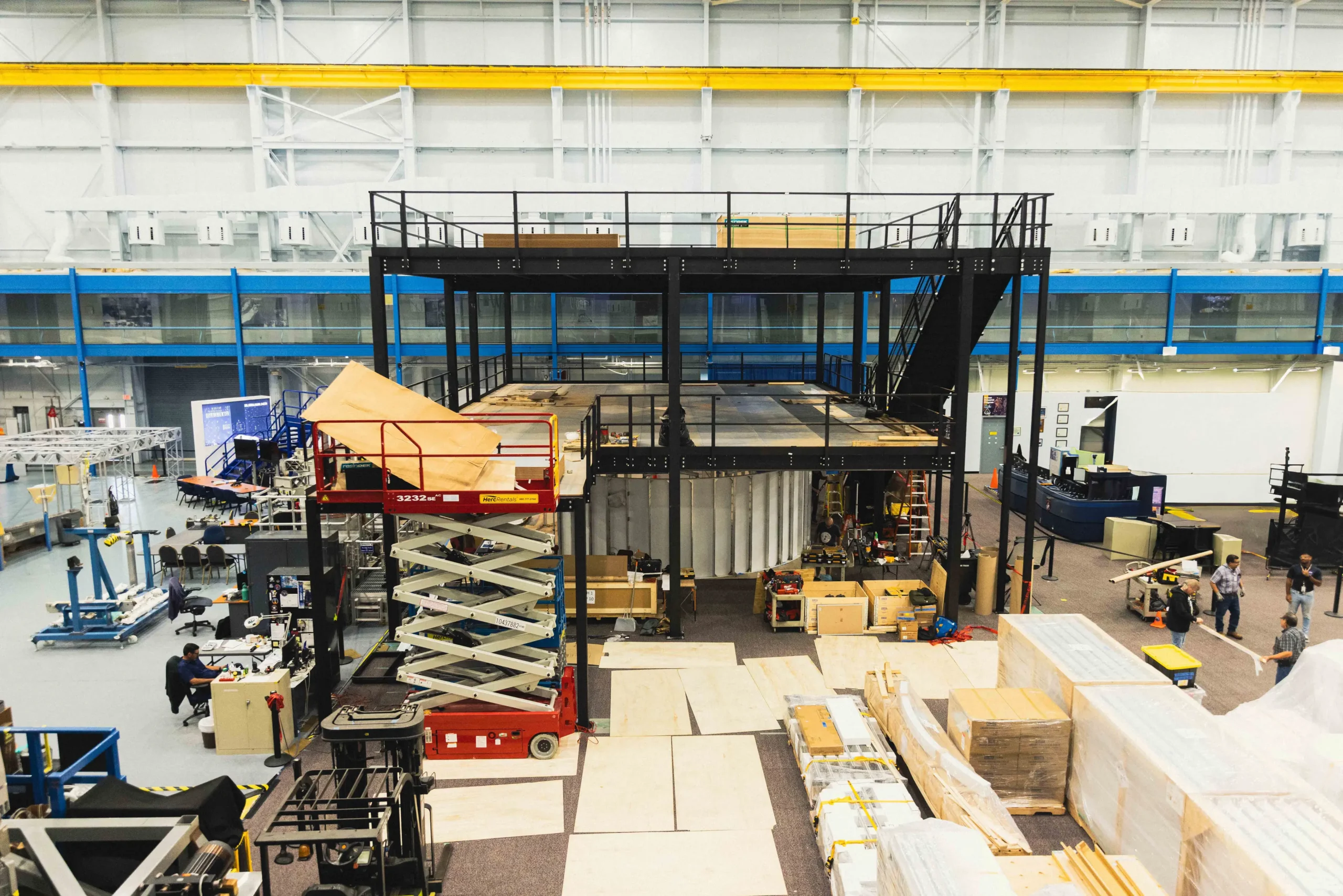
The International Space Station’s possible successors are usually encountered as renderings, milestone charts and contract announcements. Inside Building 9 at NASA’s Johnson Space Center in Houston, one of them has begun to occupy real floor space.
A steel structure supporting Starlab’s full-scale, multi-level mockup now rises inside the Space Vehicle Mockup Facility, the cavernous astronaut-training hall that already contains hardware and trainers from several eras and programmes. A recent Space.com visit described commercial equipment associated with SpaceX and Blue Origin on the floor around it. The mixture offers an unusually concrete view of a transition that remains unsettled in orbit.
It also needs a careful label.
Starlab’s Building 9 structure is a ground mockup, not a pressure vessel or flight hardware awaiting launch. It cannot establish that Starlab will be ready before the ISS retires. What it does show is that commercial-station planning has reached the point where astronauts and engineers need to inhabit the design, discover its awkward corners and work out whether a station that makes sense in a digital model also makes sense to a tired crew during an alarm.
A three-level station that can be taken apart
Teague describes the installation as a full-scale, reconfigurable training and operations mockup. Its structural frame provides three levels, observation areas, work space, storage and access around a shell fitted with power, data, lighting, ventilation and fire suppression. Modular floors, walls, ceilings and equipment panels can be changed as the station design develops.
That adjustability is the point. Flight hardware has to survive launch loads, hold pressure and function for years in orbit. A useful trainer has a different job: it must let people test a design repeatedly and alter it without rebuilding a spacecraft.
Teague says the planned habitat is nearly eight metres in diameter and 17 metres long, with roughly 400 cubic metres of habitable volume. Starlab’s public design divides the interior into functional decks for systems, laboratory work and crew habitation, with connections between them. The Earth-bound mockup uses a steel superstructure and stairs to let people reach those levels under gravity. In orbit, orientation and movement will be shaped by microgravity instead.
That difference means the mockup cannot reproduce everything. It cannot make a person float, reveal how loose objects drift through the cabin or fully simulate the effects of weightlessness on posture and reach. It can still expose a surprising number of human problems: whether two crew members can pass at a pinch point, whether a hatch is obstructed, whether labels remain visible, whether a tool can be carried through a route, and whether an injured person can be moved during an emergency.
What only a human-scale test can reveal
NASA’s July 2025 account of Starlab’s progress listed day-in-the-life walkthroughs, interior-layout assessments, crew training, procedure development, hardware-fit checks and anomaly resolution among the mockup’s intended uses. Each sounds ordinary. Together, they determine whether a station can be operated rather than merely assembled.
A day-in-the-life trial can have a crew move through exercise, meals, maintenance, science work, hygiene, conferences and sleep. The sequence reveals conflicts that are easy to miss when each system is reviewed alone. An open rack may block a route. A noisy machine may sit beside a sleep area. Two tasks may require the same work surface. A frequently used item may be stored where it creates needless traffic across decks.
Emergency rehearsals ask harsher questions. Crews need to locate breathing equipment and fire-response gear quickly, isolate a suspected leak, communicate when people are on different levels and reach a return vehicle through smoke, confusion or partial power loss. Specialists can watch where people hesitate and change both the cabin and the procedure.
That is why a large mockup is not an ornamental sign of progress. It is a design instrument.
The agreement bringing Starlab into Building 9 underlines the practical purpose. NASA allocated about 2,400 square feet of permanent floor space, plus temporary construction space, for integration, testing, simulations and training. Starlab owns the mockup, while NASA can use it for evaluations and events under the agreement. Installation was expected to begin in January 2025, and the structure was intended to remain available for public viewing.
Building 9 has been rewritten before
The commercial presence feels new because the ISS has defined human spaceflight for more than a quarter-century. The facility around it, however, was built to change.
NASA’s history of Building 9 traces construction from December 1965 to completion in March 1967. Apollo 11 astronauts rehearsed lunar-surface work there in 1969. Space Shuttle trainers arrived in the 1970s. An extension built between 1986 and 1988 supported Space Station Freedom, the US programme whose work later contributed to the ISS.
The present Space Vehicle Mockup Facility trains crews in emergency operations, maintenance, stowage, spacewalk preparation and payload work. It also supports mission teams that need a ground counterpart when something unexpected happens in orbit. Full-scale surroundings matter because a procedure tested on the ground can be relayed to a crew dealing with the real vehicle.
Seen in that history, Starlab is not displacing a timeless arrangement. Building 9 has repeatedly changed its contents as Apollo gave way to Shuttle, Freedom evolved toward ISS and exploration programmes added new vehicles. The floor has always been partly a record of the present and partly a bet on what astronauts will need next.
What is different now is ownership. Apollo, the Shuttle and the US elements of the ISS were government programmes. NASA’s stated low-Earth-orbit model for the next era is to buy services from privately owned and operated stations that also serve other customers.
Why SpaceX, Blue Origin and Starlab can share one floor
The commercial names visible in Building 9 do not all belong to the same contest or destination. SpaceX already transports NASA crews to the ISS and is Starlab’s announced launch provider. Starlab says its station is designed for a single Starship launch. That choice avoids orbital assembly in the current concept, but it also ties the schedule to a launch system whose development and certification still have to support the mission.
Blue Origin’s presence includes lunar work as well as low-Earth-orbit ambitions. In May 2026, NASA announced the arrival of a full-scale Blue Moon Mark 2 crew-cabin prototype, more than five metres tall, for Artemis training and testing in the facility. Blue Origin is also part of the Orbital Reef commercial-station team.
SpaceDaily has followed that parallel development. Human-in-the-loop tests of Orbital Reef mockups examined hatch opening, equipment movement and the handling of incapacitated crew members. Those are close cousins of the questions Starlab’s Building 9 structure is meant to answer, even though the proposed stations differ.
The floor is therefore not a showroom for one replacement ISS. It is becoming shared infrastructure where NASA can train for government and commercial vehicles, lunar missions and low-Earth-orbit services without pretending they are parts of a single architecture.
Starlab is a contender, not the appointed successor
NASA’s commercial low-Earth-orbit strategy deliberately supports more than one possible destination. The agency describes its intended role as one customer among many, purchasing crew time, research capacity and other services instead of owning the entire platform.
Starlab brings together Voyager Technologies, Airbus, Mitsubishi Corporation and MDA Space, with Palantir as a strategic partner. SpaceDaily covered the Voyager and Airbus joint venture in 2024, when the project was still moving from concept studies into a corporate structure intended to design and operate a station. The mockup makes that progression visible, but it does not end the competition.
Axiom Space is developing its own station path. Blue Origin and its partners have Orbital Reef. Vast has proposed Haven-2. NASA’s procurement still has to decide what services to buy, on what schedule and under which safety and financial terms. As earlier SpaceDaily coverage of the commercial-station programme showed, funded milestones are meant to reduce design risk before the government commits to operational services.
Starlab announced in February 2026 that it had completed a commercial critical design review attended by NASA representatives. That is a company-reported programme milestone. It should not be read as final NASA certification, a flight-readiness decision or a guarantee of a service contract.
NASA is also keeping its architecture open. In March 2026, the agency sought industry feedback on an additional path involving an ISS-anchored, government-owned core module while preserving commercial destination options. The proposal does not erase Starlab’s work. It reveals how seriously NASA is treating the risk of a gap.
2030 is not a switch that flips at midnight
The phrase “around 2030” can make the transition sound tidier than it is. NASA and its international partners have committed to operating the ISS through 2030, provided the station remains safe. The agency wants one or more commercial destinations operating before ISS activities end so research and astronaut experience do not lapse.
But “through 2030” is not the same as a fixed retirement at the start of that year, nor does it mean deorbit is completed by its final day. NASA’s transition guidance treats the end of operations and the controlled deorbit as a managed sequence. The deorbit campaign may extend into 2031. Partner decisions, station health, commercial readiness and the vehicle used to guide the ISS down all affect the calendar.
Starlab has publicly targeted a 2029 launch. Meeting that goal would require the flight habitat and service module to be built and tested, Starship to be ready for the mission, regulators and NASA to accept the relevant safety case, and the station to complete commissioning in orbit. A ground mockup addresses only part of that chain.
This is the tension visible in Building 9. The old station is still inhabited and supported every day. The next stations are being rehearsed before any one of them has earned the right to replace it.
The first transition may happen on the ground
There is a quieter reason the Starlab installation matters. NASA does not only need new spacecraft. It needs training systems, instructors, procedures, software interfaces, mission support arrangements and agreements that allow a government customer to work inside privately owned programmes.
Building 9 can become connective tissue between those models. Its staff and physical infrastructure preserve lessons accumulated through Shuttle and ISS operations, while commercial providers bring vehicles NASA will not own. The result will require boundaries over access, configuration control, proprietary information and responsibility when a trainer differs from the spacecraft in orbit.
The Starlab mockup is early evidence of that institutional change. It turns an abstract commercial marketplace into rooms, decks and workstations that crews can criticise. It also gives NASA a way to compare what providers say their stations can do with what human beings can actually do inside them.
For now, the most honest reading is neither that Starlab has won nor that Building 9 is merely displaying a prop. The structure is a working hypothesis at full scale.
Watch what follows it: repeated crew evaluations, changes to the interior, manufacture of the flight habitat, progress by the selected launcher, NASA’s service awards and a credible path from launch to sustained operations. If those pieces converge, the black steel frame now occupying the training floor will become the place where astronauts learn to live aboard a commercial station. If they do not, Building 9 will change again, as it has for nearly sixty years.