

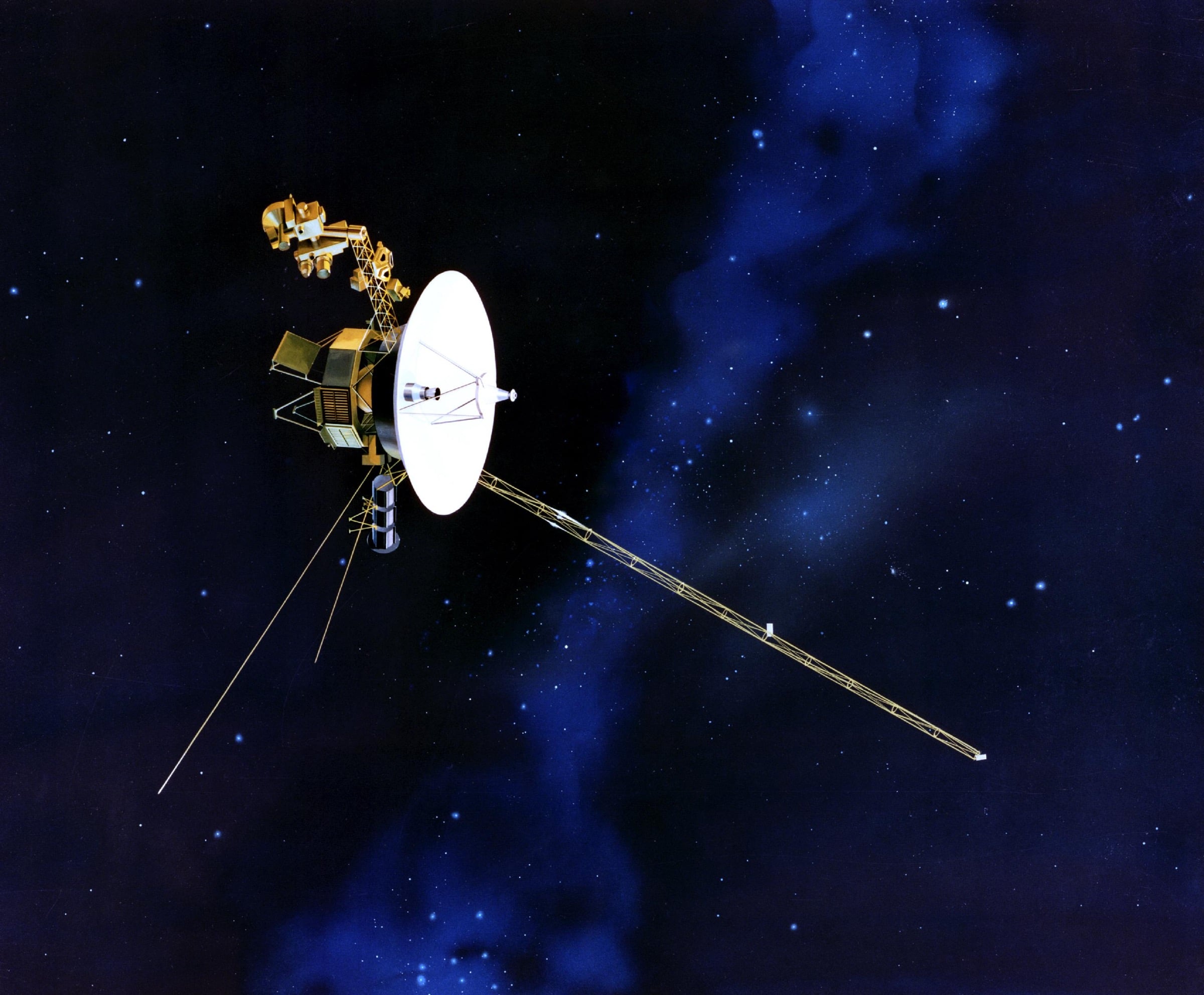
When Voyager 2 measures a magnetic field, a plasma oscillation or an energetic particle today, it is not observing interstellar space from the edge. It is already there.
That distinction is the reason NASA’s July 2026 power reconfiguration matters beyond the ingenuity of keeping a 49-year-old spacecraft alive. Voyager 1 and Voyager 2 are the only working probes beyond the heliopause, the boundary between the heliosphere shaped by the solar wind and the surrounding interstellar medium. No approved successor is being built to take over their measurements.
NASA announced on 4 August that engineers had successfully freed power on Voyager 2 through an operation nicknamed the Big Bang. Several powered devices were turned off together and replaced with lower-power alternatives, without allowing the spacecraft to become too cold to work. The agency says the saving should keep all three remaining science instruments operating for at least an extra year.
A recent Mission Notes account of the Big Bang covered the hardware and thermal trade in detail. The larger issue is what those saved watts keep in existence. They preserve humanity’s only direct, working scientific presence in interstellar space at a time when there is no funded handover mission waiting behind Voyager.
The three surviving instruments do different jobs
Voyager 2 launched with ten science instruments. Cameras, spectrometers and other systems built for its encounters with Jupiter, Saturn, Uranus and Neptune were retired after their work ended. Power shortages have since forced NASA to turn off instruments that remained useful for the interstellar mission.
The three still operating are the cosmic ray subsystem, magnetometer and plasma wave subsystem. NASA’s current instrument list identifies all three as active on Voyager 2. Voyager 1, after another shutdown in April 2026, continues with its magnetometer and plasma wave subsystem.
The magnetometer measures the strength and direction of the local magnetic field. That matters because the field in and around the heliosphere helps organise how charged particles move. Voyager’s measurements have also complicated the simplest picture of how the Sun’s magnetic bubble joins the field outside it.
The plasma wave subsystem listens for electrical oscillations. When a passing disturbance excites the thin interstellar plasma, the frequency of those oscillations allows researchers to infer the local electron density. It is not a continuous census of every particle, but it provides a way to trace density changes far beyond the solar wind.
The cosmic ray subsystem detects high-energy particles and measures their energy and composition. Outside the heliopause, it samples a particle environment no longer enclosed by most of the Sun’s shielding influence. Together, the three instruments connect field, density and particle behaviour at one actual point in interstellar space.
Location is the capability that cannot be replaced
Modern spacecraft carry faster computers, denser storage and more capable sensors. None of that substitutes for being on the far side of the heliopause. A highly sensitive instrument near Earth and a modest instrument 20 billion kilometres away are not making the same measurement.
NASA’s IMAP observatory, for example, is now operating near the Sun-Earth L1 point. It measures particles that have travelled from the heliosphere’s distant boundary and builds a broad view of how that boundary works. Its science is complementary to Voyager’s, not interchangeable with it.
IMAP is about 1.6 million kilometres from Earth. Voyager 2 is more than 20 billion kilometres away and travelling outward on a different trajectory from Voyager 1. The twins therefore provide two narrow, local tracks through a structure whose global shape has to be inferred from many kinds of observation.
The phrase “only direct scientific presence” needs care. It does not mean Voyager supplies a complete map, or that remote observations are somehow secondary science. It means the Voyagers alone are currently placing functioning instruments in the interstellar medium and returning those local measurements to Earth.
The repair loop is about 39 hours long
Voyager 2’s one-way light time is about 19 and a half hours. A command sent from Earth and the earliest telemetry confirming what happened therefore span roughly 39 hours. That is before the spacecraft has finished every step, and before the team has analysed the returned engineering data.
The July procedure was delicate because electricity and temperature are coupled. Turning off an old device saves power, but it also removes the waste heat that device contributed to the spacecraft. A component that has no remaining science role may still be helping to warm a propulsion line or electronics bay.
The Big Bang moved Voyager 2 from one power-and-heat arrangement to another. The lower-power alternatives had to keep critical systems warm, while the transition itself could not demand more electricity than the radioisotope generators could provide. Those generators convert heat from decaying plutonium-238 into electricity and lose about four watts of usable output each year.
At ordinary household scale, four watts sounds negligible. On Voyager, it is now large enough to determine which instrument remains alive. The earlier Mission Notes article covers the detailed device swap; the point here is that every successful reconfiguration preserves a measurement location humanity cannot recreate on short notice.
“No successor” does not mean nobody has a plan
NASA’s own overview of future interstellar exploration says there are no current NASA plans to send a new spacecraft into interstellar space. That statement needs a little context. Researchers have developed serious concepts, but a concept study is not an approved mission in development.
The best-known American proposal is Interstellar Probe, a large strategic mission designed to travel through the outer heliosphere and into relatively undisturbed interstellar material. The 2024 heliophysics decadal survey describes it explicitly as a mission that “proposes to follow-on from the Voyager missions”, with a target speed near seven astronomical units per year and a planned reach beyond 300 astronomical units over a 50-year prime mission.
That is a substantial scientific and engineering architecture. It is not hardware moving through an approved development schedule. Funding, selection, design, launch vehicle commitment and decades of operations would all have to follow.
Other proposed missions and international concepts deserve attention too. The narrow claim is not that Voyager has inspired no successor ideas. It is that, as of August 2026, there is no approved probe under construction that can guarantee continuity of direct measurements beyond the heliopause.
Even a faster successor would leave a gap
Voyager 2 took just over 41 years to reach the heliopause, crossing in November 2018. That is not a fair measure of what a purpose-built interstellar probe could achieve: Voyager followed a planetary tour and was not launched on the fastest possible escape path.
The Interstellar Probe concept is designed to move much faster. Its roughly seven-astronomical-unit-per-year target could put a new spacecraft across the heliopause in something like 16 years, depending on the boundary’s location and the chosen trajectory.
Sixteen years after launch is still a long time. Mission approval, detailed design, construction and launch preparation would come first. If both Voyagers stop returning science before a successor leaves Earth, the interruption in direct interstellar data could easily be measured in decades.
Some losses would be permanent rather than merely delayed. A later probe could resume local sampling, but it could not reconstruct every field change, plasma disturbance or cosmic-ray variation that passed through Voyager’s region during the silent years.
At least another year is not a warranty
NASA’s language is deliberately modest: the power saving should keep Voyager 2’s three instruments operating for at least an extra year. It is a planning estimate, not a promise that every part of the spacecraft will remain healthy for that period.
Power is only one failure path. A transmitter, computer, thruster, propellant line or communications component could develop a problem first. Nearly five decades of radiation exposure and thermal cycling are not captured by subtracting four watts from an annual spreadsheet.
Nor does the eventual loss of one instrument automatically end the mission. Voyager 2 could continue with two instruments, then perhaps one, as long as it can operate its computers, point its antenna and send usable data. NASA has previously said the twin probes may retain at least one science instrument into the 2030s if the spacecraft remain otherwise healthy.
The saved year is also a decision window
The immediate achievement is straightforward. Engineers found a lower-power way to run old hardware, sent the change across a 19-and-a-half-hour radio path, and confirmed it across the same distance. Voyager 2 kept all three science channels.
The consequence is harder to price. Another year extends humanity’s only in-place record from this region. It gives researchers more time to compare two different interstellar trajectories, and it postpones the day when one more kind of direct measurement disappears.
It also gives space agencies another year in which the absence of a successor remains a choice rather than an inherited fact. Voyager 2’s instruments are not irreplaceable because they are old. They are irreplaceable because, for now, nothing approved is on its way to where they are.