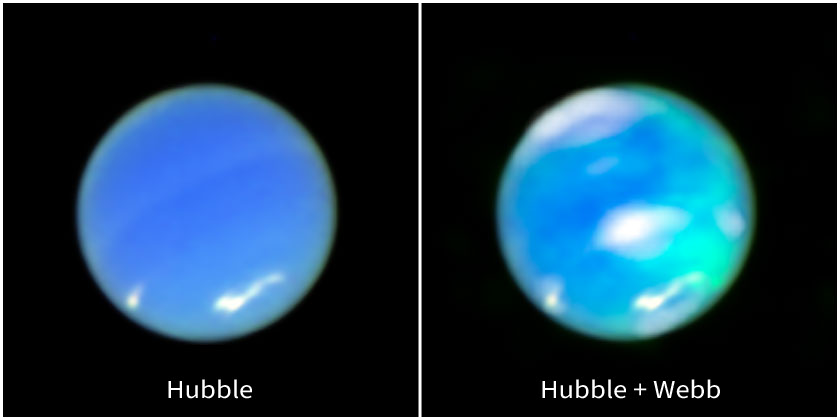
The first definitive detection of auroras on Neptune came with a quieter discovery concealed in the same infrared spectrum. When the James Webb Space Telescope observed the distant planet in June 2023, it found the molecular signature astronomers had pursued for decades. It also found an upper atmosphere far colder than the one Voyager 2 measured during its 1989 flyby.
The auroras made the image. The temperature made the puzzle.
When NASA and the research team announced the result on 26 March 2025, the comparison was striking. Webb measured about 358 kelvin. Voyager’s best estimate had been around 750 kelvin. Even after allowing for the different instruments and atmospheric layers involved, the gap remained much too large to dismiss as a change of thermometer.
That does not mean scientists watched Neptune cool steadily for 34 years. They have two widely separated snapshots, made in different ways. What they can say is narrower and still surprising: the thin gas high above Neptune’s clouds was several hundred degrees cooler in 2023 than it appeared to be in 1989, and no one yet has a complete explanation.
Webb found a chemical fingerprint, not a blue-green light show
Webb observed Neptune on 22 June 2023 with its Near-Infrared Spectrograph, NIRSpec. Rather than merely photographing the planet, the instrument separated its light by wavelength across different points on the disc. In that spectrum, researchers identified clear emission from H3+, a molecule made from three hydrogen nuclei and two electrons.
H3+ forms when energetic particles ionise molecular hydrogen and the resulting chemistry rearranges the atoms. On Jupiter, Saturn and Uranus, it is an established tracer of auroral activity. Neptune had been the holdout. Voyager 2 detected radio emissions associated with the planet’s magnetic environment and returned suggestive ultraviolet observations, but not the decisive H3+ signature.
The cyan patches in NASA’s published Webb composite are a map of that infrared emission layered over images of Neptune. They are not a literal representation of what a person hovering near the planet would see. The colour makes the signal legible to us; the spectrum is what makes the detection convincing.
Neptune puts its auroras in unexpected places
On Earth, people learn to associate auroras with the far north and south. Neptune does not arrange its magnetism so neatly. Its magnetic field is tilted by about 47 degrees relative to its rotation axis, and the field is also offset from the planet’s centre. Geographic north and magnetic north are therefore very different directions.
Webb’s strongest H3+ enhancements appeared around southern mid-latitudes, rather than forming a familiar cap over the geographic pole. That location fits a world whose magnetic axis swings through space at an extreme angle as Neptune rotates every 16 hours or so.
This geometry matters beyond the appearance of an aurora. It determines where charged particles can be channelled into the atmosphere, where they deposit energy, and how local heating might be distributed around the planet. An auroral map is also a rough map of the forces acting on the upper atmosphere.
Two thermometers, 34 years apart
The study published in Nature Astronomy derived an H3+ temperature of 358 plus or minus 8 kelvin. That is about 85 degrees Celsius. Voyager 2’s ultraviolet solar-occultation measurement in 1989 yielded an exospheric temperature near 750 plus or minus 150 kelvin, about 477 degrees Celsius at the central estimate.
Temperatures expressed in Celsius can sound misleading here. Neptune’s upper atmosphere is so rarefied that it contains very little heat in the everyday sense. A molecule may be moving at a speed corresponding to a high kinetic temperature while the gas remains far too thin to warm a person or a spacecraft as dense air would.
The more important caution concerns comparability. Voyager inferred the temperature of the exosphere from the way ultraviolet sunlight passed through the atmosphere. Webb inferred a temperature from the distribution of H3+ emission lines lower down. They did not put the same instrument at the same altitude on the same date.
The researchers addressed that difference with an atmospheric model. It indicated that the H3+ temperature should be less than 10 per cent below the equivalent Voyager-style exospheric temperature. That correction is meaningful, but nowhere near enough to bridge a central-value gap of almost 400 kelvin. Their conclusion was that Neptune’s ionosphere really was considerably hotter during the Voyager encounter.
It is best described as a change between two epochs, not as a measured cooling rate. The atmosphere could have risen, fallen or fluctuated in between. There are no annual readings hiding behind the headline.
The colder atmosphere may explain a decades-long failure
Before Webb, astronomers had repeatedly searched for Neptune’s H3+ emission from the ground without a firm detection. Those attempts were shaped partly by the hot atmosphere Voyager found. If Neptune remained near 750 kelvin, its H3+ should have radiated more strongly in the infrared and might have been within reach.
But H3+ emission is strongly sensitive to temperature. At roughly 358 kelvin, the ion radiates much more weakly. The auroral chemistry could therefore be present while its most useful infrared beacon sat below earlier detection limits.
Webb had the sensitivity and spectral coverage to pull that faint structure from Neptune’s light. The NASA account of the discovery describes both the relief of finally seeing the signal and the surprise of finding such a cold ionosphere. In this case, a nondetection over many years did not mean the phenomenon was absent. The atmosphere had made its evidence harder to see.
A Neptunian season is nearly as long as the gap
Neptune takes about 165 Earth years to orbit the Sun, so each season lasts roughly four decades. The 34 years between Voyager and Webb are almost a season, which makes seasonal change an obvious suspect. Yet the paper argues that season alone does not settle the problem. Changes of this size can occur on timescales shorter than Neptune’s full seasonal rhythm, and the planet does not experience the extreme seasonal geometry of Uranus.
A simple solar-cycle answer is also unsatisfying. The level of solar ultraviolet activity was broadly comparable around the two observations. Neptune is about 30 times farther from the Sun than Earth, and predicting the solar wind there is difficult. The researchers note that Webb’s visit may have coincided with one of the stronger modeled increases in solar-wind dynamic pressure during 2023, but the estimated arrival time carries uncertainty measured in weeks.
That leaves several plausible contributors without a settled division of responsibility. Charged particles guided by Neptune’s magnetic field can heat the auroral atmosphere. Waves rising from lower layers may carry energy upward. The solar wind can compress and disturb the magnetosphere. Material arriving from the rings or elsewhere in the Neptune system may alter ionospheric chemistry and cooling.
These are mechanisms to test, not a list from which one has already been chosen.
The atmosphere is cold only by comparison
Even at 358 kelvin, Neptune’s upper atmosphere is warmer than sunlight alone should make it. The researchers estimate that absorbed solar energy would support a temperature closer to 130 kelvin. Explaining the remaining difference is part of the long-running giant-planet upper-atmosphere energy problem: how do these remote worlds move enough energy into their thin outer layers?
This is related to, but distinct from, the question in Space Daily’s recent examination of Neptune’s hidden heat and its contrast with Uranus. That comparison concerns the planet’s overall energy budget and the heat escaping from its deep interior. The Webb result concerns the thermosphere and ionosphere, extremely tenuous layers far above the visible clouds.
A planet can release more internal energy than it absorbs from sunlight while its upper atmosphere cools between observations. Heat must still be transported through many layers, and magnetospheric energy can be deposited from above. Treating every temperature at Neptune as one shared thermostat would erase the very physics researchers are trying to isolate.
Cooling changes the size of the upper atmosphere
The result is not only about a number on a temperature scale. Hot gas expands. Cooler gas is held more tightly by gravity. According to the study, a fall from around 750 to around 350 kelvin would reduce the atmospheric scale height by more than a factor of two.
Scale height describes how quickly atmospheric density falls with altitude. A smaller value means Neptune’s upper atmosphere is more compact. That affects models of how ring particles spiral inward, where infalling material encounters drag, and what a future spacecraft might meet above the clouds.
It also changes the context for old data. Voyager’s hot upper atmosphere cannot automatically be treated as Neptune’s permanent baseline. A single flyby produces exquisite detail at one moment, but it can turn weather, magnetospheric activity or another temporary state into what later generations mistake for a fixed planetary property.
The next Webb visit can test change rather than memory
The team wants repeated observations over the Sun’s roughly 11-year activity cycle. Webb can measure the H3+ spectrum again, map where the emission brightens, and see whether its temperature changes with solar-wind conditions or auroral intensity. A run of observations would begin to separate a long trend from short-lived variability.
Voyager 2 is still the only spacecraft to have visited Neptune. It passed about 4,800 kilometres above the planet’s north polar region on 25 August 1989, gathered its close measurements, and continued outward. The mission’s brief encounter remains foundational, but it was never designed to watch an entire Neptunian season.
Webb cannot sample plasma in place or orbit Neptune’s magnetic field. What it can do is return. That ability turns Voyager’s historic snapshot into the first point in a much longer comparison.
The auroral detection closed one search and immediately made the temperature discrepancy harder to ignore. Neptune’s upper atmosphere was much cooler when Webb looked than when Voyager passed, yet it was still far warmer than sunlight alone can explain. Somewhere between solar wind, magnetic geometry, atmospheric waves, chemistry and the planet below lies the missing energy accounting. For now, the honest result is not a tidy cause. It is a much better measurement of how much remains unknown.