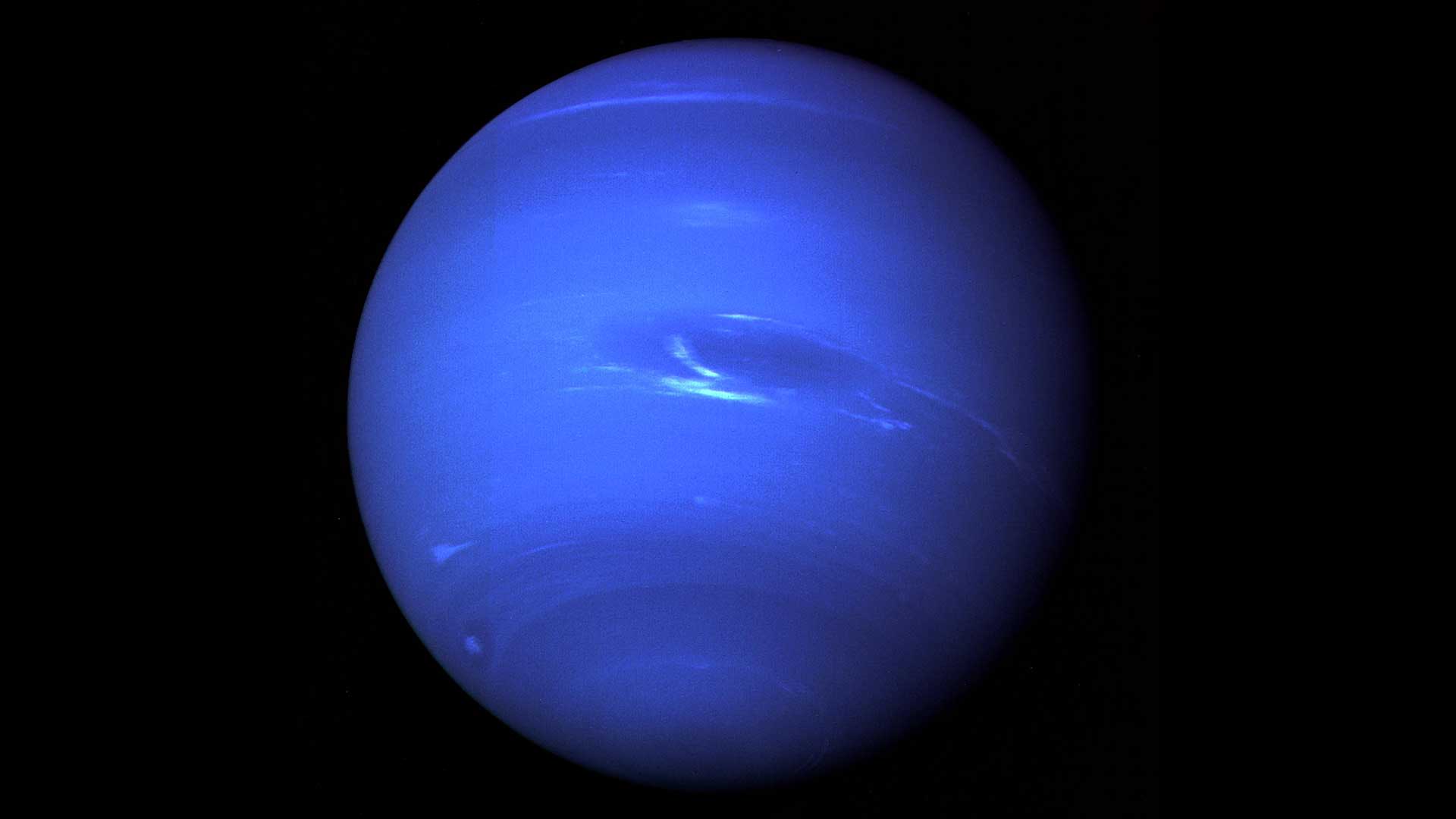
Neptune receives only about one nine-hundredth of the sunlight available at Earth, yet it sends substantially more energy back into space than that remote sunlight can supply. Measurements from Voyager 2 put its total thermal emission at 2.61 plus or minus 0.28 times the solar power the planet absorbs.
The familiar “about 2.5 times more” description needs one important boundary. The measured ratio is roughly 2.5 times as much total outgoing energy, not the absorbed sunlight plus another 2.5 times on top. Subtracting the solar contribution leaves an internal excess around 1.6 times the absorbed power.
That is clear evidence of heat escaping from inside Neptune. It is not evidence for one identified hidden furnace. Scientists still have to explain how much energy remains from the planet’s formation, whether other processes contribute, how the heat crosses the deep interior and why broadly similar Uranus releases so much less.
The calculation starts with sunlight that is absorbed
Neptune travels around the Sun at an average distance of about 30 astronomical units, or 4.5 billion kilometres. Light intensity follows an inverse-square law, so moving 30 times farther away reduces the available sunlight to roughly one part in 900. NASA describes high noon on Neptune as comparable to dim terrestrial twilight.
Not all of that faint light warms the planet. Some is reflected by clouds and haze. A quantity called Bond albedo measures the fraction returned to space in every direction and across all wavelengths. The denominator in Neptune’s famous heat ratio is the sunlight left after reflection, averaged over the globe and its orbit.
“Receives” in the headline is therefore convenient shorthand for absorbed solar power, not every photon that reaches the top of the atmosphere. Researchers compare that absorbed input with the planet’s outgoing thermal infrared radiation. If the second number is larger, the difference must be supplied from within.
Voyager found a planet warmer than sunlight predicts
Voyager 2’s infrared interferometer spectrometer and radiometer observed Neptune from pole to pole during the 1989 encounter. A 1991 analysis by John Pearl and Barney Conrath combined those measurements with observations of reflected light to derive an orbital-average Bond albedo of 0.290 plus or minus 0.067.
That albedo and Neptune’s distance produced a solar-equilibrium temperature of 46.6 plus or minus 1.1 kelvin, or about minus 226.6 degrees Celsius. This is the temperature a simplified planet would need in order to radiate exactly the energy it absorbed from the Sun.
Neptune’s measured thermal spectrum instead yielded an effective temperature of 59.3 plus or minus 0.8 kelvin, about minus 213.9 degrees Celsius. A gap of 12.7 kelvin may not sound large. Radiated power, however, rises with the fourth power of absolute temperature, so the difference becomes the 2.61 energy ratio.
The result remains the canonical measurement, but it is not infinitely precise. Voyager made one fast flyby. Its broad thermal coverage was excellent for an encounter, while the albedo calculation still had to combine limited spacecraft viewing angles with earlier observations. No orbiter has since mapped Neptune’s full energy budget through seasons.
The absolute heat flow is smaller than the ratio sounds
Neptune’s intrinsic heat flux is about 0.43 watts per square metre. That is the average internal contribution crossing each square metre of the planet, separate from reradiated sunlight. The large ratio arises partly because the solar input at 30 astronomical units is extremely weak.
For scale, Earth absorbs globally averaged solar power of roughly 240 watts per square metre. Neptune’s internal flux is tiny beside that. It dominates the local balance only because the distant Sun supplies so little energy.
The planet is therefore not a blazing body wrapped in an icy disguise. Its visible clouds and upper atmosphere remain deeply cold, and the escaping energy is infrared radiation that human eyes cannot see. The striking result is that a modest internal flow has persisted for 4.5 billion years and still exceeds the absorbed sunlight.
Cooling after formation is the leading reservoir
Neptune assembled through collisions, compression and the inward fall of material. Those processes converted gravitational energy into heat. As heavier and lighter constituents separated, additional gravitational potential energy could be released. The young planet began hotter than it is now and has been losing that stored energy ever since.
Slow contraction can continue to convert gravitational energy into heat, while radioactive decay in rocky material makes another contribution. These are broad categories rather than a complete accounting. Planetary scientists do not yet know Neptune’s internal composition and circulation well enough to apportion the observed 0.43 watts per square metre among them.
The word “ice” in ice giant can be misleading here. It refers to water, ammonia and methane incorporated as volatile compounds during formation, distinguishing Uranus and Neptune from hydrogen-rich Jupiter and Saturn. Under current deep-interior pressures and temperatures, those materials may form hot dense fluids, superionic phases and mixtures unlike ordinary frozen ice.
A major review of Uranus and Neptune’s formation and interiors describes many structures compatible with existing observations. Models can contain distinct layers, gradual composition gradients or regions with sharply different abilities to transport heat. Matching mass and radius does not select one unique interior.
Speculative mechanisms do not yet close the account
One frequently repeated proposal is that carbon separates from methane-rich material under pressure, crystallises and sinks. Falling diamond would release gravitational energy, just as any dense material settling deeper does. Laboratory experiments support carbon precipitation under some ice-giant conditions, but they do not establish how much occurs inside Neptune or whether it supplies an important fraction of the measured luminosity.
The same caution applies to other forms of differentiation. Helium rain is used in models of Saturn, and separation of heavier constituents may matter in ice giants, but the relevant mixtures and phase boundaries at Neptune’s pressure remain difficult to reproduce. An appealing mechanism is not yet a measured planetary power source.
Heat generation and heat transport must also be separated. Neptune could retain a large reservoir yet release it slowly, or generate no unusual new heat while convection efficiently carries old energy outward. The energy budget records what crosses the atmosphere today, not the precise depth or process from which it came.
Heat from below helps the weather without fully explaining it
Neptune’s interior supplies energy beneath an atmosphere containing the fastest measured planetary winds. Bright clouds and storm features have been tracked at more than 2,000 kilometres per hour, despite the weak sunlight. Rising internal heat can promote convection, condensation and the atmospheric disturbances that transfer momentum.
Space Daily’s earlier examination of how Neptune sustains its 2,000-kilometre-an-hour jets found that internal heat is only one part of the answer. The planet’s roughly 16-hour rotation organises motion into east-west bands. Waves and turbulent eddies move momentum, while the absence of a solid surface removes the mountain and landscape drag familiar on Earth.
A heat flux is not a speedometer. Faster winds do not follow automatically from more watts per square metre, and Uranus also has strong jets despite a much weaker internal supply. Researchers still debate how deep Neptune’s winds extend, where they gain momentum and how rapidly their kinetic energy is dissipated. Internal heat makes activity easier to sustain; it does not by itself derive the observed circulation.
Uranus is quiet by comparison, not heatless
Uranus and Neptune are near twins only in broad outline. Both are close to four Earth radii wide and contain hydrogen, helium and a much greater proportion of heavy elements than Jupiter or Saturn. Neptune is more massive and denser. Uranus rotates almost on its side, experiences extreme seasons and presents a different atmospheric and magnetic geometry.
For decades, Voyager-era measurements were interpreted as showing that Uranus emitted no significant internal excess. That sharpened the puzzle: two planets in the same general class appeared to have radically different cooling histories.
A 2025 full-orbit analysis of Uranus’s energy budget revised the absolute claim. It found an internal heat flux of 0.078 plus or minus 0.018 watts per square metre, equivalent to about 12.5 per cent of absorbed solar power. An independent 2025 analysis put the total emitted-to-absorbed ratio near 1.15.
As Space Daily noted when examining why parts of Uranus’s atmosphere become colder than Neptune’s, the update means Uranus is not completely heatless. It does not make the twins thermally equivalent. Neptune’s internal flux remains roughly five times stronger, and its internal contribution is about 162 per cent of absorbed sunlight rather than 12.5 per cent.
The difference may lie in how one planet traps heat
A giant impact is one proposed dividing event. The collision invoked to explain Uranus’s extreme tilt may have expelled some primordial energy, rearranged the interior or created composition gradients that later inhibited cooling. Simulations do not yet identify one impact history that explains every observation, and alternatives can reproduce the tilt.
Stable stratification is another leading family of explanations. In an efficiently convecting fluid, warm material rises and cooler material sinks, carrying energy outward. If density increases downward because composition changes with depth, a parcel warmed from below may still be too heavy to rise. Deep heat can then remain trapped behind a slowly conducting boundary.
Uranus may contain a larger inhibited region, while Neptune may be more thoroughly mixed or possess a less restrictive thermal boundary. They could also have started with different rock-to-volatile ratios and initial energy budgets. Current gravity and magnetic measurements permit multiple versions of all these ideas.
This is why the energy contrast does more than distinguish two atmospheres. It is an indirect probe of billions of years of interior evolution. Any successful model must explain not only today’s radius and gravity, but also how one planet kept a strong outward flux while its neighbour became comparatively reluctant to cool.
One spacecraft encounter still anchors the comparison
Voyager 2 passed Uranus in January 1986 and Neptune in August 1989. It remains the only spacecraft to visit either planet. Space Daily’s account of the two unfinished ice-giant encounters explains why modern interior models still depend so heavily on brief flybys.
Earth-based observatories and telescopes such as Hubble and Webb can follow clouds, seasons and atmospheric composition. They cannot make the repeated close gravity passes, global magnetic mapping and direct atmospheric sampling available to an orbiter and probe.
A dedicated Neptune mission could measure thermal emission across latitude and time, improve the Bond albedo, map the gravity field and determine how deeply the winds penetrate. An atmospheric probe could connect cloud-level temperatures and composition to the planet below. Voyager 2 transformed Neptune from a telescopic point into a world, but it could not watch that world long enough to close its energy account.
The mystery is therefore not whether Neptune possesses internal heat. Its excess infrared radiation answers that. The uncertainty lies in what its deep interior contains, where the remaining energy is stored, how it escapes and why Uranus suppresses so much more of its own.
Thirty times farther from the Sun than Earth, Neptune is warmed mostly from the wrong direction for an ordinary climate: from below. The faint output is enough to separate two apparent twins and expose how little a similar size and colour can reveal about the histories hidden inside planets.