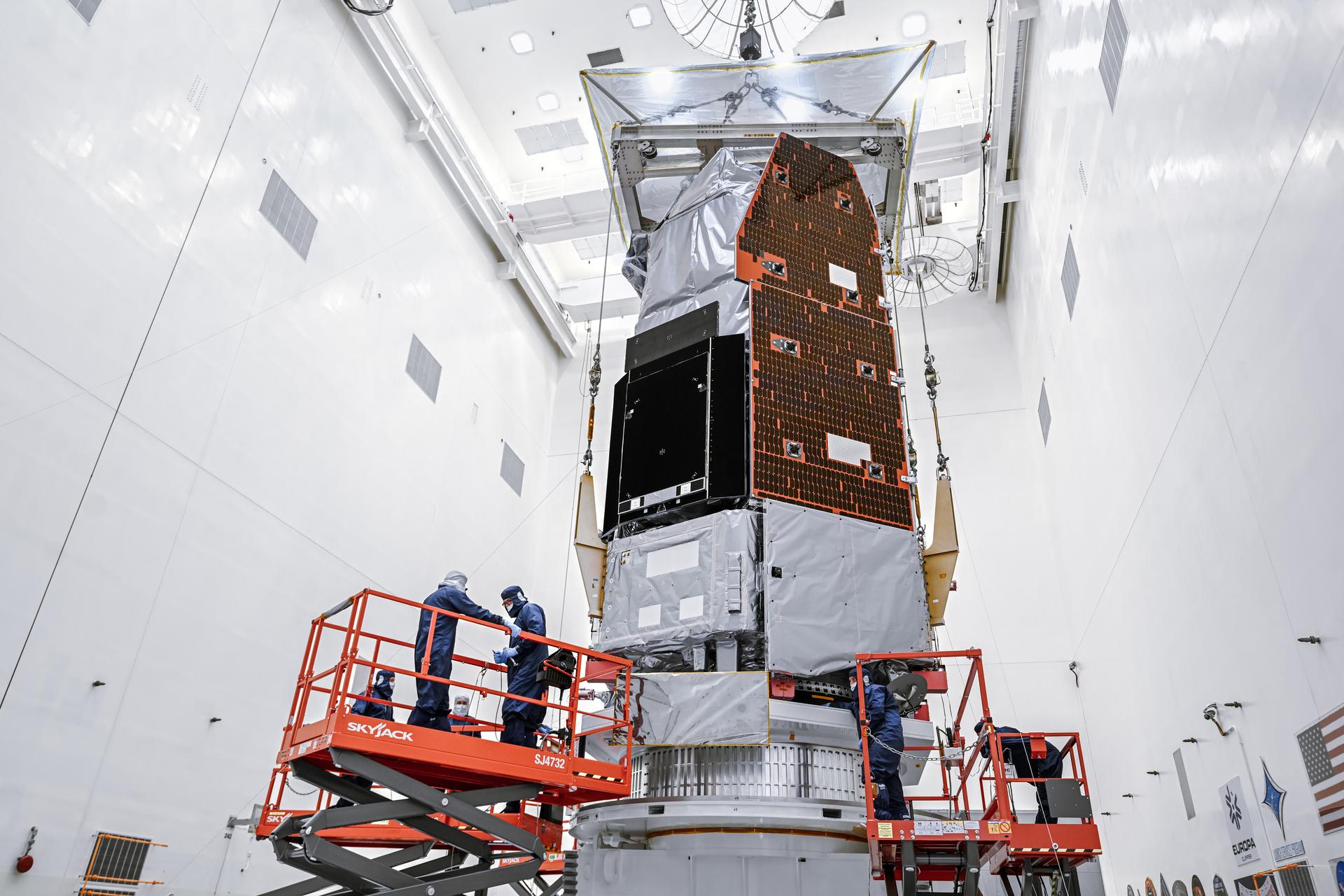
On 30 August 2026, a SpaceX Falcon Heavy is scheduled to carry NASA’s Nancy Grace Roman Space Telescope away from Kennedy Space Center. NASA currently lists liftoff at 7:26 am EDT, or 11:26 UTC. If launch and commissioning proceed as planned, Roman will begin a five-year survey mission built around an unusual combination: a Hubble-sized primary mirror and a camera that sees at least one hundred times more sky in each exposure.
That wide view is why NASA says Roman could reveal around 100,000 planets, compared with nearly 6,300 confirmed when the agency published its latest forecast in May. The enormous number is not a promise of 100,000 Earth twins and not a list of confirmed worlds already waiting to be announced. It is a projected transit yield from repeatedly watching an exceptionally crowded region of the Milky Way.
August 30 is the official target, not a guaranteed liftoff
NASA’s current Roman mission page gives an exact launch time of 7:26 am EDT on Sunday, 30 August, from Launch Complex 39A at Kennedy Space Center in Florida. Falcon Heavy will send the telescope toward the second Sun-Earth Lagrange point, L2, about 1.5 million kilometres from Earth.
The observatory reached Kennedy in June after teams completed assembly and testing ahead of the mission’s older May 2027 commitment date. SpaceDaily covered Roman’s arrival in Florida and the move to an August launch. Technicians then performed final servicing, fuel loading, rehearsals and integration work.
Launch dates can still move because of weather, rocket readiness or a late technical issue. “Set to launch” means that August 30 is NASA’s live target and the date on its countdown. It does not mean the launch has already cleared every condition that will exist on the morning itself.
A mirror the size of Hubble feeds a radically wider camera
Roman’s primary mirror is 2.4 metres across, the same diameter as Hubble’s. Mirror diameter governs how much light a telescope collects and helps set its finest possible angular resolution, but it does not dictate the area of sky recorded by an instrument behind it. That depends on optics and detector layout.
Roman’s Wide Field Instrument combines 18 infrared detectors into a 288-megapixel focal plane. NASA’s technical mission answers give its field as 0.28 square degrees, a patch larger than the apparent full Moon and at least one hundred times the field of Hubble’s comparable imaging camera. Roman can survey broad areas up to one thousand times faster while retaining similar near-infrared sensitivity and resolution.
The shorthand “100 times more sky in one shot” is therefore a field-of-view comparison. It does not mean Roman will magnify objects one hundred times more or make images one hundred times sharper than Hubble. SpaceDaily previously explored the scale through a simulated survey that showed how Roman could cover one hundred Hubble Ultra Deep Fields in a single view.
The 100,000 forecast comes mainly from planetary shadows
Roman’s Galactic Bulge Time-Domain Survey will point toward the centre of the Milky Way, where stars appear densely packed. It will monitor around 100 million stars for hundreds of days, returning repeatedly to the same fields. The repetition is what turns a panoramic camera into a planet finder.
If a planet’s orbit is aligned nearly edge-on from Earth, the planet crosses the face of its star and blocks a small fraction of the light. Repeated dips reveal the orbital period, and the depth of a dip gives the planet’s size relative to the star. NASA’s May 2026 exoplanet forecast assigns roughly 100,000 worlds to this transit channel.
Short-period giants are the easiest catches. A large planet hides more of its star and completes more transits during a fixed survey, so the predicted haul will be weighted toward hot Jupiters and other close-orbiting worlds. Roman could also detect smaller planets, but the headline number is not a forecast of 100,000 rocky, temperate analogues of Earth.
SpaceDaily described the earlier modelling behind the prediction in its report that Roman could reveal 100,000 transiting planets. The final yield will depend on how common planets really are in the bulge, the adopted survey cadence, detector performance in crowded fields and the ability of analysis pipelines to separate genuine transits from impostors.
Microlensing searches an almost opposite planetary population
The same images will be searched for gravitational microlensing. When a foreground star passes almost exactly in front of a more distant star, its gravity bends and magnifies the background light. A planet around the foreground star can add a brief extra feature to the brightening. The event does not need the planet to transit its own host.
Microlensing is sensitive to worlds at greater orbital distances, including planets as small as Earth or Mars, and to objects beyond the snow line where transit surveys struggle. It can also detect free-floating planets if their gravity briefly magnifies a background star without a host-star signal. NASA currently describes a yield of more than 1,000 microlensing planets, while some mission pages cite about 2,500 under different survey assumptions.
These events can last days, with planetary deviations lasting hours, and the alignment usually never repeats. The evidence and follow-up are therefore different from periodic transits. SpaceDaily’s examination of Roman’s possible rogue-planet harvest explains why its forecasts carry wider uncertainties than a simple count suggests.
A coronagraph tests direct imaging but does not supply the 100,000
Roman carries a second instrument that approaches planets in another way. Its Coronagraph Instrument uses masks to block most of a star’s glare, plus deformable mirrors and active wavefront control to suppress remaining optical errors. Faint reflected light from a giant planet or dusty disk can then be separated spatially from the star.
The coronagraph is a technology demonstration, not the engine behind the 100,000-world forecast. Its initial campaign comprises pre-planned observations spread through the first year and a half. The main goal is to prove high-contrast techniques in space and prepare a path for later observatories designed to image smaller planets around nearby Sun-like stars.
Roman will therefore find or study planets through three distinct channels. Transits should generate the huge close-orbit census. Microlensing reaches cooler, wider and unbound worlds. The coronagraph will examine a limited set of nearby giant planets and disks directly. Combining their raw counts without labels would hide the different questions each technique can answer.
More than every earlier telescope combined is true only in one sense
NASA said nearly 6,300 exoplanets had been found by missions and partner observatories when it published the 100,000 estimate. If Roman detects anything close to its projected transit total, its candidate haul will exceed the present confirmed catalogue by roughly a factor of sixteen. No previous planet-hunting observatory has approached that number in one mission.
But the comparison places a forecast beside a confirmed historical count. A dimming signal is not automatically a planet. Eclipsing binary stars, background objects blended into the same pixel, detector effects and stellar variability can imitate transits. Roman teams are preparing synthetic datasets, automated searches and machine-learning filters, yet many candidates will still need statistical validation or observations from other facilities.
Microlensing events create a separate challenge because they generally cannot be replayed. Researchers infer a lens system from the shape, duration and colour behaviour of one alignment. Roman’s stable images and uninterrupted monitoring should make those inferences much stronger than most ground-based measurements, but not every event will produce a uniquely determined planet.
The camera also has a universe beyond planets to survey
Exoplanets occupy only part of Roman’s mission. Its high-latitude surveys will measure hundreds of millions of galaxies, supernovae, galaxy clustering and weak gravitational lensing. Those observations are designed to trace how cosmic structure grew and how the expansion of the Universe changed over time, testing explanations involving dark energy and the behaviour of gravity on the largest scales.
The wide camera is the common tool. Repeated imaging that watches stars dim also catches exploding stars and changing galactic nuclei. Deep fields that map galaxy shapes reveal foreground asteroids and distant stellar populations. NASA expects the mission to collect around 20 petabytes during its five-year primary phase, with processed data released without an exclusive-use period.
This breadth is why Roman complements rather than replaces Hubble or Webb. Hubble and Webb can spend long exposures dissecting smaller fields and individual targets. Roman is designed to locate populations, map their environment and supply statistically selected objects that other telescopes can examine in detail.
Launch starts a journey, not the science catalogue
After liftoff, Roman must deploy, communicate with the ground, travel to L2 and complete orbit insertion and commissioning. Its million-mile vantage point keeps the Sun, Earth and Moon on the shielded side of the telescope, supporting the cool, stable conditions required for infrared surveys. The launch-day clock is the start of that process, not the date of the first planet announcement.
Once observations begin, ground systems are designed to receive about 1.4 terabytes of science data each day. Algorithms must measure tiny brightness changes across crowded fields, issue transient alerts, build calibrated images and separate astrophysical signals from instrument behaviour. The scale of that analysis is as central to Roman’s discovery rate as the glass and detectors in space.
Roman’s promise is repetition at scale: Hubble-like detail across fields Hubble would need a large mosaic to cover, revisited often enough for shadows and gravitational flashes to disclose worlds. If real flight data support the forecasts, the mission will not merely enlarge the exoplanet list. It will turn a catalogue dominated by the Sun’s neighbourhood into a map of planetary populations across the Milky Way.