JWST found a compact red source called MoM-BH*-1 whose light began travelling when the universe was about 660 million years old. It looked oddly star-like in its spectrum, yet the team’s model put its total output at roughly 100 billion times the Sun’s luminosity. No ordinary star can sustain that.
The preferred explanation is a feeding black hole surrounded by an extraordinarily dense envelope of hydrogen. The headline’s word “realised” compresses months of observation and modelling into one beat. Webb measured the light. Astronomers then asked what physical arrangement could produce it.
SpaceDaily covered the object’s scale and discovery evidence in detail yesterday. I do not want to repeat that article under a new title. The more useful question here is narrower: how can hydrogen make a black hole look like a star?
This is one paper, not settled consensus. The “black hole star” picture is the authors’ best-fitting interpretation, not a direct image of a cocoon with a dark object visible inside it.
Webb saw a break in the spectrum, not a cocoon
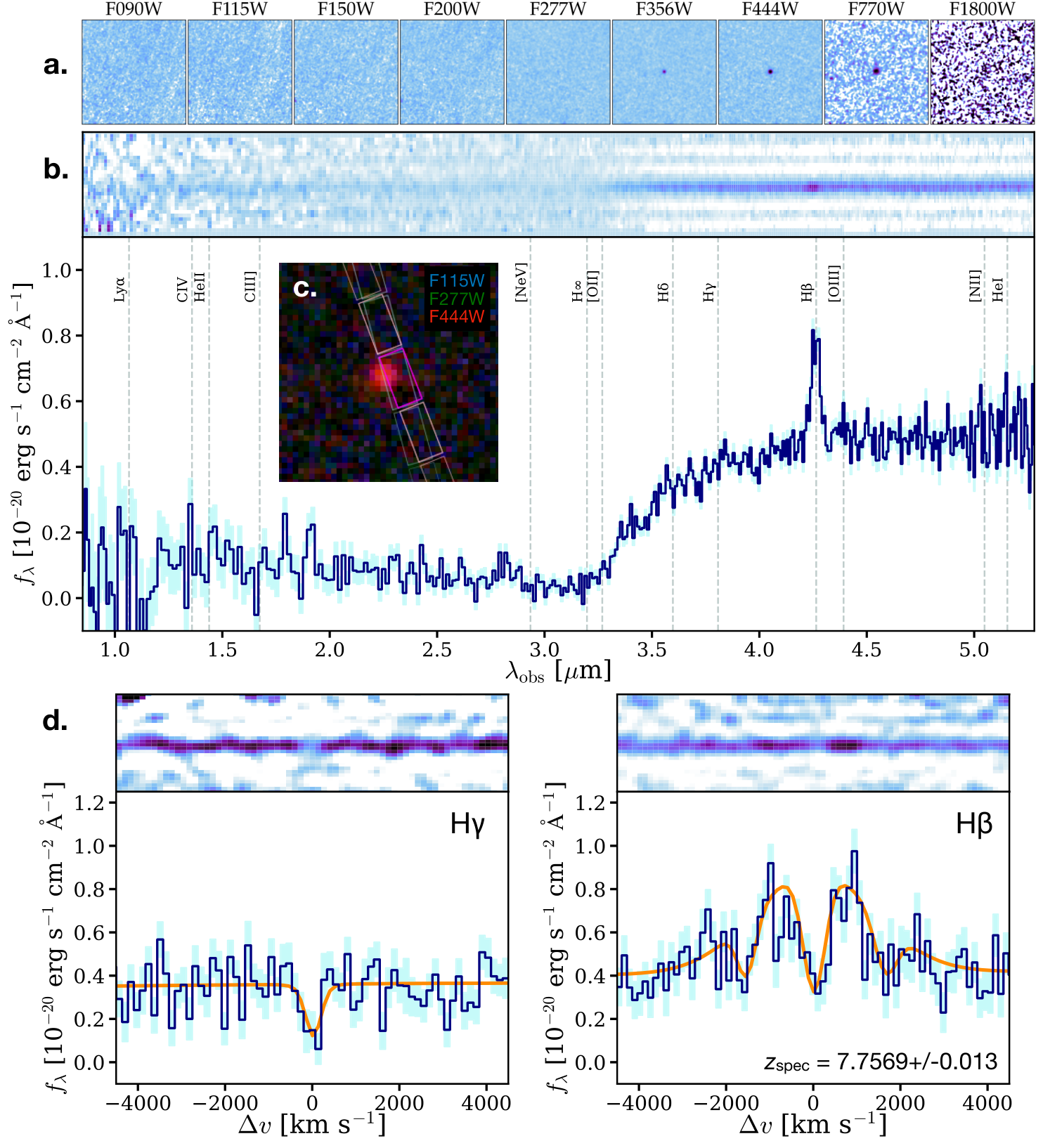
MoM-BH*-1 first stood out because it was bright in Webb’s longer-wavelength filters and nearly vanished in shorter-wavelength ones. A 4.5-hour observation with the telescope’s NIRSpec instrument showed why. Between observed wavelengths of three and four micrometres, the measured flux dropped by more than a factor of 20.
This feature is called the Balmer break. Stellar populations produce it when hydrogen in stellar atmospheres absorbs light around a characteristic wavelength. But the break in MoM-BH*-1 had a measured strength of 7.7. According to the peer-reviewed Nature paper led by Rohan Naidu, a typical dust-free stellar population should peak around 3. Even an extreme population made entirely of A-type stars should remain below 5.
The source also showed broad hydrogen emission together with deep hydrogen absorption. That combination was the clue. A normal collection of stars struggled to explain all of it at once.
Dense hydrogen can manufacture a stellar disguise
A normal star pays for its light through nuclear fusion. MoM-BH*-1 appears to use gravity. Gas falling towards the central black hole heats up and releases energy before crossing the event horizon. The black hole itself remains dark.
The surrounding hydrogen then transforms the escaping radiation. In the team’s preferred model, the gas reaches a density of about 100 billion particles per cubic centimetre, with a turbulent velocity near 500 kilometres per second and an enormous column between us and the centre. Hydrogen absorbs, scatters and re-emits the original light until the spectrum develops a blackbody-like shape, a deep Balmer break and absorption lines associated with stellar atmospheres.
The NASA spectrum comparison makes the effect easier to see. The dense-gas model follows both the broad shape of the observed light and several hydrogen features. Very little dust is needed. In this interpretation, the source looks red mainly because gas is opaque at particular wavelengths, not because dust has reddened an otherwise ordinary object.
Where the figure of 100 billion Suns comes from
The paper gives a bolometric luminosity near 1044.5 ergs per second. Converting that value produces a little over 80 billion solar luminosities, so “roughly 100 billion times the Sun” is a fair order-of-magnitude description.
It is not a brightness read directly from one Webb filter. Bolometric luminosity estimates the power across the full spectrum, and here it follows from integrating the modelled spectral energy distribution. That distinction matters because the same model also changes how much power astronomers think is hidden at wavelengths they did not measure directly.
Luminosity alone would not reveal what sits at the centre. The case for a black hole comes from the full combination: enormous power, broad emission, dense-gas absorption, compact appearance and a hint of variability.
The hidden black hole is inferred, not directly seen
The preferred calculation places the hydrogen over roughly 10 to 100 astronomical units, with a representative model extending about 40 AU. That is wider than Neptune’s orbit. Webb did not resolve a crisp surface at this scale. It only established that the source was point-like below roughly 100 parsecs, millions of times larger than the proposed envelope.
Naidu’s team selected the fit from a grid containing close to a million models, but the authors explicitly call the exercise simple and idealised. The gas may not be spherical. Its internal structure could be convective, and the original spectrum from the accretion flow may differ from the assumed one.
To my reading, the strongest conclusion is that an ordinary stellar population cannot comfortably account for the spectrum. A gas-wrapped black hole explains several difficult features together. The exact anatomy inside that unresolved point remains a model to test.
Why this may clarify the Little Red Dots
JWST has found many compact, red early-universe sources known as Little Red Dots. Their broad lines suggest accreting black holes, yet their colours and weak X-rays have resisted the familiar picture of an active galactic nucleus hidden by dust.
A separate Nature study of Little Red Dots found broader evidence for young supermassive black holes inside dense ionised cocoons. MoM-BH*-1 may be unusually useful because its host galaxy contributes little to the observed light, allowing the central component to be examined with less contamination.
That does not make every Little Red Dot the same object. It gives astronomers a concrete spectral template. If future sources repeatedly show the same extreme Balmer break, absorption and gas-driven redness, the hydrogen cocoon will move from an elegant explanation for one object towards a recognisable stage in early black-hole growth.
For now, Webb has supplied the spectrum. The enormous star is the disguise, and the black hole inside it is the physical model that currently makes the disguise work.