

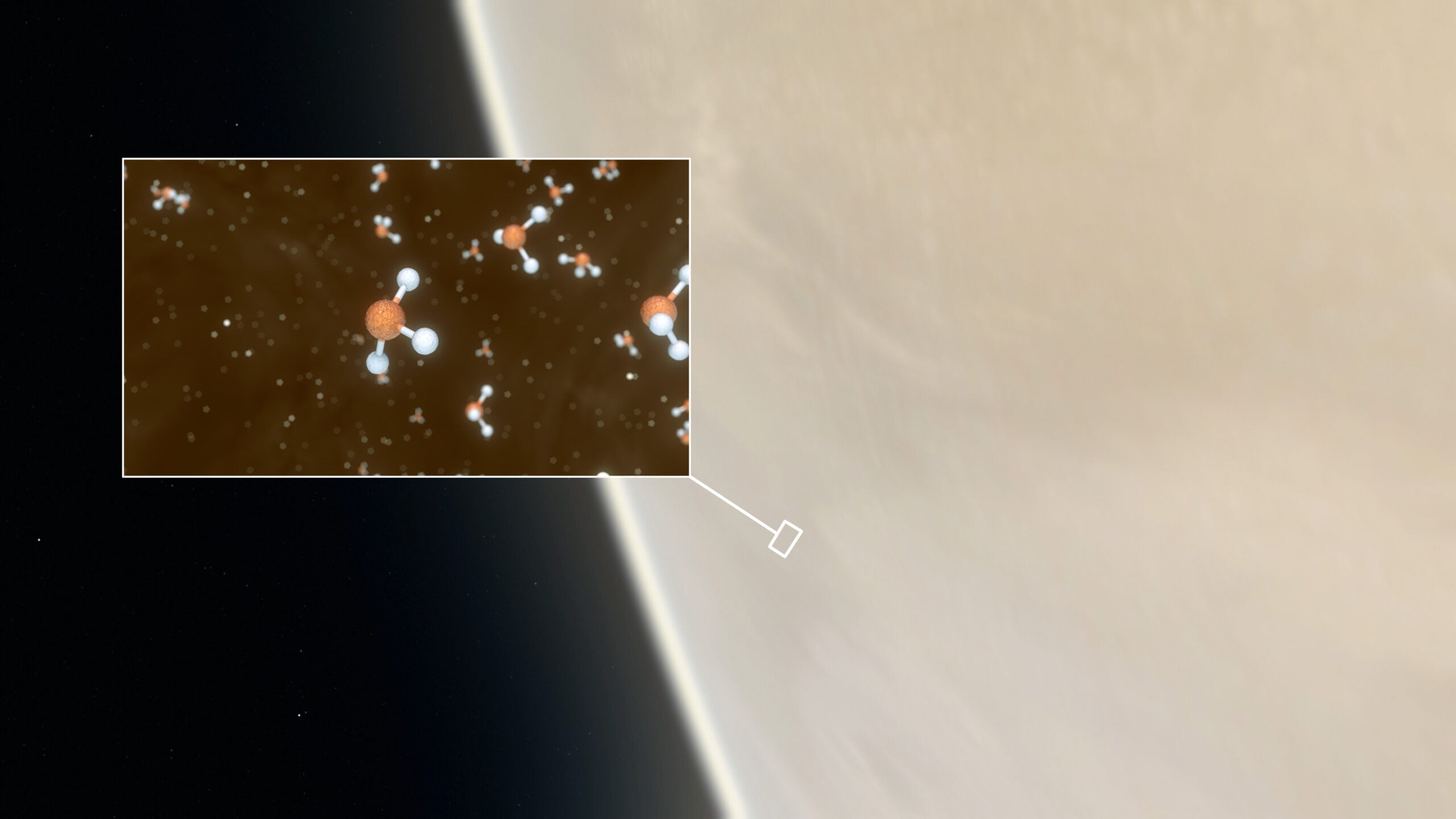
The phosphine argument at Venus did not end when the original result was challenged. Reprocessed ALMA observations, a disputed reanalysis of SOFIA data and a far larger monitoring programme with the James Clerk Maxwell Telescope have all recovered candidate signals.
That makes the 2020 finding harder to dismiss as one bad spectrum. It does not make phosphine universally accepted, and it does not establish life in the clouds.
Three questions are often compressed into one: whether the absorption feature is real, whether phosphine is the molecule causing it, and whether phosphine, if present, has a biological source. The evidence for each is different.
Why the 2020 detection was vulnerable
Jane Greaves and colleagues reported in Nature Astronomy in September 2020 that they had found an absorption line near 266.94 gigahertz in 2017 JCMT data and 2019 observations from the Atacama Large Millimeter/submillimeter Array. They attributed it to phosphine, or PH3, and initially inferred roughly 20 parts per billion.
Venus is an unusually bright and difficult millimetre-wave target. ALMA staff subsequently found a calibration ripple and released a corrected dataset. Independent groups argued that the line was not statistically significant, that the baseline fitting could generate a false feature, or that a nearby sulphur dioxide line offered a conventional identification.
Space Daily covered the sulphur dioxide case in January 2021. A separate Nature Astronomy analysis led by Geronimo Villanueva found no significant phosphine in its reduction of the ALMA data. Other telescopes returned upper limits.
This was more than reflexive scepticism. The feature was weak, instrumental ripples were larger than it, and phosphine and sulphur dioxide absorb at nearby frequencies.
The signal has nevertheless kept coming back
The original collaboration recovered the ALMA feature after observatory recalibration using several reduction methods. In a 2022 Monthly Notices of the Royal Astronomical Society paper, Greaves and colleagues estimated that sulphur dioxide contributed no more than about 10 per cent of the JCMT absorption and less than 2 per cent in the cleaner ALMA region they studied.
SOFIA observations initially yielded a strict upper limit. Greaves’s group then removed calibration-load signals it considered non-essential and reported a 5.7-sigma candidate in Geophysical Research Letters, corresponding to about three parts per billion above the clouds.
The largest new dataset comes from JCMT-Venus. A 2026 proceedings paper by Imperial College London’s David Clements says the programme was awarded 200 observing hours and had used about 100. Its first campaign alone produced 140 times as much information as the original discovery dataset.
A Fourier-based method recovered narrow phosphine and HDO lines. An experimental technique also recovered broad wings that, if correctly attributed, imply roughly 0.3 parts per million of phosphine near 55 kilometres altitude.
That is substantial follow-up, with an important limitation: it is not fully independent confirmation. The researchers and analyses overlap heavily with the original team. Clements also writes that much of the processing remains unfinished, and that reflections inside the telescope system produce baseline ripples whose amplitudes exceed the expected absorption lines.
Mixed results may contain a pattern, or another warning
Detections and upper limits do not necessarily sample the same atmosphere. They probe different altitudes, times and portions of a planet whose clouds circle it in only a few Earth days. Greaves and colleagues have proposed that sunlight destroys phosphine, explaining why stronger candidates appear on Venusian mornings and weak signals or upper limits appear after longer daylight exposure.
It is an interesting, testable pattern. It is not yet an established atmospheric cycle.
The same record also shows how sensitive the answer can be to calibration, baseline removal and the selected region of Venus’s disc. Recovering a dip at the expected frequency strengthens the detection case, but the cleaner test would find other phosphine transitions at mutually consistent abundances, preferably through independent reductions.
The chemical gap does not point uniquely to life
Phosphine forms without biology deep inside Jupiter and Saturn, where pressure and temperature drive chemistry unavailable on Venus. In the oxidising environment of a rocky planet, phosphorus should instead favour phosphates and other oxidised compounds.
A 2024 review led by William Bains considered volcanism, lightning, meteorites, gas reactions and photochemistry. It found no demonstrated mechanism that sustains the claimed amounts. It also identified cloud-particle photochemistry as an open abiotic possibility requiring laboratory work.
“No known process” is therefore a statement about the limits of present models and experiments. It does not mean every non-biological reaction on Venus has been excluded.
Life faces its own severe objections. Space Daily’s earlier look at Venusian cloud life found that moderate temperatures and pressures do not solve the extreme acidity and scarcity of biologically available water. Producing phosphine and sustaining a cell are separate problems.
A probe should not have to infer the answer from one faint line
The case has a clear parallel with the possible dimethyl sulphide signal at K2-18 b. As our recent coverage explained, a molecule associated with terrestrial life is not a life detection when the spectral identification and alternative chemistry remain disputed.
Venus at least offers a way beyond remote spectra. A descent probe can sample gases at known altitudes and look for several phosphorus-bearing compounds at once. It can also measure the acidity, water and surrounding chemistry needed to interpret any phosphine it finds.
Five years of follow-up have left the claim stronger than a single announcement and weaker than a consensus. The candidate signal keeps returning. So do legitimate questions about the instruments, the altitude and the chemistry that could put it there.