

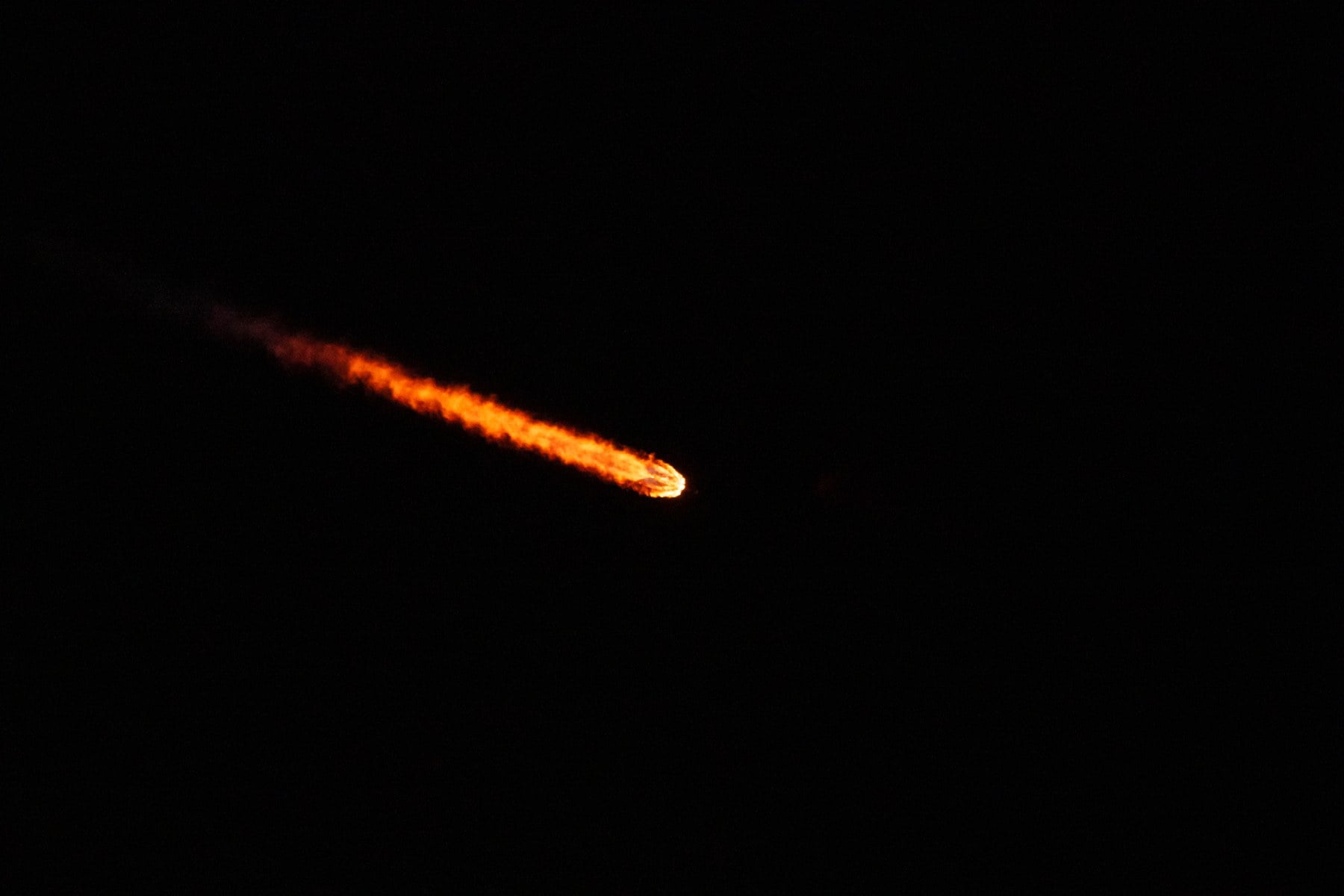
At 04:01 UTC on 19 August 2026, a Falcon 9 rose from California carrying 24 more Starlink satellites. About an hour later, their deployment appears to have pushed SpaceX’s broadband constellation through another threshold: more than 11,000 Starlinks circling Earth.
The number needs a definition and a timestamp. Some of those spacecraft are still climbing toward operational orbit, while others are descending toward reentry. Independent catalogs also update on different schedules. But the scale is no longer ambiguous. A single commercial network now represents roughly two-thirds of the world’s active satellites.
That concentration has arrived with startling speed. Starlink’s first full batch launched in May 2019, when fewer than 2,000 active satellites of every kind were in orbit. Seven years later, one constellation contains more than five times that entire earlier population.
The launch that appears to have crossed 11,000
The Starlink Group 17-50 mission lifted off from Space Launch Complex 4 East at Vandenberg Space Force Base. Its 24 satellites were scheduled to separate from the Falcon 9 upper stage about 61.5 minutes after launch.
It was SpaceX’s 100th mission of 2026 and its 97th Falcon 9 flight of the year. The first-stage booster, B1097, completed its 12th flight and landed on the drone ship Of Course I Still Love You roughly eight and a half minutes after liftoff.
The threshold can be reconstructed from recent public counts. Before the 11 August Starlink 10-19 launch, a report citing orbital tracker Jonathan McDowell put 10,939 Starlinks in orbit. That mission added 29. Starlink Group 17-49 added another 24 on 12 August, and Group 17-50 supplied 24 more.
Straight addition produces 11,016. The true live count can differ by several spacecraft because Starlinks reenter regularly and trackers revise classifications as new objects are cataloged. The defensible claim is therefore that the August 19 deployment pushed the in-orbit fleet past the 11,000 line, not that 11,016 will remain its exact total.
“In orbit” and “operational” are different counts
A stack of newly released Starlinks is in orbit, but it is not instantly part of the working network. Satellites begin in a relatively low deployment orbit, undergo checks and use onboard propulsion to move toward their assigned planes. Some fail before reaching them. At the other end of the lifecycle, retired satellites remain in orbit while lowering themselves toward destructive atmospheric reentry.
Jonathan McDowell’s Starlink statistics distinguish several states, including objects in operational orbit, those raising or lowering their orbits, failures and reentries. His phase-plane plots include only satellites classified as being in operational orbit.
This explains why contemporary reports may say “nearly 11,000 operational satellites” even after a launch takes the total physically in orbit above 11,000. Launched, deployed, in orbit, active and operational orbit are not interchangeable labels.
There is no contradiction in saying the constellation crossed 11,000 in orbit while acknowledging that fewer than 11,000 may have been service-ready at the same moment. One is a location count. The other is an operational judgment.
Where the two-thirds comparison comes from
The cleanest recent denominator is Look Up’s second-quarter space index. Published in June 2026, it counted 15,711 active satellites, including 10,365 Starlinks. That made Starlink 65.97 percent of the active total.
Both sides of that fraction have changed since June. SpaceX has added hundreds of spacecraft, but China, Amazon Leo and other operators have also launched satellites. An exact August percentage would require a single catalog applying one operational definition to every fleet on one timestamp.
“Roughly two-thirds” is therefore the honest scale description, not a claim that precisely 66.67 percent were working Starlinks at 04:01 UTC. It also compares active payloads, not every tracked object. Rocket bodies and debris pieces are excluded, as are satellites judged no longer functional.
SpaceDaily’s earlier analysis of the 10,000-Starlink milestone emphasized the same boundary. Satellite totals are snapshots compiled under stated rules. The concentration remains clear even when reasonable catalogs differ at the margins.
From fewer than 2,000 satellites to one network of 11,000
At the start of 2019, the global active-satellite population was below 2,000. Starlink’s first full batch of 60 launched that May. By June 2026, the active population had grown almost eightfold, and Starlink alone had become more than five times larger than the entire global active fleet of early 2019.
Falcon 9 reuse made the launch cadence possible. Standardized satellites could be manufactured in series and packed by the dozens onto rockets whose first stages repeatedly returned to fly again. In 2026, 74 of SpaceX’s first 100 missions were devoted to Starlink.
The constellation is not simply accumulating forever. Earlier spacecraft are being retired, failed vehicles descend under atmospheric drag, and newer versions replace older ones. Starlink is a continuously refreshed network, so maintaining and expanding it requires a persistent stream of launches.
That churn is another reason “11,000” should be understood as a threshold rather than a permanent inventory. It marks the scale of the system despite the traffic moving through it.
One network now changes the workload for everyone
The benefits of scale are the reason Starlink exists. A dense low-orbit network can offer lower-latency internet to ships, aircraft, rural communities, disaster zones and other places that are difficult to reach with terrestrial infrastructure. A satellite moving beyond one user’s horizon can hand the connection to another passing overhead.
The shared costs also scale. Operators must screen more conjunctions, coordinate maneuvers and dispose of failed spacecraft safely. Astronomers must work around more bright trails and radio transmissions. A low orbit helps by allowing atmospheric drag to remove satellites over time, but a dead spacecraft cannot maneuver during the interval before it reenters.
SpaceDaily recently examined how McDowell’s independent catalog became a reference point for this new environment. The need for such tracking grows when one fleet changes by dozens of objects in a single launch and by hundreds over a few weeks.
Object count is still only one measure of influence. It does not represent mass, bandwidth, scientific value, military capability or economic importance. A compact Starlink and a large weather satellite each add one to the count. Yet counts matter for traffic management because every spacecraft is another object whose orbit must be predicted.
The exact number will move; the concentration will remain
Some of the 24 satellites launched on August 19 will take time to reach their working planes. Meanwhile, older Starlinks will reenter and another launch will push the gross total higher. A responsible live count must always say when it was measured and what qualified.
The 11,000 milestone nevertheless captures a durable change. The world’s largest constellation is larger than every other active satellite fleet combined. Decisions made by one company about altitude, collision avoidance, brightness, reliability and disposal now shape low Earth orbit more than any single operator’s choices have before.
Seven years ago, that future was still a proposal measured in planned shells. On 19 August 2026, it became a network of more than 11,000 physical spacecraft overhead. The round number will quickly become outdated. The structure of the orbital population it reveals will not.