

On the evening of June 16, 2026, a Falcon 9 lifted off from Vandenberg Space Force Base carrying twenty more Starlink satellites, and by the time the second stage released its payload into low Earth orbit, SpaceX had crossed a threshold no company or nation had ever approached: more than 10,000 working Starlink satellites circling the planet, each one about the size of a folded ping-pong table, each one traveling at roughly 27,000 kilometers per hour, each one belonging to a constellation owned by a single man. That launch was the 1,500th Starlink of 2026 alone, and it happened during the first week SpaceX traded as a public company.
The math of what Elon Musk now owns above your head is difficult to hold in your mind. Roughly two out of every three active satellites in orbit around Earth are Starlinks. Not two out of three American satellites. Two out of three, period — counting every weather satellite, spy satellite, GPS satellite, communications satellite, science probe, and student cubesat operated by every government and company on the planet.
How one company outnumbered everyone else combined
For most of the Space Age, the count of working satellites in orbit grew slowly. In 2010 there were roughly 1,000 operational satellites total, the accumulated work of every space program since Sputnik in 1957. That number had taken more than half a century to build.
Then Starlink began launching in 2019, and the curve bent almost vertical. SpaceX now flies a Falcon 9 loaded with 20 or more Starlinks roughly every four or five days from Vandenberg or the Cape. In the first six months of 2026, the company launched more than 1,500 Starlink satellites, running ahead of even 2025’s record pace. That single half-year output is greater than the total number of active satellites operated by any country other than the United States.
The rest of the field has not stood still. OneWeb has assembled a few hundred birds. China is racing to build the Guowang and Qianfan constellations. Amazon’s Project Kuiper is beginning to fly. But the gap is a canyon. As of mid-2026, everyone else combined — every government, every rival telecom, every scientific mission — accounts for roughly one satellite for every two that carry the Starlink logo.
The 100,000-satellite ambition
Ten thousand is not the target. It is a waypoint. SpaceX has already filed an application with the U.S. Federal Communications Commission for permission to operate as many as 100,000 third-generation Starlink satellites — a fleet an order of magnitude larger than the current one, and roughly fifteen times the number of active satellites in orbit from all sources combined.
Each Gen3 satellite will be heavier and more powerful than the current V2 Mini design, built to be lofted by Starship rather than Falcon 9. The V2 Minis flying now weigh about 800 kilograms each. The Gen3 satellites are expected to weigh close to 2,000 kilograms, carry laser links for satellite-to-satellite routing, and deliver something on the order of a terabit per second of bandwidth per craft.
The application is not a promise that 100,000 will fly. It is a bid for spectrum and orbital shells, filed with the regulatory foresight of a company that intends to be the only one still occupying that altitude when the paperwork clears. Even a fraction of that fleet — 30,000, say — would still make Starlink larger than the sum of every other operator on Earth for the foreseeable future.
What one Starlink actually is
The physical object doing the work up there is unglamorous. A current V2 Mini Starlink is a flat panel roughly 2.7 meters long, folded up like a slim briefcase during launch and then unfurled into a solar array once it reaches its operational shell around 550 kilometers up. Its business end is a phased-array antenna facing Earth, capable of steering dozens of beams electronically to individual ground terminals — the pizza-box-sized dishes bolted to farmhouse roofs in Montana and Ukrainian command posts and Antarctic research stations.
Each satellite is designed to last about five years before its krypton-fueled Hall-effect thrusters can no longer keep it in position against atmospheric drag. When that day comes, ground controllers command a deorbit burn, and the satellite plunges back into the upper atmosphere and burns up on reentry. The design goal is that essentially nothing reaches the ground.
That five-year lifespan is important to understand. Starlink is not a fleet of satellites the way GPS is a fleet. It is a river. To hold the constellation steady at 10,000 birds, SpaceX must launch roughly 2,000 replacements every year forever, plus additional launches to grow the network. To hold it at 100,000 would require launching, on average, 20,000 satellites per year just to replace the ones falling out.
The traffic problem no one has solved
Low Earth orbit is not empty. It is a thin shell of space perhaps a few hundred kilometers thick where every object, working or dead, is moving at orbital velocity relative to every other. A one-centimeter fleck of paint at that speed hits with the energy of a hand grenade.
The U.S. National Academies flagged the risk to spacecraft from meteoroid and orbital debris more than a decade ago, when the total operating population was a small fraction of what it is now. Since then, the density of tracked objects in the shells Starlink occupies has climbed sharply. Every Starlink is equipped with an autonomous collision-avoidance system that consumes conjunction data from the U.S. Space Force and nudges the satellite out of the way when a close pass is predicted.
SpaceX has said its satellites now perform tens of thousands of avoidance maneuvers every six months. That figure will only rise as the constellation grows and as Chinese and other megaconstellations begin filling adjacent shells. A February 2026 report on orbital debris warned that the trajectory of current launch cadences is pushing certain altitudes toward the density at which a Kessler-style cascade — where debris from one collision triggers others — becomes plausible within decades.
SpaceX’s engineers argue that Starlink’s low altitude is a feature, not a bug: anything at 550 kilometers will fall on its own within five to ten years if left untended, so the shell self-cleans. Critics point out that this only works if every operator plays by the same rules, and that no international body currently has the authority to force them to. The emerging field of space sustainability is essentially the study of how to prevent that assumption from failing.
What the constellation actually does on the ground
Starlink has more than 5 million subscribers in more than 100 countries as of mid-2026. The service delivers broadband to places terrestrial fiber has never reached — Chilean mountain villages, Kenyan farming cooperatives, ships in the middle of the Pacific, remote scientific outposts on every continent. It has also become a strategic infrastructure inside active war zones, most visibly in Ukraine, where Starlink terminals have functioned as the backbone of frontline communications since 2022.
That dual-use nature is part of what makes the concentration of ownership so unusual. No previous piece of global communications infrastructure has been simultaneously so extensive, so essential to civilian internet access in poor regions, and so directly controlled by one private individual. The undersea cables that carry most of the world’s internet traffic are owned by consortia of telecoms and hyperscalers. GPS is a U.S. military system. The Iridium constellation, which used to be the largest in orbit at 66 satellites, is a public company with dispersed institutional ownership.
Starlink, until June 2026, was a wholly owned subsidiary of SpaceX, which was itself private and controlled by Musk. Even after the recent public offering, the founder’s voting control remains overwhelming. This is the situation the phrase “one man’s network” is doing real work to describe. The dependency runs deep enough that NASA itself has no American-built way to reach the ISS except SpaceX’s Dragon capsule, a parallel monopoly in human spaceflight that formed on roughly the same timeline.
What the sky looks like now
Astronomers noticed first. Beginning around 2020, wide-field astronomical images started showing bright streaks — Starlink trails crossing the frame during long exposures. The Vera C. Rubin Observatory in Chile, designed to survey the entire visible southern sky every few nights, has had to build software specifically to identify and mask Starlink tracks. SpaceX has cooperated on darkening coatings and sunshades, and the newer satellites are dimmer than the first-generation ones, but the sheer number now means that during twilight, at any given moment, dozens of Starlinks are visible somewhere above the horizon to the naked eye.
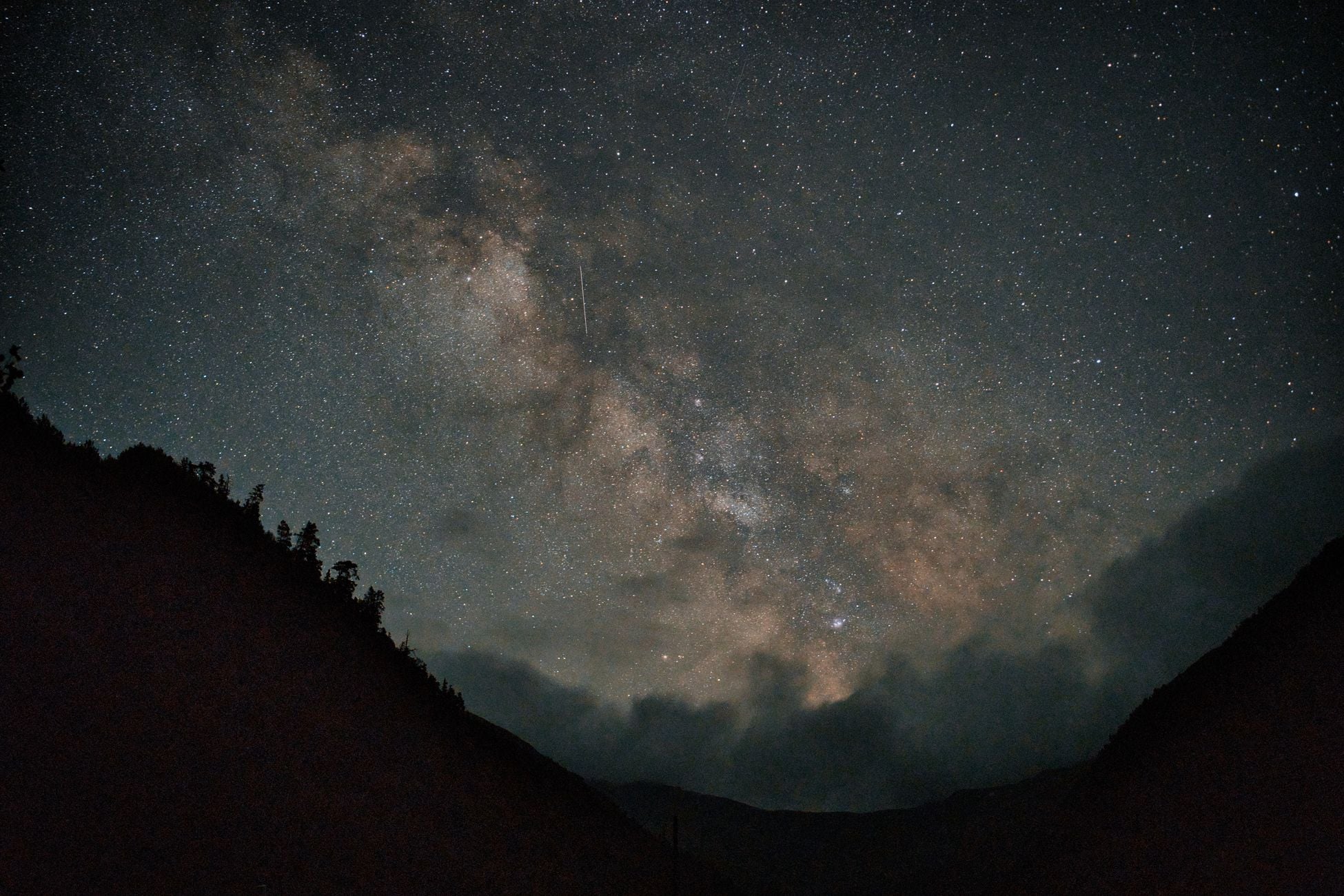
Step outside on a clear night an hour after sunset, look up, and you will almost certainly see one within a few minutes — a steady white point moving faster than an aircraft, not blinking, not turning, just sliding across the constellations on a straight line. If you catch a fresh launch you may see a whole train of them, twenty in a row, like beads on an invisible wire, still bunched from deployment before they spread out into their operational slots.
Those pinpricks of reflected sunlight are the physical expression of a fact that is still difficult to absorb: the sky above every human being on Earth is now, by a two-to-one margin, patrolled by satellites owned by a single company. A century after the first radio broadcasts crossed national borders and half a century after Sputnik, the low frontier of space has quietly become the private property of one enterprise, with the paperwork already filed for ten times more.