
Humanity has sampled Jupiter directly along a single falling line.
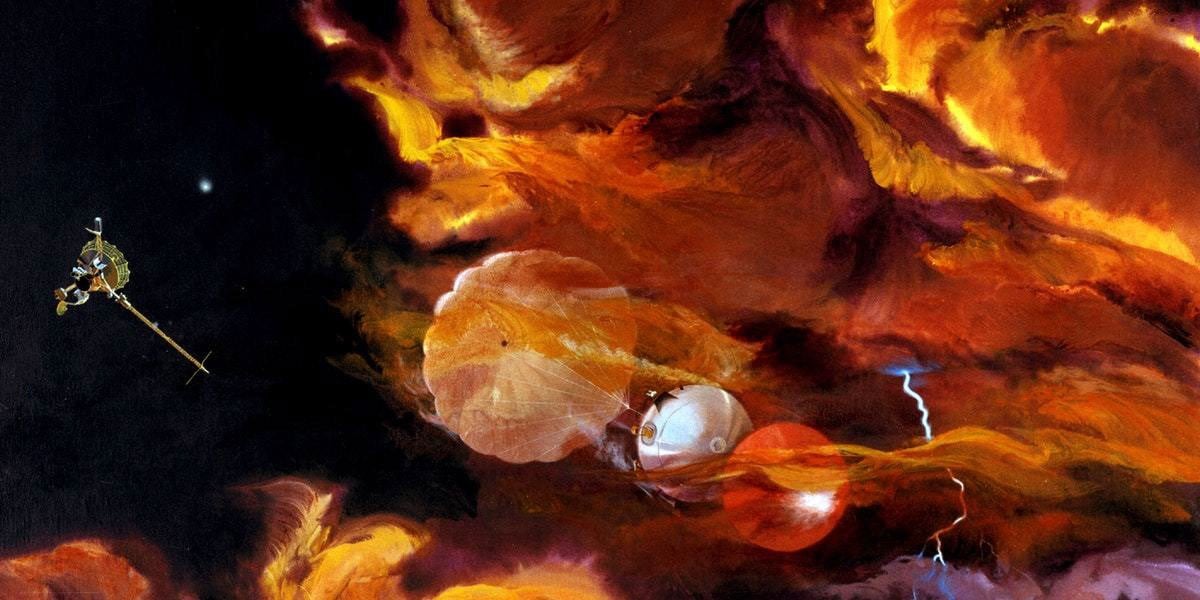
On 7 December 1995, a 337-kilogram probe released by NASA’s Galileo spacecraft hit the giant planet’s upper atmosphere at 47.4 kilometres per second. It survived a deceleration of roughly 228 g, discarded its heat shield, opened a parachute and began sending measurements to the Galileo orbiter overhead. The scientific transmission lasted 57.6 minutes, which is normally rounded to 58.
Nothing has repeated that experiment. Every spacecraft observation of Jupiter before and since has been made remotely, from an orbiter, a flyby trajectory, a telescope near Earth or a telescope in space. Galileo remains our only instrumented descent through the clouds of a planet about 11 Earths wide. Yet its path crossed one very particular piece of Jovian weather: a dry, cloud-poor clearing near 6.5 degrees north.
That leaves Jupiter science with an unusually instructive problem. The probe gave us the most direct measurements we possess, while its landing point made some of those measurements among the least safe to generalise. Both statements are true.
The 58 minutes were a data window, not the instant of destruction
The familiar summary says that Galileo transmitted for 58 minutes before Jupiter destroyed it. That captures the brutal direction of the journey, but not its timing.
A NASA technical account records 57.6 minutes of relayed science data. NASA’s more detailed mission chronology says the orbiter stopped receiving the probe by 6:19 p.m. Eastern time. The agency estimates that the descending machine was fully vaporised at about 3 a.m. the following morning, several hours after the useful signal ended.
Another NASA mission summary places transmitter failure 61.4 minutes after entry, at a depth of about 180 kilometres and a pressure of 22.7 atmospheres. The few-minute difference arises because the science relay did not begin at the first instant of atmospheric contact. “Fifty-eight minutes” refers to the measurement interval, not an observed moment when the hardware was crushed.
The distinction does not soften what happened. The probe had no surface on which to land and no path back out. As Space Daily has explained in another look at Jupiter’s interior, continuing downward means encountering hotter, denser hydrogen until no ordinary spacecraft can survive. Galileo was designed to keep its instruments alive only long enough to return a vertical slice of the upper atmosphere.
It was a small laboratory falling into a planet
Galileo’s entry was one of the harshest controlled atmospheric arrivals ever attempted. Its initial speed exceeded 106,000 miles per hour. The heat shield reached about 16,000 degrees Celsius, hotter than the visible surface of the Sun, as the probe turned motion into heat and slowed hard enough to subject the vehicle to roughly 228 times Earth’s gravity.
Once through that violent opening, the probe separated from the protective hardware and descended under a parachute. Six instruments then turned the fall into a compact atmospheric observatory. They recorded pressure, temperature, acceleration, winds, incoming and outgoing light, lightning and radio emissions, cloud particles, and the identities and abundances of gases.
The archive from the atmospheric structure instrument reaches to roughly 24 bars and about 160 kilometres below the nominal entry level, only around 0.22 percent of Jupiter’s radius. The Planetary Data System record shows how the descent slowed from about 400 metres per second after parachute deployment to around 30 metres per second near the end. The mass spectrometer sampled the atmosphere over approximately 0.5 to 21 bars. The nephelometer shone light through surrounding particles to determine where clouds existed and how dense they were.
This was not a fleeting snapshot in the ordinary sense. It was a tightly coordinated set of instruments sampling the same changing column, with measurements linked by altitude, pressure and time. The limitation was geographic, not analytical: an immensely detailed sounding at one latitude and longitude.
The probe had entered Jupiter’s version of a desert
Galileo’s entry site was inside a feature known as a five-micron hot spot. The term is easy to misread. It does not merely mean a warm spot in the everyday sense. At wavelengths near five microns, clouds normally block thermal radiation rising from deeper levels. A relatively clear patch lets more of that radiation escape, so it looks bright in infrared images.
These clearings are tied to atmospheric circulation. Descending air warms and dries, which inhibits condensation and thins the clouds that would otherwise hide the warmer layers below. Galileo had not been aimed at this particular feature. Winds and uncertainties accumulated during the long cruise shifted the entry point, and the probe arrived near the southern edge of one.
The instruments encountered far fewer cloud particles than the expected textbook stack of ammonia ice, ammonium hydrosulfide and water clouds suggested. The peer-reviewed nephelometer analysis in the Journal of Geophysical Research reported tenuous cloud structures and an unusually particle-free environment over much of the measured pressure range. A separate Icarus analysis of the composition data found that water remained below three percent of the solar abundance at 12 bars and interpreted the site as a dry downdraft.
That first result created a temptation to treat Jupiter itself as unexpectedly water-poor. But images from the orbiter supplied the missing map. In 1997, the Galileo team reported that other areas were much moister and described the entry point as the “Sahara Desert of Jupiter”. The probe had measured the atmosphere correctly. The early mistake was asking one exceptionally dry column to represent the planet.
Some findings were weather; others reached back to Jupiter’s formation
Calling Galileo’s sample unrepresentative can itself become an overcorrection. Not every result is equally sensitive to local clouds.
Water, ammonia, hydrogen sulfide and condensate particles can vary strongly with rising and sinking air. Their abundance at a particular pressure may reflect local circulation, evaporation and cloud formation rather than Jupiter’s well-mixed bulk composition. In these cases, the hot spot matters enormously.
Noble gases and certain isotope ratios tell a different kind of story. Galileo directly measured helium, neon, argon, krypton and xenon, along with isotopic information that remote telescopes find difficult or impossible to obtain with the same certainty. These species do not all condense into Jupiter’s ordinary weather clouds. Their patterns remain evidence for the materials and temperatures involved when the planet assembled.
The probe also tracked its motion through the surrounding air. A 1996 Science paper on the Doppler wind experiment found a high-speed jet near six degrees north, with winds increasing below the visible clouds before becoming approximately constant. The result helped establish that Jovian jets are not simply thin markings painted across the cloud tops.
This is the useful split: Galileo’s local meteorology should be treated as local, while its direct chemical and dynamical measurements must be judged species by species and instrument by instrument. “One dry spot” is a warning label, not a reason to discard the archive.
Juno changed the context without replacing the probe
NASA’s Juno orbiter arrived at Jupiter in 2016 carrying a microwave radiometer capable of looking below the visible clouds. Unlike Galileo’s probe, it does not touch or ingest the atmosphere. It senses microwave emission across several wavelengths, allowing researchers to infer water and ammonia at depth over a much wider area.
At the equator, Juno measured more water than Galileo had at its entry site. A 2020 Nature Astronomy analysis found an equatorial water abundance around 2.7 times the protosolar oxygen abundance, while stressing that the result did not yet establish a global value. NASA’s accompanying Juno science update made the remaining difficulty plain: even below the cloud tops, Jupiter’s atmosphere is not necessarily well mixed.
Juno has also revealed a deep ammonia cycle involving narrow downwellings, shallow lightning and ammonia-rich slushballs sometimes called mushballs. Those results give physical mechanisms for moving volatile material through the atmosphere rather than leaving it in neat horizontal layers. An earlier Space Daily report on the Juno findings describes how strongly this circulation can complicate a simple reading of cloud chemistry.
That is progress, but not a replacement. Juno offers breadth and repeated coverage. Galileo offered direct contact, precise local calibration, particle counting and mass spectroscopy. Remote sensing can reveal how exceptional the 1995 column was; it cannot retroactively turn one physical sample into several.
One column is both more and less than it sounds
A common analogy compares Galileo with a weather balloon released over Earth’s Sahara and then used to calculate the humidity of the entire planet. The analogy is useful, especially for water and clouds, but it leaves out how much the probe actually did.
A single balloon over a desert would still give accurate temperatures, pressure changes, winds and local chemistry. It might expose a jet that extends far beyond the launch site. It could measure stable gases carrying information about the atmosphere’s origin. Most importantly, later satellites could place its local profile inside a global map. That is close to the relationship between Galileo and Juno.
The scale mismatch remains severe. Jupiter spans roughly 140,000 kilometres at its equator, and individual belts and storms cover regions comparable to whole terrestrial continents or more. Galileo’s direct measurements followed a track about 160 kilometres deep at one location for less than an hour. The sample was vertically rich and horizontally almost dimensionless.
This is why the mission’s result should not be summarised as either “we measured Jupiter” or “we accidentally measured the wrong place.” We measured one real part of Jupiter with instruments that have never been returned there. The dry hot spot was not a flaw in the data. It was a property of the atmosphere that the data forced researchers to recognise.
A second descent would ask a genuinely new question
A new probe sent into a visibly different circulation regime would not be a ceremonial repeat of 1995. It could test which features of Galileo’s profile recur elsewhere, compare cloud layers under rising and falling air, and give Juno’s microwave measurements another point of direct calibration. Multiple probes entering different belts and zones would be more valuable still.
There would be no easy engineering route. Any successor would face a similarly punishing entry, a brief relay window and an inevitable end deep in the atmosphere. It would also need an orbiter or flyby craft positioned to receive data in real time, because no transmitter buried behind thousands of kilometres of hydrogen can call Earth afterward.
The basic story of Galileo’s 58-minute fall is rightly remembered as an engineering achievement. Its scientific afterlife is more interesting. The mission showed that a direct measurement can be exquisitely trustworthy and geographically misleading at the same time.
For more than thirty years, Jupiter’s only physical atmospheric sample has therefore remained a falling line through a planetary desert. It was enough to overturn models, anchor later observations and expose the depth of the planet’s winds. It was not enough to turn one patch of weather into a world.