
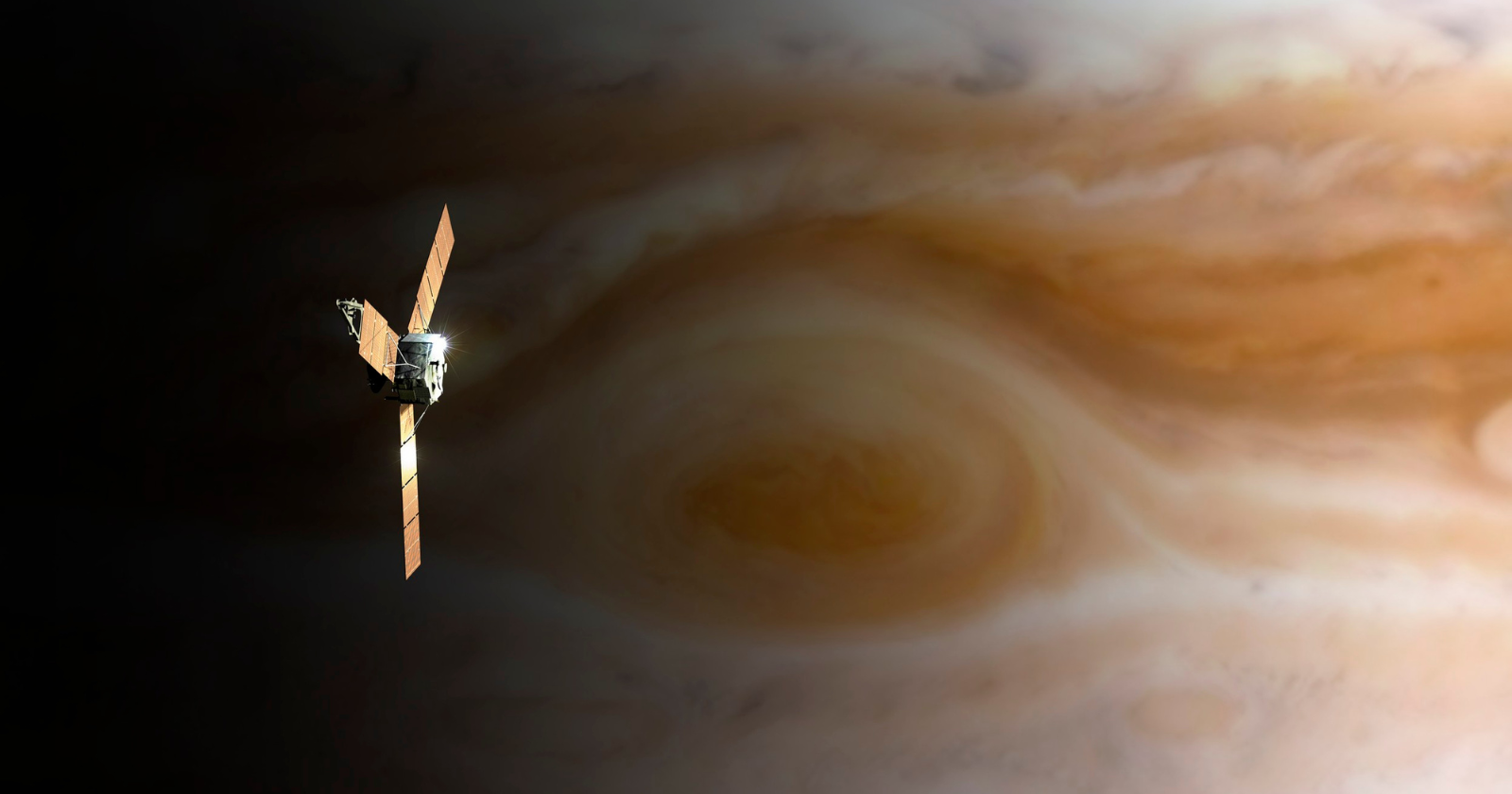
On 7 December 1995, a small probe released by NASA’s Galileo spacecraft entered the atmosphere of Jupiter and transmitted data as it fell. It kept transmitting for about 58 minutes before rising heat and pressure ended the signal. In that time it returned the first measurements ever made from inside the atmosphere of a giant planet.
No spacecraft had done this at Jupiter before, and none has done it there since. The Galileo probe remains the only object humans have ever sent into Jupiter’s atmosphere.
How it got there
The probe did not fly itself to Jupiter. It was carried there by the main Galileo spacecraft, which had launched from the Space Shuttle Atlantis in October 1989 and taken six years to reach the planet.
On 13 July 1995, about five months before arrival, Galileo released the probe and let it coast the rest of the way on its own. The probe had no engine and no guidance. It was aimed, set loose, and left to fall. It was a squat, cone-and-dome shape often described as wok-like, about 1.3 metres across, weighing roughly 339 kilograms, and most of that mass was heat shield.
The heat shield was the point. The probe hit the top of Jupiter’s atmosphere at about 47 kilometres per second, in the region of 170,000 kilometres per hour. Nothing built by humans had entered an atmosphere that fast. In the first couple of minutes, the probe decelerated at more than 200 times the force of Earth’s gravity, and the front of the heat shield reached temperatures around 16,000 degrees Celsius, hotter than the surface of the Sun. Roughly half the heat shield’s mass was burned away in those minutes. Only after that violent slowing, with the probe now below the speed of sound, did it deploy its parachute and begin the measured descent it had been built for.
What it measured on the way down
Under its parachute, the probe fell deep into Jupiter’s upper atmosphere, and its instruments reported as it went.
It carried instruments to measure temperature, pressure, and density, the chemical composition of the atmosphere, cloud structure, the balance of energy flowing up and down through the atmosphere, and electrical activity. It returned a total of about 3.5 megabits of data, relayed up to the Galileo orbiter passing overhead, which stored it and later sent it on to Earth. The probe could not have reached Earth directly. It spoke only to the orbiter, and the orbiter relayed.
Some of what it found was unexpected. The probe had, by chance, entered one of Jupiter’s relatively dry, cloud-free patches, a so-called hot spot, and it detected far less water than predicted. According to the results published in the journal Science in 1996, the descent measurements were consistent with the absence of the deep water cloud that models had anticipated. It also found that Jupiter’s atmosphere was, in places, denser and hotter than the pre-encounter models had assumed, and it measured the abundances of several elements, data that bears on how Jupiter formed. The single entry point is a real limitation, and worth stating plainly. The probe sampled one column of one hot spot, not the planet, and Jupiter’s atmosphere varies from place to place.
How it ended
The probe was never going to come back, and was never meant to. Jupiter has no surface to land on. It is gas at the top, grading into denser and hotter material with depth, with no clear boundary where atmosphere becomes ground.
So the descent had a one-way ending built into it. The deeper the probe fell, the higher the pressure and temperature climbed. The transmission stopped after about 58 minutes. NASA puts the transmitter failure at 61.4 minutes after entry, when the probe was about 180 kilometres below its entry point and the pressure had reached roughly 23 times sea-level pressure on Earth. The usual explanation is that the pressure, and the increasingly hostile conditions around the probe, overwhelmed the transmitter.
That was the end of the data, not the end of the probe’s fall. The probe kept descending after it went silent, into conditions that climbed well beyond what any of its parts could survive. NASA’s estimate is that within a few hours its components had melted and then vaporised entirely, somewhere in the deep atmosphere of the planet. The probe did not so much crash as cease to exist.
What it was, in the end
The 58 minutes are easy to undersell as a brief result for a six-year flight and a spacecraft that took decades to plan. That undersells it. The probe was not built to last. It was built to fall through a place nothing had ever measured directly, and to keep reporting for as long as the descent allowed, and that is exactly what it did.
Almost everything known from direct measurement, rather than from remote observation, about the inside of a giant planet’s atmosphere still traces back to those 58 minutes in December 1995. The Galileo probe is still the only descent probe ever sent into a giant planet. Until another is sent, it is the only one there is.
