
On 30 June 2026, a camera roughly the size of a small car stopped being primarily an engineering project and became the working eye of a ten-year survey.
That was the date the NSF-DOE Vera C. Rubin Observatory formally announced the start of its Legacy Survey of Space and Time, or LSST. From Cerro Pachon in Chile, Rubin is now building a repeatedly refreshed record of the southern sky: a new detailed image about every 40 seconds during nighttime observations, roughly a thousand images on a typical night, and another pass across the survey’s broad southern footprint every few nights.
The numbers make Rubin sound like an oversized camera with an unusually fast shutter. That undersells it. The observatory is really a linked system of mirrors, sensors, motors, fibre connections, data centres and public software. Its purpose is not merely to photograph the sky. It is to notice when the sky is no longer the same.
A small-car camera weighing three tonnes
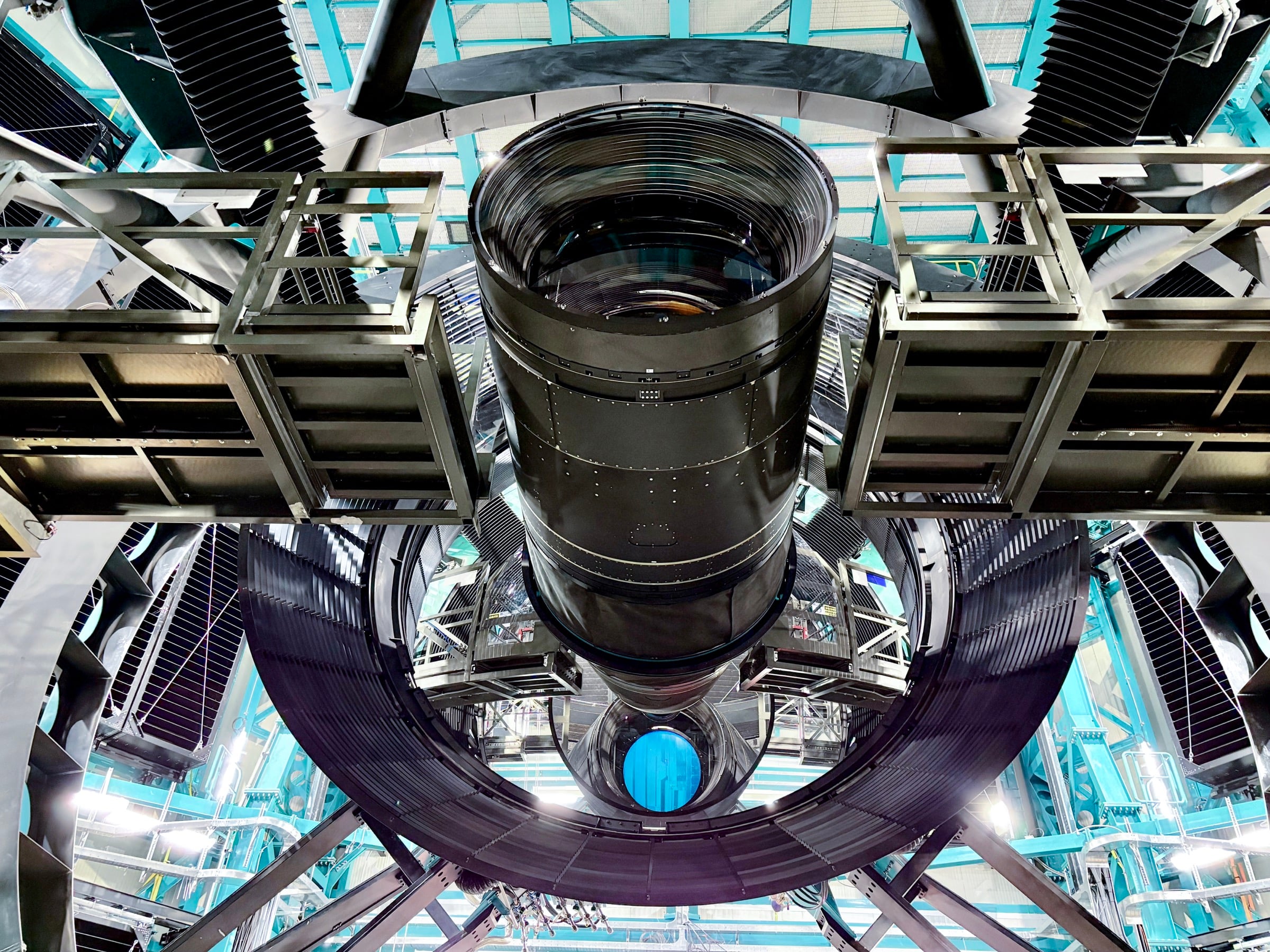
The LSST Camera contains 3,200 megapixels, or 3.2 billion light-sensitive picture elements. It weighs about 3,000 kilograms and is approximately the size of a small car, though roughly twice as heavy. Its focal plane is assembled from 189 charge-coupled devices, while its sensors are held near minus 100 degrees Celsius to reduce spurious bright pixels. Rubin’s camera guide sets out those specifications with an almost comic comparison: a single exposure would need hundreds of ultra-high-definition televisions to display at full scale.
The instrument was built at SLAC National Accelerator Laboratory in California, shipped to Chile in May 2024 and installed on the Simonyi Survey Telescope in March 2025. Space Daily followed the camera’s carefully monitored journey to Cerro Pachon, when the survey was still a promise and engineers were more concerned with whether three tonnes of precision optics had survived a winding mountain road.
Size alone, however, is not Rubin’s defining advantage. Many large telescopes look deeply at narrow pieces of sky. Rubin couples an 8.4-metre telescope to a very wide field and a mount able to move rapidly between fields. Approximately every 40 seconds, including exposure, readout and repositioning, the system is ready with another enormous image.
Over ten years, the plan is to return to each point in the survey footprint about 800 times. That repetition turns a collection of pictures into something closer to a time series. The sky is not captured all at once, and poor weather, daylight, the Moon and seasonal visibility still apply. “The entire southern sky every few nights” is survey shorthand for repeatedly covering the accessible southern footprint, not a claim that one exposure somehow sees a hemisphere.
The survey began in June, but the alerts began in February
One chronological distinction is easy to miss. Rubin had already taken commissioning images and started sending alerts before 30 June. On the night of 24 February 2026, it distributed about 800,000 scientific alerts to researchers worldwide. The observatory’s account of that first alert night described supernovae, variable stars, active galactic nuclei and moving Solar System objects among the detections.
The June date marks the formal start of the ten-year LSST, after system optimisation and an operational review of image quality, survey speed, calibration, reliability and data performance. In other words, the camera did not suddenly take its first picture on 30 June. That was when the completed observatory moved from testing and early operations into the long, consistent observing programme on which much of its scientific value depends.
This matters because a ten-year survey is only as useful as its continuity. A brilliant first month cannot reveal a slow stellar dimming that takes six years, establish the long orbit of a faint body beyond Neptune, or supply the uniform measurements needed to test subtle cosmological effects. Rubin’s headline feature is speed, but its deeper asset is speed sustained long enough to create history.
What seven million alerts actually means
The expected peak of seven million alerts a night does not mean seven million discoveries. An alert is deliberately more modest: Rubin has found a statistically significant change between a new exposure and its prior view of the same field.
The processing system aligns and calibrates each new image, then compares it with a template built from earlier observations in the same colour filter. Subtract the template from the new frame and much of the unchanging sky disappears. What remains may be a new point of light, a star that has brightened, an asteroid that has shifted position, an active galaxy that has flickered, or an imaging artifact. For each qualifying change, Rubin can issue a public alert within about two minutes of taking the image.
That is why “alert” should not be read as “emergency” either. Most notifications will concern ordinary but scientifically useful variability. Some objects will generate repeated alerts on different nights. Some signals will already be known. A fraction will be false detections that quality controls and later analysis remove. The seven-million figure describes the scale of a change-detection stream, not seven million wholly new things appearing in the Universe before breakfast.
No person could inspect that stream manually. Rubin sends it to community alert brokers, software services that match detections against catalogues, analyse their light curves and assign possible classifications. Researchers can then ask for a manageable subset: likely young supernovae, fast-moving objects, unusual variable stars, or sources near a recent gravitational-wave location. Rubin’s public guide to the alert stream is unusually clear about the brokers’ role. The telescope notices change; the brokers make that change searchable.
A movie with gaps, filters and revisits
Calling LSST a ten-year time-lapse is helpful so long as we do not imagine an ordinary film. Rubin does not stare continuously at one fixed scene. It moves among fields, uses six broad colour filters over the course of the survey, and revisits a given area according to a carefully optimised schedule. The result is closer to a vast set of interleaved flipbooks than one smooth video.
That structure is scientifically useful. Changes over minutes and days can reveal explosions, flares and moving asteroids. Repeated measurements over months and years show longer cycles, subtle motions and slow changes. Multiple exposures can also be combined, allowing astronomers to pull out objects too faint to stand confidently above the noise in one frame.
Rubin’s early work has already shown how productive that combination can be. During roughly six weeks of optimisation observations, the observatory reported more than 11,000 previously unknown asteroids, including 33 near-Earth objects and 380 trans-Neptunian objects. Space Daily recently covered the first peer-reviewed asteroid study based on LSST Camera data, including an unusually fast-spinning main-belt object found before the main survey had formally started.
Those early totals are evidence that the system works, not a promise of identical discovery counts every six weeks. Survey yield depends on where Rubin looks, observing conditions, object brightness, follow-up work and the definition of a new object. A detection becomes durable knowledge only after its measurements survive checking and, often, confirmation by other observations.
Four programmes sharing one stream of images
Rubin was designed around four broad scientific programmes: cataloguing the Solar System, mapping the Milky Way, exploring the changing sky, and investigating dark matter and dark energy. The same exposure can contribute to more than one of them.
An image taken partly to trace how galaxies are distributed across the Universe can contain an asteroid moving through the foreground. A series used to measure a variable star can also improve a map of the Milky Way. A supernova alert may prompt another telescope to collect a spectrum while Rubin’s archive preserves what the region looked like before the explosion.
The observatory’s name connects its broad survey directly to one of those long-term questions. Vera Rubin and Kent Ford measured galaxy rotation in enough detail to show that stars far from galactic centres were moving much faster than visible matter could explain. As our earlier account of Rubin’s rotation-curve work noted, she did not invent the idea of missing mass, but her observations supplied some of its most persuasive evidence. The observatory named for her will approach the problem statistically, using billions of galaxies and repeated measurements of how matter bends light and structures grow.
The telescope includes a trip to California
Rubin collects about ten terabytes of image data each night. That material travels from Chile to the US Data Facility at SLAC in California for initial processing. Software must calibrate the images, compare them with templates, construct alerts and distribute the results quickly enough for other observatories to respond while a short-lived event is still visible.
Seen this way, the telescope does not end at the mountaintop. The fibre links, processing centres, databases and alert brokers are as necessary to time-domain astronomy as the mirror and camera. Without them, Rubin would still take extraordinary images, but the fastest and most temporary events could remain buried until their useful follow-up window had closed.
The arrangement also changes who can take part. Rubin’s world-public alerts can be accessed through its broker network, while larger processed datasets will arrive through scheduled releases. Access to data does not erase the need for computing skill, telescope time or institutional resources, but it distributes the starting material far more widely than an observatory whose images remain with one small team.
The real instrument is repetition
The easiest detail to remember is the car-sized camera. The most consequential number may be 800, the approximate number of visits each point in the survey will accumulate. A single image tells astronomers what was visible. A long, consistently measured sequence can show what changed, when it changed and whether it changed before.
That is where Rubin may be most valuable. The rare supernova caught minutes after appearing will make a fine headline. So will an asteroid passing unusually close to Earth or a distant object behaving in a way no catalogue predicted. But many of the survey’s strongest results will emerge from the ordinary nights between those moments, when the telescope repeats the same disciplined work and extends the baseline by another 40 seconds, another visit, another season.
Rubin is often presented as a machine for finding what nobody has seen. It is also a machine for remembering what the sky looked like before anything seemed important. In astronomy, where the decisive event may happen once and fade before anyone knows to look, that memory is a form of discovery in its own right.