
Vera Rubin did not watch individual stars race around distant galaxies in real time. She and instrument designer Kent Ford split the faint light from glowing gas in spiral galaxies into spectra, measured tiny shifts in emission lines, and used those Doppler shifts to calculate orbital speeds at different distances from each galactic center.
The result was simple enough to draw as a line. Where visible matter predicted that speeds should fall, Rubin’s measurements stayed nearly flat. The outer regions of galaxy after galaxy were moving as though they felt the gravity of far more mass than telescopes could see.
Those rotation curves became some of the clearest evidence that most matter is dark. They did not show what dark matter is, and they did not establish that most of the universe’s total contents are dark matter. In the current cosmological inventory, ordinary matter is about 5%, dark matter about 27%, and dark energy about 68%.
How light became a speed measurement
Rubin joined the Carnegie Institution’s Department of Terrestrial Magnetism in 1965, where Ford had developed an image-tube spectrograph. The device electronically amplified faint spectra and cut exposure times to roughly one-tenth of what ordinary photographic plates required. That made it practical to measure dim regions far from the bright centers of galaxies, where the missing-mass problem was easiest to see.
Gas clouds ionized by young stars emit light at known wavelengths, including the red hydrogen-alpha line. Rotation shifts the light from the side of a galaxy moving toward Earth slightly toward the blue, while light from the receding side shifts toward the red. Correcting those shifts for the galaxy’s tilt and systemic motion yields its rotation speed as a function of radius.
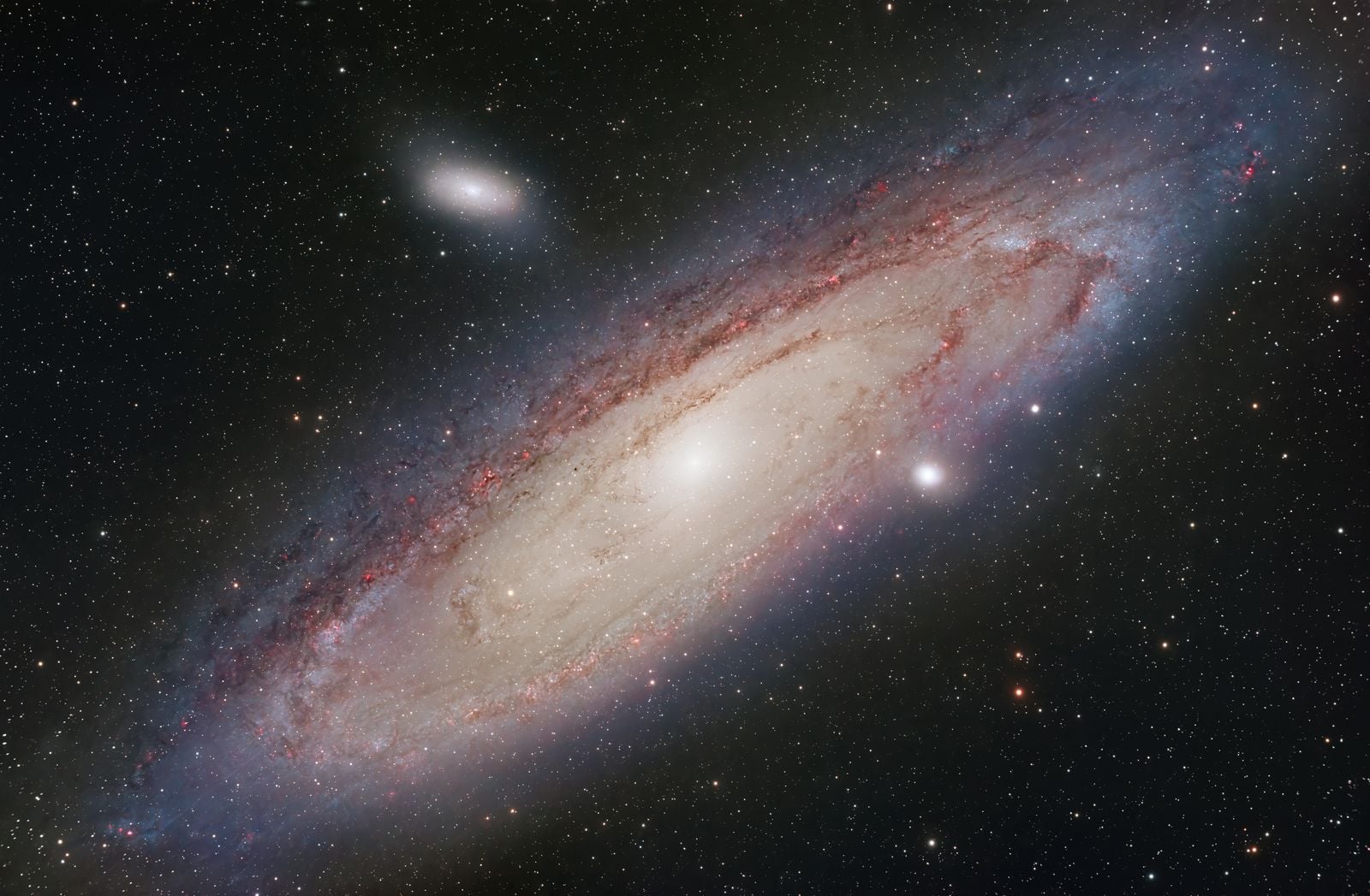
Rubin and Ford applied the method to 67 ionized regions in the Andromeda Galaxy, or M31, spanning distances from about 3 to 24 kiloparsecs from its nucleus. Their 1970 paper in The Astrophysical Journal presented the rotation curve that would become central to Rubin’s scientific legacy.
Why astronomers expected the curve to fall
Orbital motion links speed to gravity. For a roughly circular orbit, the relevant relation can be written as v squared equals G times the mass enclosed within the orbit, divided by the orbital radius. If almost all the mass is concentrated inside the orbit, as it is for planets around the Sun, increasing the radius should make orbital speed decline.
A galaxy is not a point mass. Stars and gas are spread through a disk and central bulge, so the inner rotation curve can rise as more mass is enclosed. Far beyond the brightest part of the disk, however, the visible mass adds up more slowly. If light traced nearly all the mass, the curve should eventually bend downward in a broadly Keplerian decline.
It did not. In Andromeda, and then in many other spiral galaxies, the measured speed remained roughly constant into faint outer regions. A flat rotation curve has a direct mathematical implication: the enclosed mass must continue increasing approximately in proportion to radius even where the visible light is fading.
Under standard gravity, the natural interpretation is an extended halo of non-luminous matter surrounding the bright disk. The outer stars and gas are not moving too fast for gravity. They are moving too fast for the gravity of the matter that emits light.
One galaxy became a systematic result
Andromeda alone could not settle the issue. Its mass distribution might have been unusual, or the measurements could have been affected by geometry and non-circular motion. Rubin, Ford and their colleagues therefore repeated the work across spiral galaxies with different sizes and luminosities.
In 1980, Rubin, Ford and Norbert Thonnard published rotation curves for 21 Sc galaxies, ranging from a compact system with a measured radius of 4 kiloparsecs to UGC 2885 at 122 kiloparsecs under the distance scale used in the paper. The curves differed in detail, but the expected outer decline was generally absent.
The repetition changed the argument. An unexplained curve in one galaxy was an anomaly. The same broad behavior across a carefully observed sample suggested a general property of spiral galaxies.
Rubin was not the first astronomer to infer missing mass. Fritz Zwicky had argued in 1933 that galaxies in the Coma Cluster moved too quickly for the cluster’s visible mass. Horace Babcock measured an unexpectedly high mass-to-light ratio in Andromeda in 1939, and radio observations later traced neutral hydrogen beyond bright stellar disks. Carnegie’s history of Rubin’s work describes her contribution as the sustained optical evidence that made the problem difficult to dismiss.
The curves measured gravity, not a particle
A rotation curve reveals a mismatch between observed motion and the gravity predicted from visible mass. It does not identify the cause of that mismatch. The leading account adds cold dark matter that interacts gravitationally but emits, absorbs and reflects little or no light. In that model, galaxies form inside much larger dark halos.
An alternative changes the law of gravity at the extremely low accelerations found in galactic outskirts. Modified Newtonian dynamics can reproduce many galaxy rotation curves with a close connection between ordinary matter and acceleration. Dark matter remains the dominant framework because it also fits evidence from galaxy clusters, gravitational lensing, the cosmic microwave background and the growth of large-scale structure. Yet Rubin’s curves by themselves measure dynamics; they do not directly detect a dark-matter particle.
That distinction remains important because no proposed dark-matter particle has been conclusively detected in a laboratory. The observational case for missing gravity is much stronger than the evidence for any single particle candidate.
Most matter is not the same as most of the universe
NASA’s current summary of the cosmic inventory assigns about 5% of the universe’s mass-energy to ordinary matter and 27% to dark matter. On that basis, dark matter accounts for about 85% of all matter. The remaining 68% is dark energy, the name given to whatever is driving the accelerated expansion of the universe.
Dark matter and dark energy share the word “dark” because neither has been identified in the ordinary sense. They are not presumed to be the same substance. Dark matter clusters gravitationally around galaxies and helps shape cosmic structure. Dark energy appears smooth on large scales and affects the expansion of space. Rubin’s rotation curves were evidence for the first, not the second.
Her work nevertheless helped establish the broader fact behind the title: the luminous universe is a small fraction of the physical one. Telescopes show where ordinary matter radiates, while motion reveals a much larger gravitational structure around it.
The question survived its strongest early evidence
Rubin died in 2016 without learning what dark matter is. The observatory that now bears her name was chosen because its wide, repeated survey of the southern sky can map invisible mass through weak gravitational lensing and test how cosmic structure changes over time. The NSF-DOE Vera C. Rubin Observatory describes dark matter and dark energy as central targets of its ten-year survey.
The enduring power of Rubin’s result is that it did not depend on seeing the unknown component. She measured visible tracers moving through a gravitational field and showed that the field extended far beyond the light. More than half a century later, the curves remain clear while the identity of the mass that shaped them remains hidden.