

On 7 August, Elon Musk appeared to be writing Ship 40’s obituary at sea. “Unfortunately, ship recovery is not looking good right now,” he posted, as rough conditions complicated an improvised effort to save the Starship upper stage.
Eleven days later, the story had changed. SpaceX announced on 18 August that its recovery team had successfully guided Ship 40 to a location just off Christmas Island after approximately 24 days at sea. Engineers were heading to the remote Australian territory to examine the spacecraft in calmer water before the company attempted to return it to Starbase.
It is a genuine first for the Starship programme. No previous Starship upper stage had returned from space, remained in one recognisable structure after splashdown and then been deliberately brought under control by a recovery team.
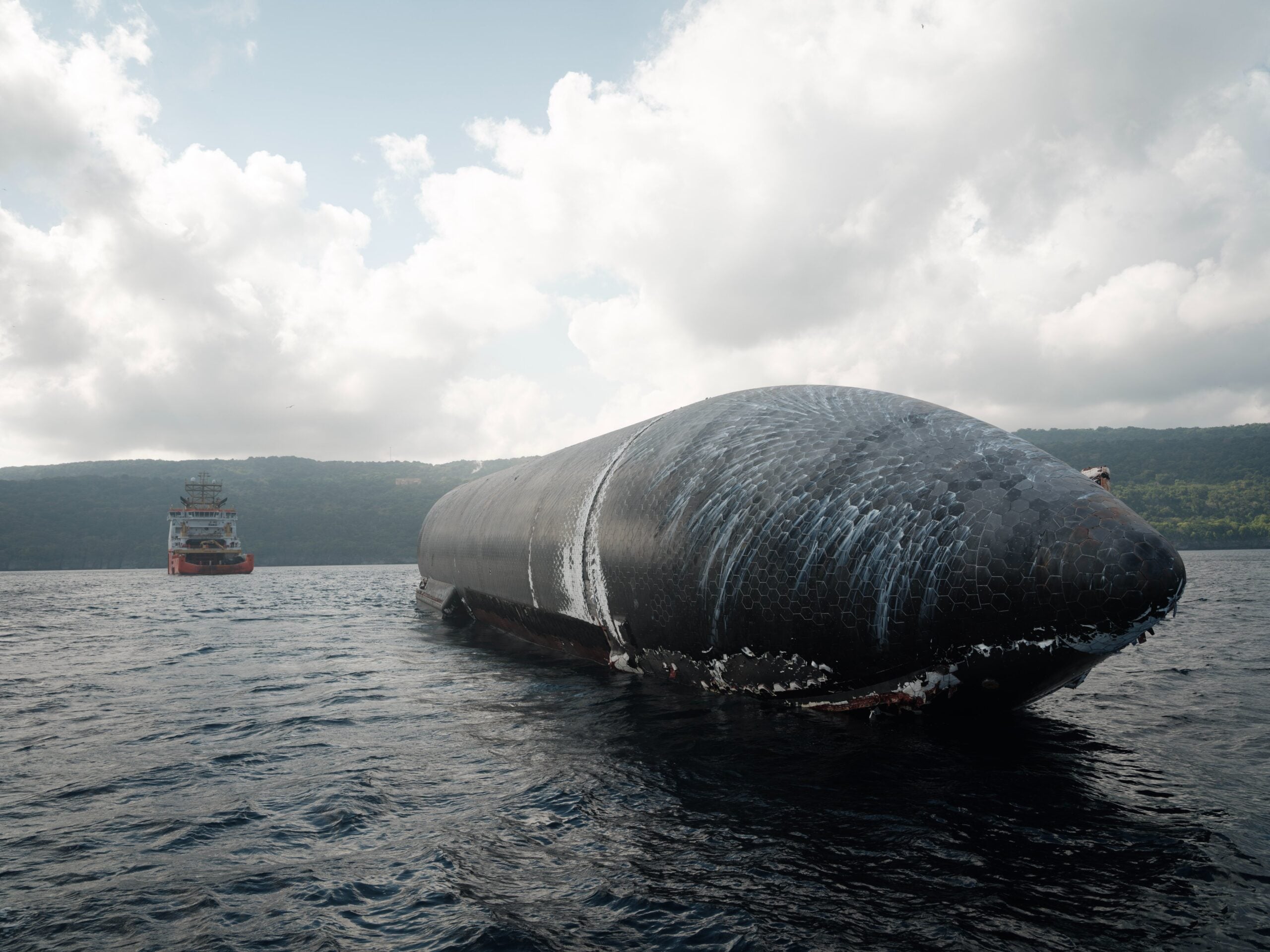
But two words need care here: intact and recovered. The official photographs show a battered spacecraft with abraded and missing heat-shield tiles. Ship 40 is still floating, not sitting on a dock or back in Texas. “Intact” means the 52-metre vehicle did not break into scattered wreckage. “Recovered” means it was salvaged from the open ocean and guided into more manageable water. Neither word means undamaged, dry or ready to fly again.
Ship 40 was not supposed to come home
Ship 40 left Starbase, Texas, on 24 July as the upper stage of Starship Flight 13. The test sent it through space on a suborbital, orbital-class trajectory. It did not complete a full circuit of Earth, but it travelled fast enough and high enough to face the central problem every reusable orbital spacecraft must solve: giving up enormous speed without being destroyed by atmospheric heating.
Before re-entry, the stage deployed operational Starlink V3 satellites and completed an in-space relight of a Raptor engine. It then turned its heat shield into the airflow, descended through the atmosphere, flipped upright and performed a landing burn over the Indian Ocean.
The splashdown was unusually gentle. More surprisingly, Ship 40 stayed afloat as a single vehicle and continued transmitting data. SpaceX had not designed Flight 13 around recovering the upper stage from the sea. The planned engineering value was in the telemetry, imagery and tests completed before and during descent. The surviving hardware was an unplanned bonus, sitting far from the equipment normally used to handle a rocket.
That detail is easy to miss. A planned recovery can place ships, cranes, lifting fixtures and trained crews at a precise location before the vehicle arrives. Ship 40 instead created a salvage operation after the fact, in remote open water, around a spacecraft never meant to be towed home.
Related: Watch our video on Elon Musk owning the sky above us…
A Starship is a terrible boat
The name makes the image sound almost natural: a ship floating at sea. In practice, a Starship is about as awkward a tow as maritime crews could be asked to manage.
It has no crew to pass a line, no steering while cold and inactive, and no conventional hull shaped to remain comfortably stable in waves. Its broad flaps were built to control a falling spacecraft, not to absorb days of irregular ocean loads. Its stainless-steel tanks are enormous lightweight pressure vessels rather than the heavily framed hull of a cargo ship. Thousands of ceramic tiles cover the windward side, each important during re-entry and each vulnerable to impacts and abrasion afterward.
The recovery team had to approach that partly submerged structure, establish a secure connection and influence its movement without tearing away useful hardware or putting people unnecessarily close to it. A vehicle roughly as tall as a 17-storey building can also present a huge area to waves and current even while lying on its side.
By 7 August, the operation had been fighting difficult conditions long enough that loss of the stage looked likely. Musk’s short assessment was not unreasonable pessimism. A cracked tank section, a failed line or one severe period of rolling could have changed a complete spacecraft into debris before it reached shelter.
What SpaceX actually achieved on 18 August
SpaceX’s announcement was deliberately precise. After about 24 days at sea, the company said, the recovery team had “guided” Starship to a position just off Christmas Island. A SpaceX engineering team would conduct additional analysis in calmer water before attempting to return the vehicle to Starbase.
Christmas Island is an Australian territory in the Indian Ocean, much closer to Flight 13’s splashdown region than the Texas coast. For Ship 40, the waters off the island are a staging point where engineers can inspect the vehicle and decide what is physically and logistically possible next.
That is why reports that it has already been “returned” or brought ashore go beyond what SpaceX has said. The stage has not yet completed a journey home. It has completed the part that looked doubtful on 7 August: surviving the open sea long enough to reach calmer water under the control of the recovery operation.
There is still a demanding second act. Engineers must understand the state of the tanks, trapped water, residual hazards, attachment points and weakened exterior before deciding how the spacecraft can be moved. Getting a floating cylinder beside an island is not the same problem as lifting it, securing it for ocean transport and carrying it thousands of kilometres without causing a breakup.
Why this recovery is different from earlier Starship splashdowns
Starship upper stages have reached the ocean before. In June 2024, Flight 4 survived re-entry and completed its first controlled splashdown, despite visible heat damage to a flap. Later missions refined the manoeuvre. Those were major milestones because a precise water landing proved that the stage could remain controlled through the most violent part of its return.
Ship 40 adds a different achievement. It stayed afloat and towable long enough for a recovery crew to turn a splashdown into an actual salvage. Within the Starship programme, it is the first upper stage recovered intact after returning from space.
That distinction should not be stretched into a claim that it is the first upper stage or spacecraft of any kind ever recovered. Space Shuttle orbiters landed after spaceflight, crew capsules routinely return under parachutes, and other reusable vehicles have been retrieved. Nor should Ship 40 be confused with the Super Heavy boosters SpaceX has caught at Starbase. Super Heavy is the first stage; Ship 40 is the upper stage that reached space and endured orbital-class re-entry heating.
What is unprecedented here is narrower and still important: this is the first time a Starship ship has been available as a largely complete physical object after all of that.
The hardware is a flight recorder engineers can touch
Modern rockets produce mountains of telemetry. Sensors can show engineers when a structure flexed, a temperature rose or a pressure shifted. Cameras can reveal when a tile disappeared. What those streams cannot always show is the final physical chain of events.
A recovered Ship 40 can be measured, photographed and sampled. Engineers can inspect tile gaps and attachment hardware, map abrasion across the heat shield, study flap edges and hinges, look for distortion around welds, and examine engine and plumbing hardware that travelled all the way through re-entry and splashdown.
That matters because the heat shield remains one of the hardest parts of reusable spaceflight. The system must survive extreme heating while also being light, durable and quick to inspect. A shield that protects the vehicle once but needs extensive tile replacement afterward may enable recovery without enabling economical reuse.
The official image near Christmas Island already hints at the work ahead. Large areas of the tile surface look weathered or stripped. Some of that damage may have occurred during re-entry, some at splashdown, and some during nearly three and a half weeks of waves, salt water and towing. Separating those causes will not be simple.
Yet the ocean contamination does not make the spacecraft useless. It turns the investigation into a forensic problem. Engineers can compare the recovered surface with recorded temperatures, onboard video and earlier close-range imagery. Damage that was visible before a storm can be distinguished from damage found afterward. Areas that survived both re-entry and prolonged immersion can be studied alongside those that did not.
An engineering prize, not proof of rapid reuse
Ship 40’s recovery is impressive precisely because it was difficult. It is also almost the opposite of the operational system SpaceX ultimately wants.
The goal is for a Starship upper stage to return to its launch site, be caught by the tower, undergo limited inspection and fly again. A stage drifting and being towed for 24 days cannot demonstrate that turnaround. Salt-water exposure is hostile to engines, valves, electronics and every interface that would need to be trusted on another flight. There is no public indication that SpaceX plans to refly Ship 40.
This difference matters to the economics. The largest projected reductions in orbital launch cost depend on rapid, full and repeated reusability, not merely on retrieving an upper stage. A one-off salvage can be scientifically and operationally valuable without making the spacecraft cheap to operate.
The programme also has larger unfinished tasks. As we recently examined, Starship has now accumulated 13 flight tests but has not demonstrated ship-to-ship propellant transfer in orbit. It has not caught an upper stage at the tower, refurbished one for a second launch or reflown a ship. Those are the milestones that connect a spectacular test programme to lunar logistics, large-scale satellite deployment and eventual Mars missions.
Ship 40 does not erase that list. It gives engineers another unusually rich source of evidence while they work through it.
The value of bringing the evidence home
Rocket development often advances through vehicles that will never fly again. Their value lies in the argument they settle, the failure they explain or the next design change they make possible.
Ship 40 has already done more than Flight 13 required of it. It deployed satellites, relit an engine in space, survived re-entry, landed softly enough to remain whole and endured weeks in an ocean environment for which it was never designed. The recovery team then kept a difficult salvage alive after the company’s own chief executive publicly doubted the outcome.
The clearest conclusion is therefore neither that Starship is now reusable nor that the stage came through unharmed. It is that SpaceX has preserved the first complete Starship upper stage ever available for inspection after returning from space. If engineers can eventually move it from the water and study it closely, Ship 40 may answer questions that no telemetry trace can settle by itself.
On 7 August, those answers appeared likely to sink with the vehicle. On 18 August, they were floating off Christmas Island.