
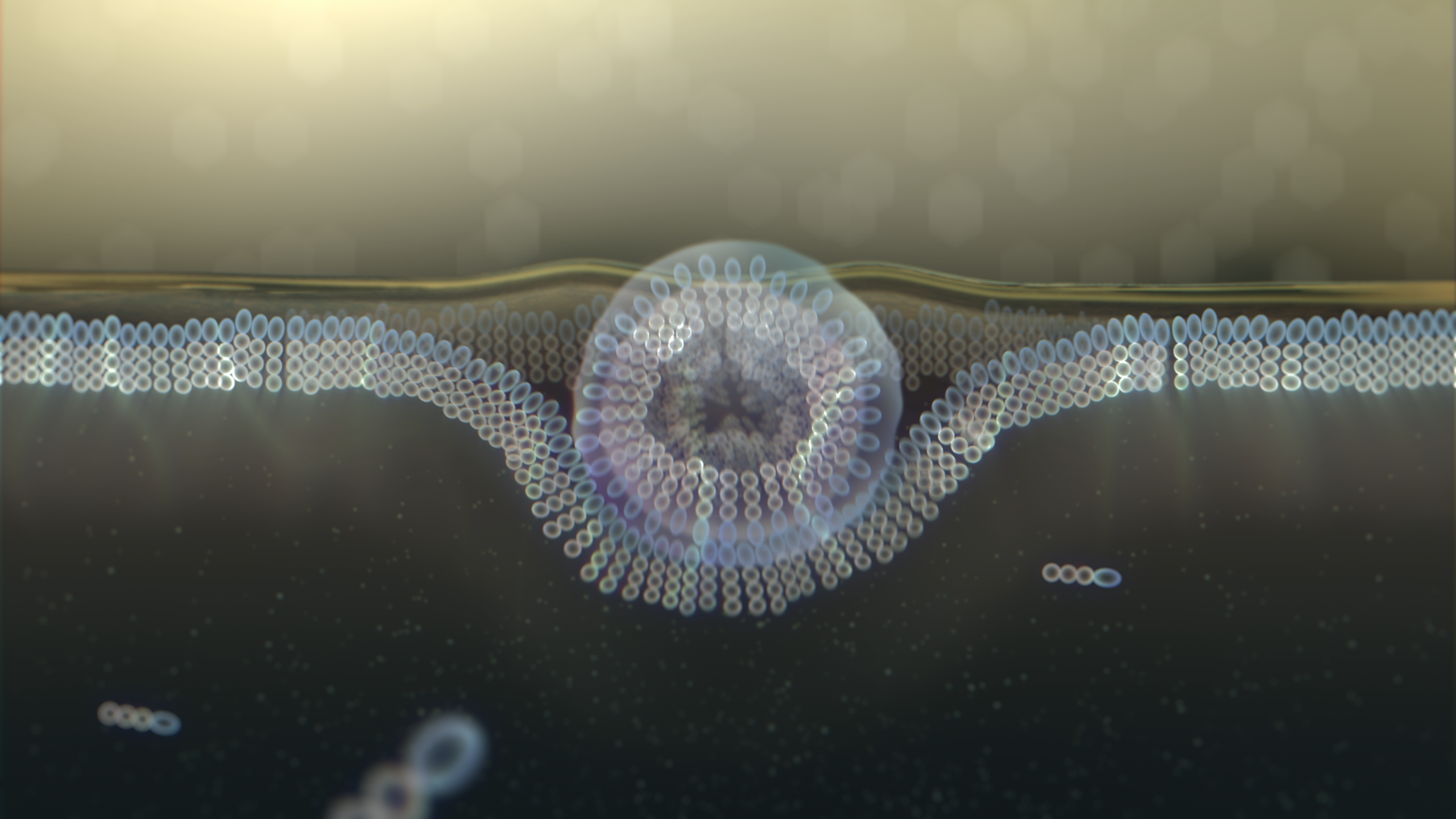
Imagine a methane storm passing over one of Titan’s dark polar seas. A heavy drop strikes the surface, throws a mist of smaller lake droplets into the orange air, and then disappears into the liquid below. The splash looks like weather. In a 2025 study in the International Journal of Astrobiology, physical chemist Christian Mayer and NASA planetary scientist Conor Nixon argued that it might also be a machine for making membranes.
Their proposed sequence is almost disarmingly simple. Organic molecules collect as a single layer on the lake. An impact lifts a coated droplet from that surface. When the droplet falls back, its coating meets the coating already on the lake and closes into a two-layer shell. What sinks beneath the surface is a hollow sphere called a vesicle, with a membrane that is geometrically similar to the boundary around a living cell.
There are three cautions to put on the table immediately. No vesicle has been detected on Titan. The paper proposed a mechanism rather than reporting an experiment that made one under Titan conditions. And the headline’s “every rainstorm” should be read as a chemistry opportunity whenever suitable rain strikes a suitably coated lake, not as a claim that every shower anywhere on the moon must produce billions of protocells.
Those limits do not make the idea less interesting. They reveal why it is scientifically useful. Mayer and Nixon turned a broad question about life without water into a sequence of physical steps that can be challenged in a cryogenic laboratory and, one day, in an alien lake.
Titan copies Earth’s verbs and changes every ingredient
Titan rains. Its rivers flow into lakes and seas. Liquid evaporates, forms clouds and returns to the ground. As we explored in our article on how Titan has a water-like cycle without liquid water, the verbs sound comfortably terrestrial until we name the materials.
The average surface temperature is around 90 to 93 kelvin, or roughly minus 180 degrees Celsius. Water there is not the fluid. It is structural ice, hard enough to form hills, channels and pebbles. Methane and ethane, which are gases in an Earth kitchen, become the rain and lake liquid. Nitrogen dissolved from Titan’s thick atmosphere complicates the mixture further. The pressure at the surface is about one and a half times Earth’s sea-level pressure.
High above that surface, sunlight and energetic particles attack atmospheric methane and nitrogen. Their fragments recombine into hydrocarbons, nitriles and more complex organic material. Some products make Titan’s permanent orange haze. Others condense or hitch a ride downward with rain. The 2025 paper noted that 24 molecules had been identified in the atmosphere by then, while Cassini’s mass spectra contained signs of still more complicated material that researchers could not fully name.
This gives Titan a remarkable arrangement: a non-water liquid cycle in direct contact with an organic-chemistry factory. Rain can deliver both motion and material. The lake surface becomes the place where atmosphere, weather and liquid chemistry repeatedly meet.
Why making an inside and an outside matters
A soap bubble is not alive. Neither is a droplet surrounded by a molecular film. Yet a boundary is one of the quiet achievements on which life depends.
Without a compartment, useful molecules diffuse away. Reaction products mix back into the environment. There is no stable “inside” in which ingredients can become concentrated, chemical gradients can persist or one set of reactions can begin to differ from another nearby. Modern cell membranes do far more than act as bags, but even a primitive enclosure changes what chemistry can accomplish.
On Earth, many membrane molecules are amphiphiles. One part interacts readily with water, while another avoids it. Put enough of them into water and they can organise into bilayers: two sheets arranged back to back, with water-compatible ends exposed and water-avoiding portions sheltered within. If the sheet closes into a sphere, it creates a vesicle.
Titan presents the chemistry in reverse. Its lake solvent is non-polar methane and ethane, and the familiar oxygen- and phosphorus-rich lipids used by Earth cells are poor candidates at cryogenic temperatures. Researchers have instead looked at short, nitrogen-bearing organics such as nitriles. Their charged or polar ends might associate with one another while their less polar portions face the hydrocarbon liquid.
This is why “similar to a cell membrane” needs care. The proposed Titan structure has the same useful topology: a closed bilayer with an interior and exterior. Its ingredients, orientation, solvent and temperature are profoundly different. It has no demonstrated proteins, metabolism, genetic information, controlled transport or ability to reproduce. It resembles one piece of a cell, not a cell.
The rainstorm supplies the missing mechanical trick
The proposal begins before the first drop lands. Organic molecules made in the atmosphere settle into the lakes and preferentially gather at the liquid-air interface. Because they interact differently with the atmosphere and the hydrocarbon liquid, suitable amphiphiles could form a stacked monolayer at the surface. The authors argue that the film would lower surface tension and regenerate after being disturbed.
Then the storm arrives.
A large methane raindrop, or possibly a hail particle, hits the coated lake and throws up smaller secondary droplets. Each secondary droplet tears away with a patch of the surface film wrapped around it. At this stage it carries only one molecular layer. The droplet is not the original raindrop; it is lake liquid launched by the impact, rather like sea spray kicked up when rain pelts an ocean.
Titan’s low gravity allows the mist to settle gently. When one coated droplet meets the lake again, its monolayer comes into contact with the monolayer on the bulk surface. As the droplet passes into the lake, those two films meet and close around the original droplet content. A bilayer vesicle is born beneath the surface.
That mechanical choreography is the genuinely new part. Earlier objections showed that thousands of acrylonitrile molecules may prefer to make a crystal rather than spontaneously assemble into a hollow membrane in liquid methane. Mayer and Nixon did not simply assume that reluctant molecules would organise themselves. Their splash route uses an interface, impact energy and a second crossing of the interface to force two existing monolayers together. It is a possible way around an unfavourable self-assembly barrier.
There is experimental reason to take the droplet physics seriously. In 2023, researchers used a two-metre Titan simulation chamber at the University of Arkansas and found that hydrocarbon droplets can float on cryogenic lake mixtures under some Titan-relevant conditions. Ethane droplets persisted over a broad range of compositions, while methane droplets required a narrower range and suitable impact speed. That experiment did not create organic membranes, but it showed that rain meeting a hydrocarbon lake does not always merge instantly and simply.
Temporary vesicles could be selected without being alive
The freshly made shell would face another problem. Being physically assembled does not make it the lowest-energy form available. The paper describes the first vesicles as kinetically stable: cold conditions may let them persist for a time even though they could slowly fall apart or crystallise.
The authors then propose a second stage. As a vesicle drifts through a lake containing many organic molecules, it may incorporate amphiphiles that fit the membrane better and lower its free energy. Vesicles with stabilising mixtures last longer. Poor mixtures disappear. Repeated storms make new candidates, and continued exchange with the lake sorts them by persistence.
Separate regions could favour different mixtures because shorelines, temperatures, currents and organic supply vary. If the waters later mix, more stable populations could outlast weaker ones. The paper cautiously connects this to compositional selection and the possibility of a kind of molecular memory carried by the membrane’s recipe.
This is where language can outrun the evidence. Selection is not automatically biological evolution. A crystal that persists while another dissolves has been selected by its environment, but it has not acquired a genome. The Titan vesicles have no demonstrated inheritance system, metabolism or self-directed reproduction. The proposal says physical sorting might create increasing stability and complexity, then asks whether that process could eventually contribute to a protocell. It does not show the transition.
Still, chemistry before life had to cross precisely this awkward territory. “Not alive” is not the same as irrelevant. A naturally repeated process that generates compartments, destroys bad ones and preserves better chemical combinations would be a meaningful increase in organisation even if it stopped far short of biology.
The azotosome idea has survived a decade of disagreement
The intellectual history matters because this is not a straight march from prediction to discovery. It is a debate in which each result has changed the question.
In 2015, molecular-dynamics calculations proposed a methane-compatible membrane made from small nitrogen-bearing molecules. The researchers called it an azotosome. Their leading candidate, acrylonitrile, appeared in the simulation to produce a flexible and persistent sheet at Titan temperatures. SpaceDaily covered that early idea in our report on methane-based cells.
The ingredient was not purely hypothetical. Astronomers later used ALMA to make the first spectroscopic detection of acrylonitrile in Titan’s atmosphere. That established that the moon manufactures a proposed building block. It did not show that the molecule reaches a lake in the needed concentration or forms a membrane after arrival.
In 2020, quantum-chemical calculations found that acrylonitrile should prefer its solid crystal by a wide energy margin. The authors concluded that spontaneous azotosome self-assembly was thermodynamically unlikely. The 2025 rain-splash paper explicitly recognised this difficulty. Its answer was not a new calculation saying the crystal loses, but a route that might produce temporary membranes without waiting for bulk self-assembly.
Then came the first direct laboratory test. In March 2026, Tuan Vu and Robert Hodyss reported experiments with acrylonitrile in liquid methane and ethane under simulated Titan conditions. Acrylonitrile formed a stable molecular cocrystal with ethane and showed little change in methane during the experimental timescale. Their Science Advances paper concluded that an acrylonitrile-based azotosome is unlikely to form in Titan’s lake fluids.
That result is a real challenge, but the overlap between the experiments must be stated accurately. Vu and Hodyss tested how acrylonitrile behaves in bulk cryogenic liquids. They did not reproduce a coated lake surface, generate impact spray and watch droplets cross a second monolayer. The 2025 paper also listed other nitriles, amines and mixed membranes that might behave differently. The laboratory result weakens the most famous material candidate; it does not by itself test or erase the entire splash mechanism.
The next experiment is therefore obvious and difficult: perform the proposed storm in a cryogenic chamber, with a measured surface film and realistic lake composition, and search for hollow bilayers rather than inferring them from molecular preference.
What has been observed, and what remains a stack of assumptions
Several parts of the story rest on firm observations. Titan has methane clouds and rainfall. Cassini mapped lakes and seas, mostly near the poles. The atmosphere produces complex organic compounds. Acrylonitrile exists there. Laboratory work has reproduced relevant liquid methane, ethane and nitrogen behaviour.
The central chain has not been observed. Nobody has measured an amphiphilic monolayer on Kraken Mare or Ligeia Mare. No instrument has watched a Titan raindrop hit a sea. No coated spray droplet, bilayer or vesicle has been recovered. We do not know the concentration, mixture, replenishment rate or lifetime of suitable amphiphiles at a real shoreline.
Even the phrase methane lake is a simplification. Methane, ethane and dissolved nitrogen vary with temperature, depth and evaporation. Shorelines move, liquids can stratify, and incoming rain need not match the composition of the lake. As our recent look at Titan’s mysteriously missing river deltas showed, even apparently familiar coastal physics remains poorly constrained when the land is ice and the sea is liquid natural gas.
This also makes the new article a deliberate expansion of SpaceDaily’s shorter 2025 report on the protocell proposal. The proposal is more interesting when its mechanism, energetic motivation and vulnerabilities are visible together. “Plausible” here means that the sequence does not obviously violate present knowledge and has testable components. It does not mean probable, detected or demonstrated.
A future lake probe could look for hollow spheres
Mayer and Nixon did not stop at a diagram. They outlined both a laboratory experiment and a compact detection strategy.
In the laboratory, researchers could place a methane-rich liquid and selected amphiphiles inside a cryogenic vessel under a nitrogen atmosphere. Methane droplets would need to fall from roughly two to three metres to generate the required secondary spray. A controlled pressure cycle or temperature gradient could sustain repeated “rain.” The liquid would then be tested for vesicles, their size distribution, composition and lifetime.
On Titan, a laser could search a lake sample through dynamic light scattering. Particles moving through the beam alter the scattered light in a way that reveals their size distribution. The paper considers vesicles from about 100 nanometres to 50 micrometres across. Repeated measurements inside a shielded tube could help separate nearly buoyant vesicles from denser mineral dust or ice crystals that gradually settle.
Light scattering alone would find particles, not prove membranes. Surface-enhanced Raman spectroscopy could identify the organic molecules. A sample placed on a nanostructured metal surface would amplify weak molecular fingerprints, allowing a small instrument to look for trace amphiphiles alongside the suspected hollow structures.
NASA’s Dragonfly will transform our knowledge of Titan’s organic chemistry. As we noted in our recent guide to the nuclear-powered rotorcraft, however, it will explore equatorial dunes and the Selk impact region rather than sail a polar sea. NASA has also said Dragonfly will not carry the lake light-scattering instrument needed for this search.
Direct confirmation would probably require a later polar mission: a floating lander, shoreline sampler, boat or submarine able to study the liquid itself. That is a demanding mission for structures that may be delicate, rare and almost the same density as their surroundings. It is also a sharply defined target, which is more than astrobiology often gets.
A primitive chemistry experiment is not evidence of life
It is tempting to compress this entire subject into one irresistible sentence: rain may be making cells on Titan. That sentence is wrong in nearly every important way.
The rain may create a physical route to vesicles. Vesicles are compartments. Compartments are one requirement for cellular life as we know it. The gaps between those statements contain metabolism, information, replication, energy management, useful transport across the membrane and an enormous amount of chemistry that has not been demonstrated in liquid methane.
The deeper significance is more modest and scientifically more interesting. Life on Earth uses water so completely that our biochemical intuition is built inside it. Titan lets us ask which pieces of life’s organisation belong specifically to water and which can emerge from more general physics. Does a non-polar liquid plus an interface, a supply of amphiphiles and repeated mechanical disturbance naturally create compartments? Can stability be selected from a mixture even at 90 kelvin? Or does crystal formation shut the route down before it begins?
If Titan’s lakes contain vesicles, the discovery would not prove life. It would show that matter can build a cell-like boundary in a solvent and temperature regime radically unlike ours, widening the known conditions under which prebiotic organisation is possible. If careful experiments find that the membranes cannot form, that failure will be equally valuable because it identifies a boundary that attractive computer models and planetary analogies could not cross.
That is why the rainstorm image deserves to stay. Each impact may set up the same small trial: coat a surface, break it into droplets, bring two layers together and see what survives. Titan has the atmosphere, the liquids, the organic feedstock and geological time. Whether nature gets a membrane at the end is no longer just a story about an exotic moon. It is an experiment with a method, competing predictions and a result waiting to be measured.
