

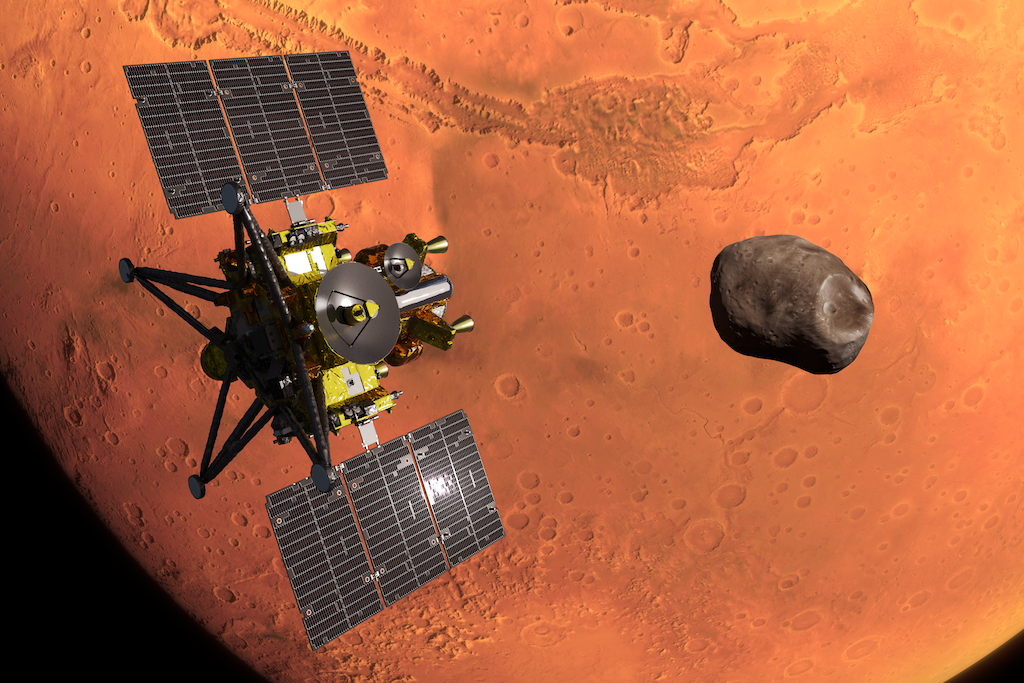
Japan’s Martian Moons eXploration spacecraft is not going to Phobos merely to photograph it. The mission is designed to fly beside the moon, release a small rover onto it, bring the main spacecraft down for a short sampling stop and then carry the material all the way back to Earth.
If the current schedule holds, JAXA will launch MMX on an H3 rocket in Japanese fiscal year 2026, reach Mars in 2027, leave in 2030 and deliver its return capsule to Australia in fiscal year 2031. European mission partners currently list October 2026 for launch. MMX has not launched yet, however, and every date remains a plan that can move.
The mission’s headline target is more than 10 grams of Phobos material. That is only a few spoonfuls, but it would be the first sample deliberately collected anywhere in the Martian system and brought to Earth. Reaching it means learning how to land where the ground barely pulls back.
The 1,700 figure is a useful approximation, not a constant
Phobos is an irregular moon about 27 kilometres long, 22 kilometres wide and 18 kilometres deep. It looks less like a ball than a battered potato. A NASA planetary-protection assessment uses a nominal surface acceleration of 0.0057 metres per second squared. Earth’s familiar value is about 9.81 metres per second squared. Divide the second by the first and the result is roughly 1,720.
That is where the “about 1,700 times weaker” comparison comes from. It should not be read as a perfectly uniform figure. Phobos is lumpy, rotates once during each orbit and sits deep inside Mars’s gravitational field. Its shape, spin and location alter the effective pull across the surface. Mission studies use values that vary by more than a factor of two depending on where the calculation is made.
The practical meaning is still startling. According to the European Space Agency’s MMX factsheet, the 25-kilogram IDEFIX rover will press against Phobos with about the same weight as a 15-gram object presses against a table on Earth. Its mass and inertia remain 25 kilograms. If it starts moving, it still resists being stopped like a 25-kilogram machine. What almost disappears is the force holding its wheels to the ground.
This is why weak gravity does not turn landing into an easy, gentle version of landing on Earth. A slight sideways motion can carry hardware across a large part of the moon. A wheel can spin without finding useful traction. A bounce can last for minutes, and the escape speed is only around 11 metres per second. In a simplified calculation, falling 50 metres under Phobos’s nominal gravity adds less than one metre per second of speed. That sounds reassuring until one remembers that the same feeble pull is also reluctant to bring a bouncing spacecraft back.
MMX will fly with Phobos before it tries to land
After the interplanetary cruise, MMX must first enter orbit around Mars. It will then spend much of its three-year stay studying Phobos and Deimos, with the sampling work concentrated on the larger moon. JAXA’s mission outline describes a series of quasi-satellite orbits around Phobos. In physical terms, MMX will still be orbiting Mars. From a reference frame that turns with the moon, however, the spacecraft will trace loops that let it remain nearby and inspect Phobos repeatedly.
That indirect arrangement is necessary because Phobos is too small, too close to Mars and too irregular for mission designers to treat it like a miniature planet with a broad, comfortably stable orbital neighbourhood. The spacecraft has to move in the combined gravity of Mars and the moon while matching an object that completes one circuit in only seven hours and 39 minutes.
In our recent explanation of Phobos’s west-to-east passage, we looked at the result of that speed from the Martian surface. Phobos overtakes Mars’s rotation, so it rises in the west, crosses the sky more than once per Martian day and sets in the east. It is also spiralling slowly inward. MMX must work inside the same fast, evolving orbital geometry.
The long reconnaissance phase is not decorative science before the “real” landing. The spacecraft’s 11 instruments will measure shape, gravity, surface roughness, temperature and composition. The MIRS spectrometer will search infrared wavelengths for minerals altered by water, water-bearing substances and organic compounds. Cameras, a laser altimeter and the MEGANE gamma-ray and neutron instrument will help the team compare candidate landing areas. On a moon where an unexpected slope or patch of coarse blocks could spoil a touchdown, mapping is part of the landing system.
IDEFIX goes down before the main spacecraft
The first hardware intended to touch Phobos is a boxy, four-wheeled rover called IDEFIX, developed by the French space agency CNES and the German Aerospace Center, DLR. MMX will release the roughly 25-kilogram rover from tens of metres above the surface rather than lower it on a cable. It may bounce and somersault after contact. Once the motion ends, a mechanism is designed to place the rover on its wheels regardless of which side initially faces the ground.
The rover then has to discover what driving means in this environment. DLR’s current IDEFIX description calls it the first wheeled rover intended to operate on a body with less than one-thousandth of Earth’s gravity. It will travel at only a few millimetres per second during a nominal mission of about 100 days. Moving slowly is not timidity. Accelerate too hard and the wheels can unload themselves instead of pushing the vehicle forwards.
Its cameras will photograph both the terrain and the wheel tracks. The miniRAD instrument will measure surface temperature and radiative properties, while the RAX Raman spectrometer will examine minerals at close range. Just as importantly, the wheels themselves become scientific tools. Their interaction with the regolith will show whether the surface is fluffy, cohesive, crusted or easily disturbed.
SpaceDaily followed IDEFIX’s development in 2022, when the programme still carried a 2024 launch and 2029 return timetable. Those dates have been superseded, a useful reminder that a mission can make real engineering progress while its calendar changes. The rover hardware has since been completed and qualified. Under the current plan, it goes to work before the main sampling attempt, turning Phobos from a surface inferred at a distance into one that has actually been driven across.
The main spacecraft gets only a short daylight stop
The main MMX touchdown is closer to a carefully timed visit than a permanent landing. In JAXA’s detailed account of the sampling sequence, the spacecraft arrives around local sunrise and lifts away before sunset, about two and a half hours later. Approximately 90 minutes within that window are allocated to obtaining the sample.
Two different collection systems are carried because nobody yet knows exactly how Phobos’s regolith will behave. The C-Sampler places a coring tube at the end of a 1.5-metre robotic arm and is intended to reach material more than two centimetres beneath the surface. That depth matters because the very top layer has been altered most strongly by radiation, micrometeorite impacts and the space environment.
The second device, the P-Sampler, was developed with NASA and Honeybee Robotics. It releases a brief pulse of pressurised gas that lofts loose grains into a container in a fraction of a second. Where the corer applies mechanical force, the pneumatic system tries to move material without requiring the spacecraft to push hard against ground that provides almost no reaction force.
JAXA’s science and sampling overview explains that the collected material will be sealed inside the return capsule. The mission target is more than 10 grams in total. That amount is enormous compared with the microscopic quantities consumed by many modern laboratory instruments. Researchers can divide it among mineralogical, chemical, isotopic and organic analyses while preserving a substantial fraction for techniques that do not yet exist.
Ten grams can contain several different histories
The oldest argument about Phobos concerns where it came from. Its dark surface and some aspects of its spectrum resemble primitive, carbon-rich asteroids, supporting the idea that Mars captured a wandering object. Yet a simple capture struggles to explain the moon’s almost circular orbit so close to the Martian equator. Impact models instead propose that debris blasted from early Mars formed a disc and later assembled into one or more moons.
Those accounts predict different mixtures of minerals and isotopes. On Earth, laboratories can measure oxygen, chromium, titanium, zinc, hydrogen, nitrogen and noble gases with a sensitivity and cross-checking power that no compact spacecraft instrument can match. The result may favour capture, impact formation or a more complicated history that borrows elements from both.
Phobos may also have collected pieces of the planet it circles. A 2019 impact-modelling study estimated that a sample larger than 10 grams could contain dozens of individual Martian grains delivered by ejecta. That is a model result, not a guarantee. The number depends on sampling location, grain size, how thoroughly impacts have mixed the regolith and whether analysts can recognise the Martian fragments among native material.
Some of Mars’s history may be present on an even smaller scale. A Nature Geoscience study of escaping Martian ions found that oxygen, carbon, nitrogen and argon from the planet’s atmosphere can become implanted in the outermost hundreds of nanometres of grains on Phobos’s Mars-facing side. SpaceDaily covered that atmospheric archive when the result was published. A laboratory receiving the returned grains would have to distinguish this extremely shallow implanted record from the material beneath it.
None of this means MMX is expected to return evidence of life. Organic molecules can form without biology, and a Martian grain would not automatically preserve the location or geological setting from which it was ejected. The more defensible promise is also the more interesting one: one container could hold evidence about the birth of a moon, the impact history of Mars and the long leakage of the planet’s atmosphere.
Australia is the final operation, not a footnote
After the Phobos work, the spacecraft is scheduled to depart Mars in 2030. Its return module will spend about a year travelling home, then release a capsule roughly 60 centimetres in diameter towards Earth. The Australian Space Agency says the sample is expected to land in South Australia around 2031 under a partnership formalised with Japan in 2023.
Australia is not an arbitrary dot at the end of the trajectory. The large, sparsely populated recovery region around Woomera has already supported JAXA’s Hayabusa and Hayabusa2 asteroid missions. Teams there have experience tracking a small incoming capsule, locating it after landing, making the site safe and transferring an extraordinarily sensitive scientific container without compromising what is inside.
The capsule would then travel to JAXA’s curation facilities at Sagamihara. Recovery is where the uninterrupted chain of evidence begins. Scientists need to know how the container was handled, which grains touched which tools and where any terrestrial material could have entered. Returning a sample is valuable precisely because its history is controlled in a way that the history of a meteorite found on Earth is not.
Martian meteorites have already made the journey here by themselves. MMX’s proposed first is narrower and more exact: no spacecraft has deliberately collected material from Mars, Phobos or Deimos and brought it back. As our June overview of the coming sample-return missions noted, this is one of several ambitious attempts to replace remote inference with material that researchers can hold, divide and revisit.
The next test is the H3 launch. If the current calendar survives, that departure begins a five-year sequence of interplanetary cruise, Mars capture, close mapping, a rover drop, a brief sampling stop, departure and Australian recovery. The capsule may be small and its cargo measured in grams, but nothing about obtaining those grams is small.