
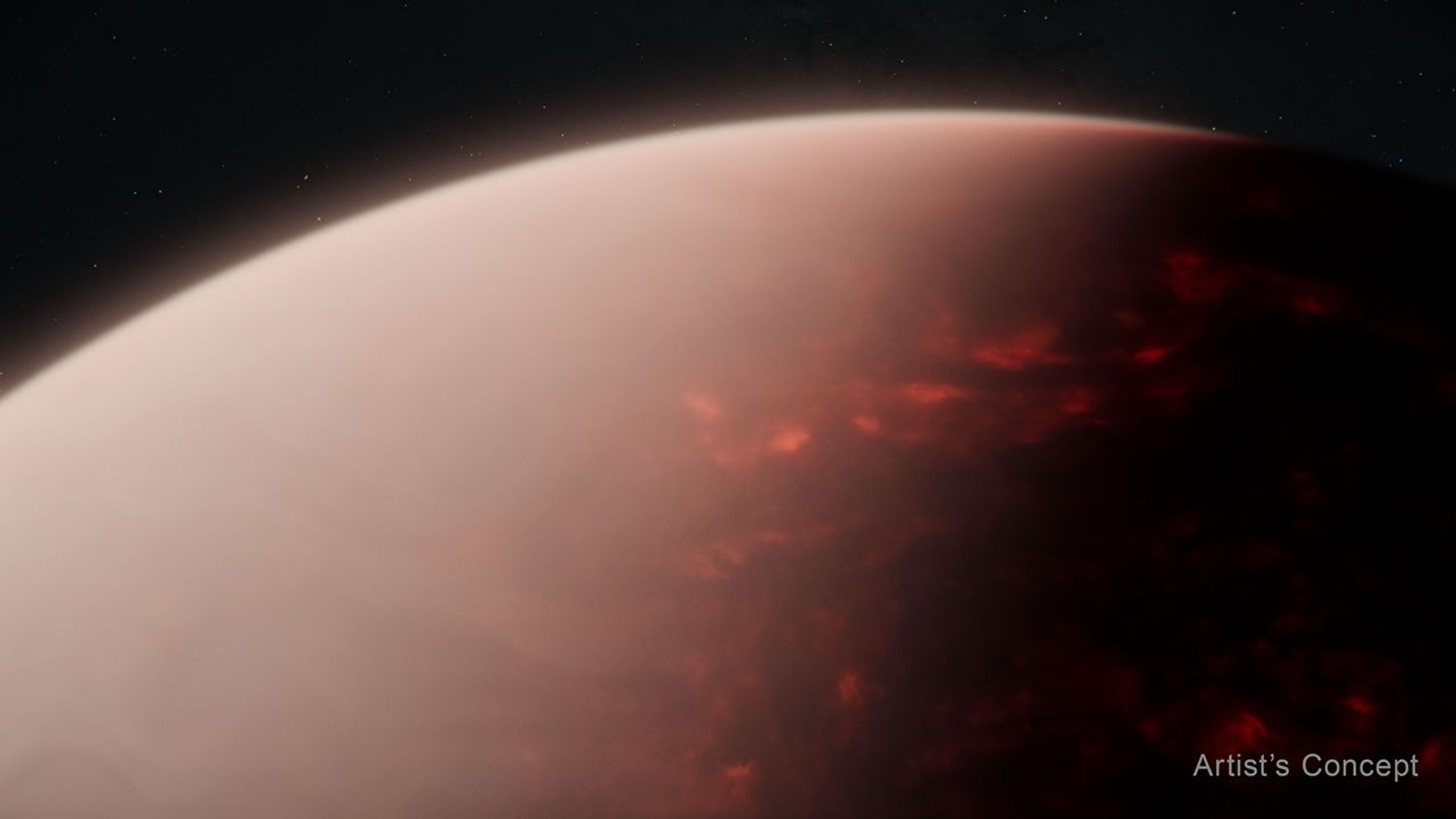
On TOI-561 b, a year is shorter than a working day. The planet circles its star in about 10 hours and 34 minutes, racing around at roughly one-fortieth of Mercury’s distance from the Sun. It is probably tidally locked, keeping one hemisphere under permanent daylight.
That should make the dayside brutally simple: exposed rock heated until it melts, with little more than a thin veil of mineral vapour above it. Instead, the James Webb Space Telescope measured a world that was much dimmer in the near-infrared than bare lava should be.
The best explanation is a substantial atmosphere rich in volatile compounds. It could absorb part of the planet’s outgoing radiation, carry heat towards the nightside and possibly form reflective clouds. For a small planet that has spent billions of years under extreme stellar radiation, that is a genuinely difficult atmosphere to explain.
An 11-hour year around an ancient star
TOI-561 b is about 280 light-years away in the constellation Sextans. NASA’s exoplanet catalogue lists a radius close to 1.4 Earths, a mass around twice Earth’s and an orbital distance of only 0.0106 astronomical units. It belongs to a class called ultra-short-period planets, rocky or mostly rocky worlds that complete an orbit in less than one Earth day.
The host is a G-type star, broadly similar to the Sun but slightly smaller and cooler. Its age and chemistry are less familiar. The star is roughly 10 billion years old, poor in iron and enhanced in alpha elements. It belongs to the Milky Way’s thick disk, an old stellar population that formed under different chemical conditions from the thin disk containing the Sun.
That history matters twice. It can change the mix of iron and rock from which the planet formed, and it gives stellar radiation an extraordinarily long time to erode an atmosphere. A small world orbiting within about one million miles of its star ought to have lost light gases quickly and heavier volatiles eventually.
Its low density was the first sign of trouble
TOI-561 b was announced in 2020, but its measured mass and radius soon made the planet interesting for reasons beyond the frantic orbit. A 2023 analysis of its bulk properties put its density below that expected for an Earth-like mixture of iron core and silicate mantle.
One explanation was an iron-poor interior, which would make sense around an iron-poor star. Another was a lower-density envelope of volatile material increasing the measured radius. Mass and radius alone could not decide between a chemically unusual bare planet and a rocky world wearing a substantial atmosphere.
The puzzle already had a useful constraint. Any envelope was unlikely to be the primordial hydrogen and helium captured when the planet formed. Those gases would be especially vulnerable so close to the star. A surviving atmosphere would more plausibly contain heavier molecules released from, delivered to or recycled through the rocky interior.
Webb found the planet by watching it vanish
Webb cannot separate TOI-561 b from the glare of its star in an image. The planet was measured through four secondary eclipses in May 2024. Immediately before an eclipse, NIRSpec received infrared light from the star and the hot planet together. When the planet moved behind the star, its contribution disappeared. Subtracting the star-only signal revealed how much light the dayside had been adding.
The observation lasted more than 37 hours, during which TOI-561 b completed nearly four full years. NIRSpec recorded light from about 2.7 to 5.1 microns. NASA’s visual explanation of the emission spectrum shows seven broad wavelength measurements compared with models for bare rock, rock vapour and a volatile-rich atmosphere.
The researchers reduced the data with two independent pipelines and tested more than one fitting method. Depending on the analysis, the inferred brightness temperature was roughly 1,800 to 2,150 kelvin. A dark bare-rock dayside with no heat redistribution should have approached 2,950 kelvin.
Brightness temperature is not a direct reading of the molten surface. It is the temperature a simple radiating body would need to match the light Webb detected in that wavelength range. Even so, the gap was too large to dismiss. As the published study’s full analysis shows, every reduction placed the dayside well below the bare-rock expectation.
Why a cooler dayside points to thick air
An atmosphere can lower the observed dayside brightness in several connected ways. Winds move energy away from the hemisphere facing the star. Molecules absorb outgoing infrared light at some wavelengths, so Webb sees cooler atmospheric layers rather than the hottest material below. Bright silicate clouds could also reflect part of the incoming starlight before it heats the planet.
A magma ocean should naturally create some rock vapour, including species such as silicon monoxide and magnesium oxide. The team modelled that case, but a thin rock-vapour layer by itself remained too bright and was also difficult to reconcile with the low bulk density. Models with more substantial volatile-rich atmospheres fitted the observations much better.
Water vapour, oxygen and carbon dioxide are among the candidate ingredients. They are not confirmed detections. The current spectrum does not uniquely determine the composition, surface pressure, cloud coverage or efficiency of winds. One plotted model uses pure water vapour as an illustrative fit; it should not be read as a measurement showing that the atmosphere is entirely steam.
That distinction is why NASA described the result as the strongest evidence yet for an atmosphere on a rocky exoplanet, rather than a complete atmospheric inventory.
The magma ocean may be a reservoir, not just a furnace
The age question remains. TOI-561 b has been exposed to fierce ultraviolet and X-ray radiation for roughly twice the lifetime of the Sun. Gas must still escape. The proposed answer is not that the same atmosphere has sat untouched for 10 billion years, but that atmosphere and interior exchange material continuously.
Molten silicate can dissolve volatile compounds. Changes in temperature, pressure and circulation allow gases to move out of the magma and into the sky, while other material is absorbed back into the interior. A large internal reservoir could therefore replenish the atmosphere faster than it is lost, especially if high-molecular-weight gases escape less efficiently than hydrogen.
That magma-ocean cycle could explain how an atmosphere persists, but Webb did not observe gases entering and leaving the melt. It is a physical interpretation that joins the emission spectrum, low density and models of planetary interiors. Late delivery of volatiles or a late move into the present orbit remain possible alternatives, though the system’s old age and compact architecture make them harder to arrange.
SpaceDaily reported the initial TOI-561 b atmosphere result when it emerged. The deeper significance is this coupling: a magma ocean may help preserve a sky by storing and returning gases, rather than serving only as evidence that a planet’s atmosphere must be doomed.
A compelling atmosphere, with important blanks
The result does not make TOI-561 b habitable. At temperatures capable of melting common rock, it is not a plausible home for life as we know it. Its scientific value lies in showing how an atmosphere, a molten mantle and stellar radiation can operate as one evolving system.
Nor has Webb photographed a glowing ocean or atmospheric bands. The featured views are artist’s concepts based on indirect measurements. The published work concentrates on the dayside emission spectrum; analysis of the full phase curve is intended to map how brightness changes around the orbit and place tighter limits on heat transport and atmospheric composition. The observing plan for Webb programme 3860 was designed around precisely that atmosphere-interior connection.
One extreme planet cannot establish how every ultra-short-period world behaves. Some comparable rocky planets look consistent with bare surfaces. TOI-561 b may owe its survival to an unusual initial supply of volatiles, its iron-poor chemistry, its interior structure or a combination of all three.
What it overturns is the simplest expectation. Age, small size and intense radiation do not automatically reduce a rocky planet to naked stone. Under a thick atmosphere, even a world whose year passes between breakfast and dinner can retain a complicated geological memory of the young Milky Way.
