
Mimas does almost everything an ocean world is not supposed to do. Its surface is old, rigid-looking and packed with craters. It has no confirmed plume, no bright field of fresh fractures and none of the dramatic resurfacing seen on Saturn’s neighbouring moon Enceladus.
In 2024, an international team reported that this apparently frozen body nevertheless contains a global ocean beneath 20 to 30 kilometres of ice. The evidence came from Cassini images, but not because a photograph showed water or a crack leading down to it. Researchers extracted tiny details of Mimas’s motion and found that a liquid layer best reconciled its rotational wobble with the slow turning of its orbit.
The ocean appears to have formed less than 25 million years ago. That makes it younger than the India-Eurasia collision that began building the Himalayas. Its youth may also explain why Mimas’s ancient-looking exterior has had so little time to betray what changed below.
A moon that advertised the wrong interior
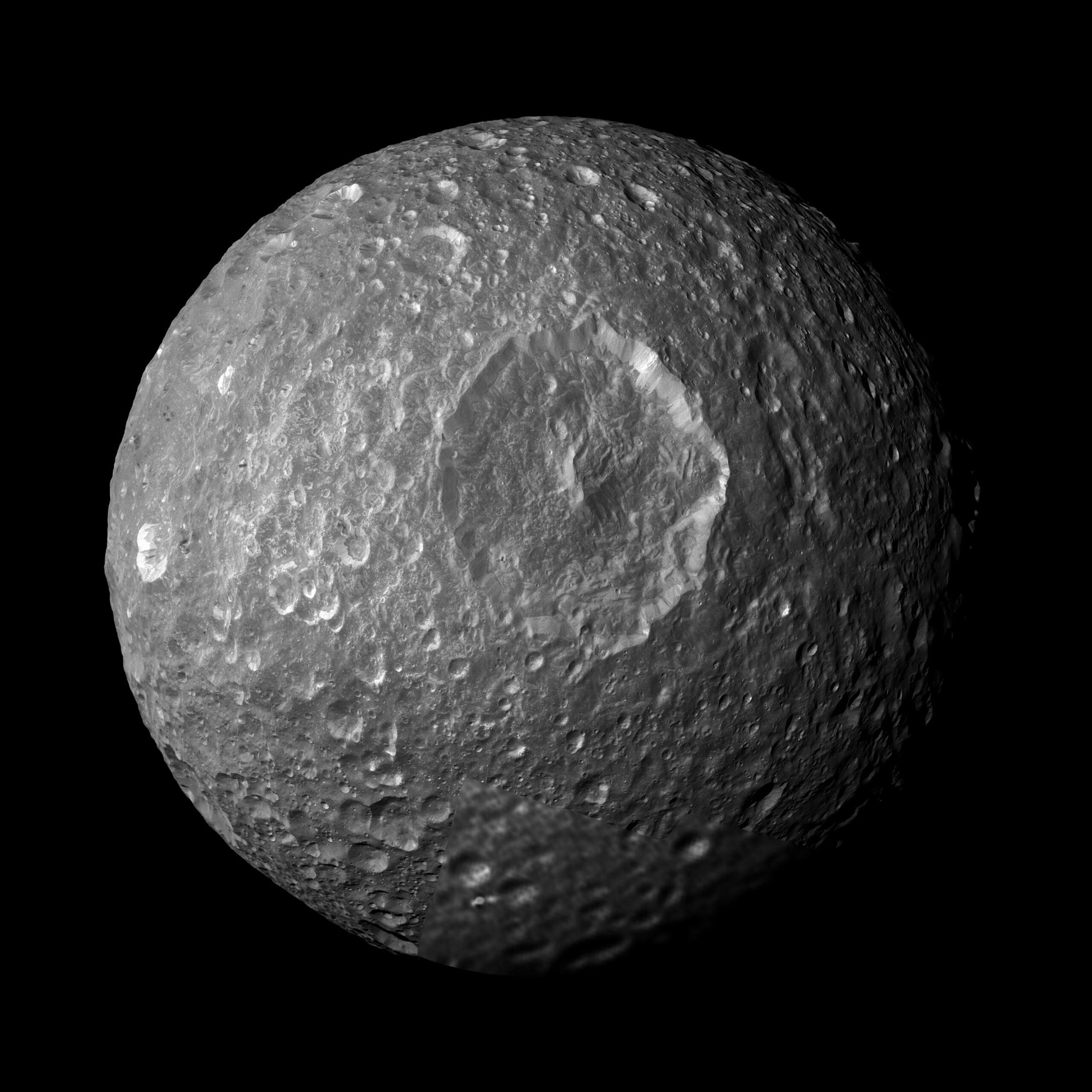
Mimas is about 396 kilometres across and has a low density consistent with a body made mostly of water ice. One crater dominates every popular portrait. Herschel is roughly 130 kilometres wide, close to one-third of the moon’s diameter, with walls kilometres high and a central mountain rising from its floor.
The resemblance to the fictional Death Star is incidental. The scientific message once seemed more important: an object that preserves such enormous impacts and remains saturated with smaller craters looks cold and geologically inactive.
By comparison, Enceladus has young terrain, long fractures and jets that throw material from its subsurface ocean into space. Europa’s shell is crossed by ridges and bands. Those worlds taught researchers to associate internal liquid with visible disruption. Mimas gave almost nothing away.
NASA’s overview of Mimas still emphasises its cratered surface and the fact that water ice is the only material detected there. The global ocean is a conclusion about the unseen interior, not a substance identified on the exterior.
Cassini turned photographs into celestial mechanics
NASA’s Cassini spacecraft orbited Saturn from 2004 to 2017 and photographed the planet’s moons repeatedly. Those images became astrometric measurements. By locating the same surface features and comparing Mimas’s position against stars and neighbouring moons, astronomers reconstructed its rotation and orbit with remarkable precision.
A 2014 Science study measured an unexpectedly large libration, the slight back-and-forth wobble visible as a locked moon travels around its planet. A uniform frozen body could not explain the amplitude. Two interpretations remained plausible: Mimas had an elongated rocky core, or a liquid layer decoupled the outer shell from the interior.
The later team sought a second signal that could distinguish those structures. It analysed the precession of Mimas’s periapsis, meaning the slow rotation of the point in its orbit where it passes closest to Saturn. The orbit is perturbed by Saturn, its rings and other moons, so the researchers modelled a complex gravitational system using thousands of Cassini observations.
In the 2024 Nature paper, the ocean model reproduced both the periapsis drift and the libration. The misshapen-core alternative could not fit the combined measurements. That is why the result was much stronger than the decade-old ocean hypothesis.
“Discovered” does not mean directly observed
No instrument saw through the ice, sampled the water or measured its salinity. The global ocean is a geophysical inference: the internal structure that best explains two independent aspects of Mimas’s motion under the laws of gravity and rotation.
That distinction is common in planetary science. Earth’s deep layers were mapped through seismic waves long before anyone could sample them. Exoplanets are discovered from changes in starlight or stellar motion rather than photographed as landscapes. An indirect result can be compelling when competing models make measurably different predictions.
Still, “confirmed” should not imply that every property is known. The 20-to-30-kilometre ice-shell thickness is modelled. Researchers have not determined the ocean’s chemistry, exact depth, volume or whether liquid water reaches the rocky interior. A future Saturn mission could refine or challenge parts of this picture.
Earlier SpaceDaily coverage examined the young-ocean interpretation. The essential evidentiary boundary is that Cassini measured Mimas’s motion extremely well; the water is the explanation that makes those measurements agree.
Less than 25 million years needs careful reading
The age did not come from dating a piece of ice. The Nature team modelled how tidal dissipation damps orbital eccentricity, the degree to which Mimas’s orbit departs from a circle. A long-lived present ocean would have altered the orbit more than observed. The result implies that melting began recently, with an upper age below 25 million years.
The Observatoire de Paris summary gives a narrower formation range of roughly 5 to 15 million years. A separate thermal-orbital evolution study found that an ocean could grow while eccentricity declined if melting began about 10 to 15 million years ago, when the orbit was substantially more eccentric.
These numbers describe model histories, not contradictory birthdays. “Less than 25 million years” is the broad claim supported by the 2024 detection paper. The narrower ranges depend on assumptions about ice viscosity, tidal heating, orbital change and how rapidly the shell responds.
The Himalaya comparison is therefore conservative. The US Geological Survey places the India-Eurasia collision and onset of Himalayan formation around 40 to 50 million years ago. Both mountain building and ocean evolution are continuing processes, so the comparison concerns their inferred starting times, not the age of every rock or drop of water.
A two-million-year delay may hide the transformation
The simulations offer an elegant answer to the quiet-surface problem. Although internal melting may have begun millions of years earlier, the ocean-ice boundary appears to have reached within 30 kilometres of the surface only during the past 2 to 3 million years.
Before that, a much thicker, colder shell could retain impact structures and resist tidal stress. Herschel crater and the densely cratered plains would survive from the moon’s earlier frozen history. As the ocean expanded upward, the surface had relatively little time to develop widespread fractures or obvious young deposits.
This is not proof that surface change has never occurred. Researchers have identified subtle lineaments and debated whether some features record early tectonic movement. The central point is that Mimas lacks the unambiguous activity expected from a mature ocean world, and a recently thinned shell makes that absence physically plausible.
The trigger remains uncertain. One family of models proposes that a past increase in orbital eccentricity intensified the flexing caused by Saturn’s gravity. Friction generated heat, interior ice began melting and the ocean grew even as subsequent tidal dissipation made the orbit more circular. Determining what altered the eccentricity requires reconstructing interactions among Saturn’s moons and rings.
A young ocean widens the search
Mimas changes the visual checklist for ocean worlds. A heavily cratered satellite cannot be rejected solely because it lacks plumes or broken terrain. Oceans may begin beneath thick shells, remain weakly coupled to the surface or be too young to leave obvious scars.
That does not mean every frozen moon hides water. It means orbital motion, gravity, libration and heat flow deserve the same attention as geology. Mimas was revealing its interior through dynamics while its photographs encouraged the opposite conclusion.
The astrobiological implications are intriguing but limited. Liquid water is one ingredient for habitability, not evidence of life. Scientists do not yet know whether Mimas’s young ocean is salty, chemically rich, in contact with rock or likely to persist long enough for complex prebiotic chemistry.
Its greater value may be chronological. Europa and Enceladus appear to be established ocean worlds. Mimas could show a much earlier phase, when a sea has recently emerged but the shell above it still carries the face of a dead moon. The surface gives almost nothing away because, in geological terms, the hidden ocean may have only just arrived.