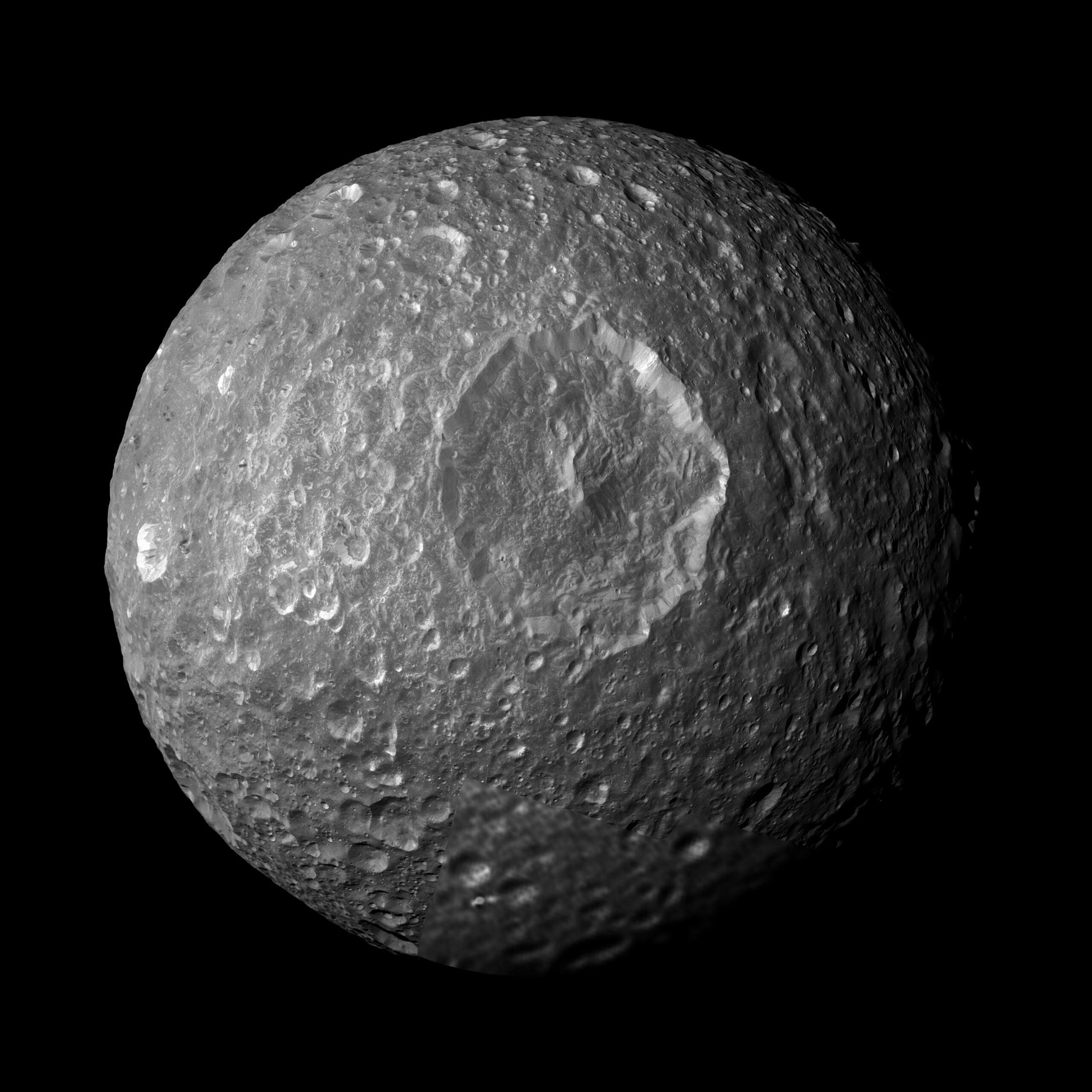
Mimas does not look like an ocean world. It is small, cold and covered in old impact scars, with none of the obvious fractures or plumes that made Saturn’s moon Enceladus famous. Its enormous Herschel crater gives it the accidental appearance of the Death Star, but otherwise the surface seems almost determined to reveal nothing.
That is why the conclusion published in Nature in February 2024 was so unexpected. Valéry Lainey and his colleagues found that Mimas’s heavily cratered ice shell is best explained by a global ocean about 20 to 30 kilometres beneath the surface.
The word “confirmed” deserves a little care. No camera has photographed this water and no probe has drilled through the ice. The evidence comes from precise measurements of how Mimas moves, combined with models of its interior. It is a strong geophysical case, not a direct sighting, and future spacecraft data could still refine the picture.
The clue was in the orbit
NASA’s Cassini spacecraft spent more than a decade studying Saturn and its moons. Among the observations it returned were repeated images that allowed astronomers to track Mimas’s position and its slight rotational wobble, known as libration.
Earlier work had already shown that the wobble was difficult to reconcile with a simple, completely frozen moon. One possible explanation was a strangely shaped rocky core. Another was a layer of liquid water separating the outer ice from the interior.
Lainey’s team examined an additional signal: the slow drift of the point in Mimas’s orbit where it comes closest to Saturn. Their numerical model could reproduce both that orbital motion and the measured libration when Mimas contained a global ocean under a shell 20 to 30 kilometres thick. The frozen-body alternative did not fit the combined measurements as well.
A very young sea beneath a very old-looking surface
The age estimate needs almost as much care as the detection. The Observatoire de Paris, where Lainey works, described the ocean as forming roughly 5 to 15 million years ago. The Nature paper itself gives a broader limit, saying it is likely less than 25 million years old. Its models also suggest the boundary between ice and water moved to within 30 kilometres of the surface only in the past 2 to 3 million years.
Those figures are not three competing ages. They describe related stages in a model of melting and ice-shell thinning. The honest conclusion is that the ocean appears geologically young, while its exact birthday remains model-dependent.
That youth helps explain the apparent contradiction above it. Mimas may simply not have had enough time to develop the fractured, resurfaced terrain associated with older ocean worlds. A 2022 Geophysical Research Letters study of Herschel crater reached a compatible result: if an ocean exists today, the ice shell must have been tens of kilometres thicker when the basin formed.
Why a cratered moon fooled us
NASA describes Mimas as the smallest and innermost of Saturn’s major moons, about 394 kilometres across. Herschel crater alone spans roughly 130 kilometres, close to one-third of the moon’s diameter. Much of the remaining surface is saturated with craters.
Researchers had good reasons to read that landscape as a frozen record. Warm, mobile ice tends to soften old topography, while internal activity can produce ridges, fractures and fresh deposits. Mimas shows little of that. The surface interpretation was reasonable; it was simply incomplete.
In an earlier Space Daily article, I looked at how tidal heating can keep oceans liquid far beyond the Sun’s traditional habitable zone. Mimas is an unusually restrained version of the same physics. Saturn’s changing pull on its slightly non-circular orbit flexes the moon and generates heat inside it, but the details of how that heating intensified so recently are still being worked out.
Mimas changes the search image
Europa and Enceladus taught astronomers to look for disrupted ice, young terrain and material escaping from below. Mimas suggests that an ocean can exist before those outward signs become obvious.
That matters because the Solar System contains many small icy bodies whose surfaces look unpromising. It does not follow that every cratered moon hides water. It does mean appearance alone is a weaker filter than it once seemed. Rotation, orbital drift, gravity and heat flow may reveal interiors that photographs cannot.
The contrast is especially clear beside my recent piece on Europa’s ocean beneath an estimated 29 kilometres of ice. Europa advertises internal change across a fractured surface. Mimas may conceal a similarly deep boundary beneath terrain that still looks ancient and quiet.
What we still do not know
An ocean is not evidence of life, and the 2024 study did not claim to detect biology or even measure the ocean’s chemistry. Researchers still do not know its salinity, the extent of water-rock interaction, or how long liquid water will persist.
A separate 2024 thermal-orbital study, summarised by the US Geological Survey, found that a growing ocean was plausible if melting began within roughly the past 10 to 15 million years, when Mimas’s orbital eccentricity was much higher. That model predicts the ocean could eventually enter a freezing phase as the orbit continues to change. It is a possible history, not a timetable anyone should treat as settled.
I find the quieter lesson more interesting than the dramatic one. Mimas did not suddenly become strange in 2024. It had been carrying this hidden structure while Cassini photographed a surface that seemed to say the opposite. The discovery is a reminder that worlds do not owe us visible clues, and that sometimes the most revealing measurement is not an image at all, but a tiny mismatch in an orbit.