

At 03:57:21 Universal Time on 1 March 1982, Venera 13 settled onto Venus after an atmospheric descent lasting roughly an hour. The Soviet lander had a planned surface lifetime of 32 minutes. It kept transmitting for 127 minutes, nearly four times that engineering target.
Those two hours and seven minutes produced more than a durability record. Venera 13 drilled the ground, moved a sample into an analysis chamber, measured its elemental composition and returned the first colour photographs from the surface of Venus. It did all of this while its pressure vessel sat in an atmosphere roughly 89 times denser than Earth’s at sea level and hot enough to melt lead.
The mission has also accumulated a layer of folklore. The verified record is impressive enough without it. The 127 minutes mark confirmed transmission, not a photographed instant when the lander melted or was crushed. The exact temperature varies across summaries, but NASA’s deep-space chronology gives 465°C and 89.5 atmospheres, matching the title’s figure.
Thirty-two minutes was a plan, not a countdown
Venus combines two engineering hazards that are difficult enough separately. Its carbon-dioxide atmosphere applies about nine megapascals of pressure at the Venera 13 site, while the surrounding gas pushes heat relentlessly into every exposed structure. Conventional electronics, seals, lubricants and cables cannot operate indefinitely in that environment.
Soviet engineers placed the instruments and electronics inside a titanium pressure vessel protected by insulation and thermal mass. The lander was cooled before it separated from the carrier spacecraft. Once it entered the atmosphere, however, there was no active refrigerator capable of rejecting heat into air already hundreds of degrees hotter than the payload.
The planned 32-minute life was the period for which the mission was designed to return useful surface science. It was not a timer that switched the probe off. Thermal models and component limits set a conservative boundary, while the real hardware and real landing conditions determined how long the margin lasted.
That architecture remains relevant. NASA notes that even the most robust Venera and Vega landers survived between 23 and 127 minutes, one reason engineers have studied mechanical rovers and high-temperature electronics for future Venus exploration.
The descent used Venus’s dense air as a brake
Venera 13 launched on 30 October 1981 as a descent craft attached to a flyby carrier. It separated on 27 February 1982 and entered Venus’s atmosphere two days later. A heat shield absorbed the first violent deceleration, after which a parachute slowed the capsule and gave its instruments time to sample the atmosphere and clouds.
A parachute that helps high above Venus becomes unnecessary lower down. The carbon-dioxide atmosphere thickens so greatly that the lander’s wide circular platform could provide sufficient aerodynamic drag. The parachute was released, avoiding a slow descent that would have consumed precious thermal margin before touchdown.
The craft landed at about 7.5 metres per second near 7.55 degrees south and 303.69 degrees east in Phoebe Regio. The carrier continued past Venus at a closest distance of roughly 36,000 kilometres, receiving the lander’s signal and relaying it to Earth.
This communication design explains an important boundary around the famous survival time. Venera 13 did not transmit directly to a permanent orbiter overhead. The confirmed record lasts as long as useful data reached the receding carrier and then Earth.
The first colour views were carefully constructed
Earlier Soviet missions had already opened a visual window onto Venus. Venera 9 returned the first photograph from the surface of another planet in 1975, followed by Venera 10. Their panoramas were black and white. Venera 11 and 12 carried colour systems, but their lens covers failed to release.
Venera 13 succeeded. Two panoramic telephotometers looked in opposite directions after pyrotechnic devices removed their protective caps. The cameras did not take modern digital snapshots. They scanned the scene line by line through colour filters while the transmitter sent each strip upward.
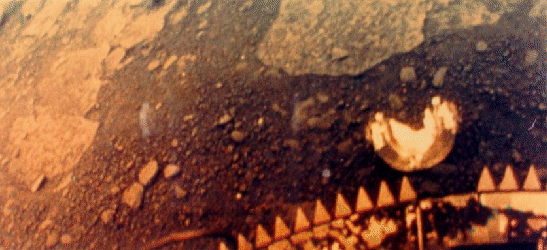
The resulting views show angular slabs, smaller fragments and loose material beneath an orange-brown sky, with the landing ring and discarded hardware in the foreground. The NASA Space Science Data Coordinated Archive catalogs 14 images from the 127-minute surface session. Other mission histories count completed panoramas differently, which is why totals vary among summaries.
Colour balance is reconstructed from filtered scans and depends on calibration choices. The familiar orange versions are not a simple camera-phone rendering of what human eyes would have seen. Even so, the NASA-hosted Venera 13 panorama is part of the first colour photographic record made on Venus’s surface.
The drill completed a laboratory sequence on another planet
Photography was only one part of the surface programme. Venera 13 carried a drilling and sampling system connected to an X-ray fluorescence spectrometer. After touchdown, the mechanism bored into the ground and transferred material into a sealed chamber where the instrument could examine it under controlled conditions.
X-ray fluorescence works by exciting atoms in a sample and measuring the characteristic X-rays they emit. The pattern identifies elements and helps researchers infer rock composition. Venera 13’s result was consistent with a potassium-rich alkaline basalt, often compared with terrestrial leucite-bearing basalt.
NASA’s historical survey credits Venera 13 with the first soil analysis from Venus, while also listing atmospheric composition, electrical discharge and cloud measurements. The word “soil” is conventional planetary shorthand here. The sample was loose surface material and crushed rock, not biologically formed soil in the terrestrial sense.
The measurement should not be stretched into a global geological conclusion. Venera 13 examined one small place. Venera 14 and Vega 2 later returned compositions from other sites, and orbital radar has supplied regional context, but Venus still lacks the broad ground-truth network available on Mars.
The lander may not have failed at minute 127
Many retellings end with the probe being crushed, melted or consumed by the atmosphere at exactly 127 minutes. The mission record supports a more careful statement: Venera 13 transmitted surface data for 127 minutes. The loss of a relayed signal does not identify which component reached its limit.
The pressure vessel had already demonstrated that it could hold the ambient load. Heat was continuously migrating inward, so eventual electronic failure was unavoidable. At the same time, the carrier spacecraft was moving away and the radio geometry was deteriorating. Venera 13 may have remained functional beyond the last data received on Earth, but there is no observation with which to extend the confirmed time.
That is why “survived for 127 minutes” is best understood as a minimum verified operational duration. Guinness records it as the longest transmission from Venus’s surface, and the Lunar and Planetary Institute’s Russian mission summary likewise pairs the 32-minute design life with 127 minutes of operation.
Earlier SpaceDaily coverage focused on the lander’s drilling and colour imagery. The engineering distinction adds something important: the record is what the communications system proved, not necessarily the exact lifetime of every component left on the surface.
Why two hours still stands as the benchmark
Venera 14 landed four days later with nearly identical hardware and returned data for 57 minutes. Vega 1 and Vega 2 reached Venus in 1985, releasing landers and balloons. No spacecraft has since transmitted from the surface, leaving Venera 13’s two hours and seven minutes as the benchmark more than four decades later.
Future Venus missions need not repeat the same design trade. Silicon-carbide electronics can tolerate temperatures that destroy conventional silicon circuits. Mechanical systems may take over functions normally assigned to computers. Short-lived descent probes can also target chemistry without attempting months of surface work.
Still, the essentials of Venera 13’s success remain instructive: arrive cold, descend quickly, protect a small interior, sequence the science automatically and send every result immediately. There was no opportunity to troubleshoot from Earth while a drilling cycle unfolded beneath an alien sky.
The planned 32 minutes guaranteed enough time for the core experiment. The unexpected 95 minutes that followed multiplied the imagery and environmental record. Venera 13 did not conquer Venus in any lasting sense. It turned a narrow thermal window into the first colour portrait and first sampled chemistry of a surface that spacecraft have not touched since 1985.