

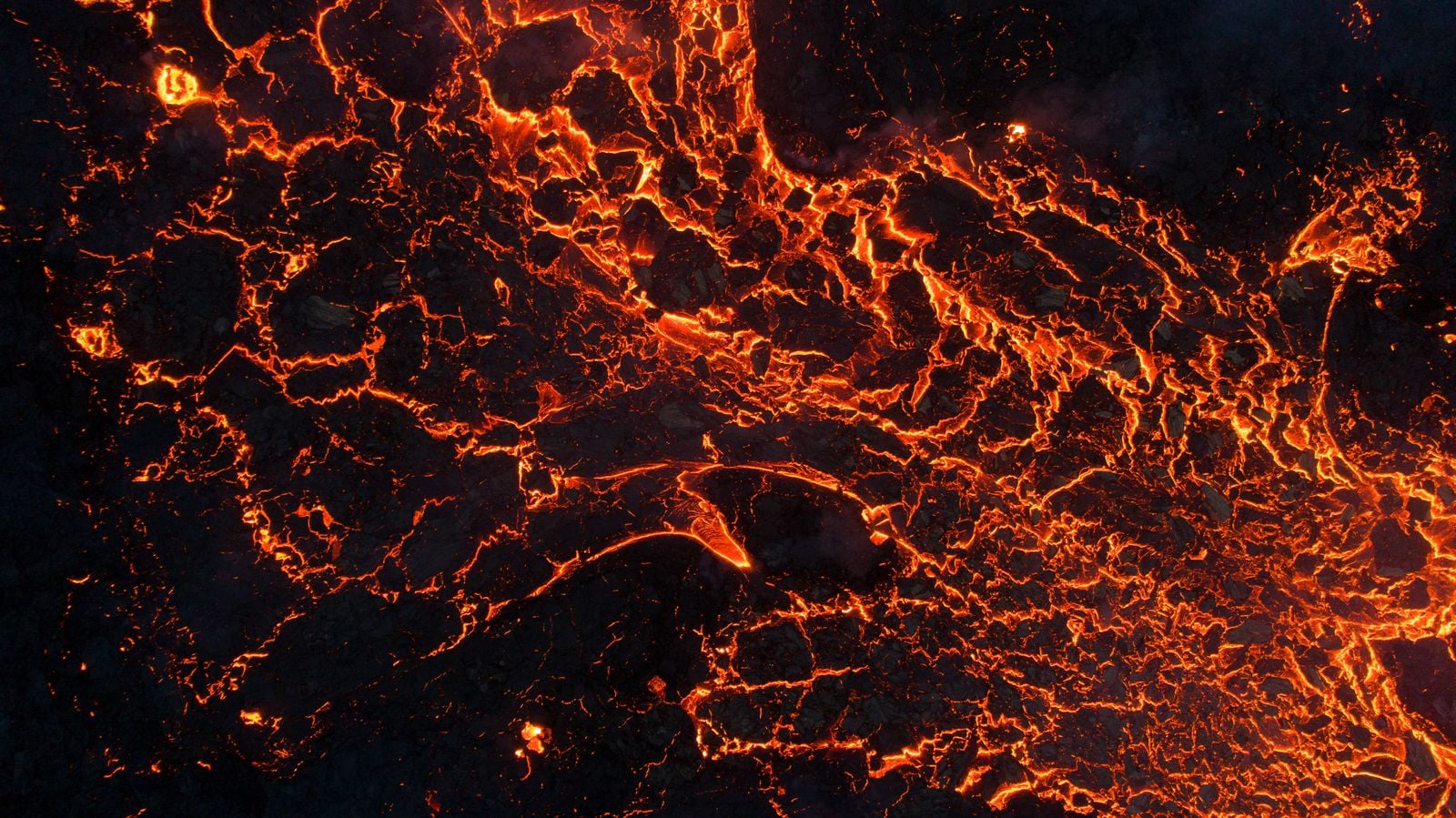
On 1 March 1982, a Soviet lander named Venera 13 fell through the sulphuric acid clouds of Venus, deployed a parachute it would soon discard, and set down on a basalt plain at about 7.5 degrees south latitude in the eastern reaches of Phoebe Regio. It was built to last 32 minutes on a surface at roughly 457 degrees Celsius — hot enough to melt lead, which liquefies at 327. It lasted 127. In those two hours and seven minutes it drilled the ground, tasted the rock with X-rays, sent home the first colour photographs ever taken from the surface of another planet, and did something no spacecraft had ever done before or has done since: it recorded the sound of the wind.
That audio, faint and gritty and filtered through a microphone pressed against an alien atmosphere ninety times denser than Earth’s, is still the only recording humanity possesses of another planet’s surface acoustics.
What the lander actually was
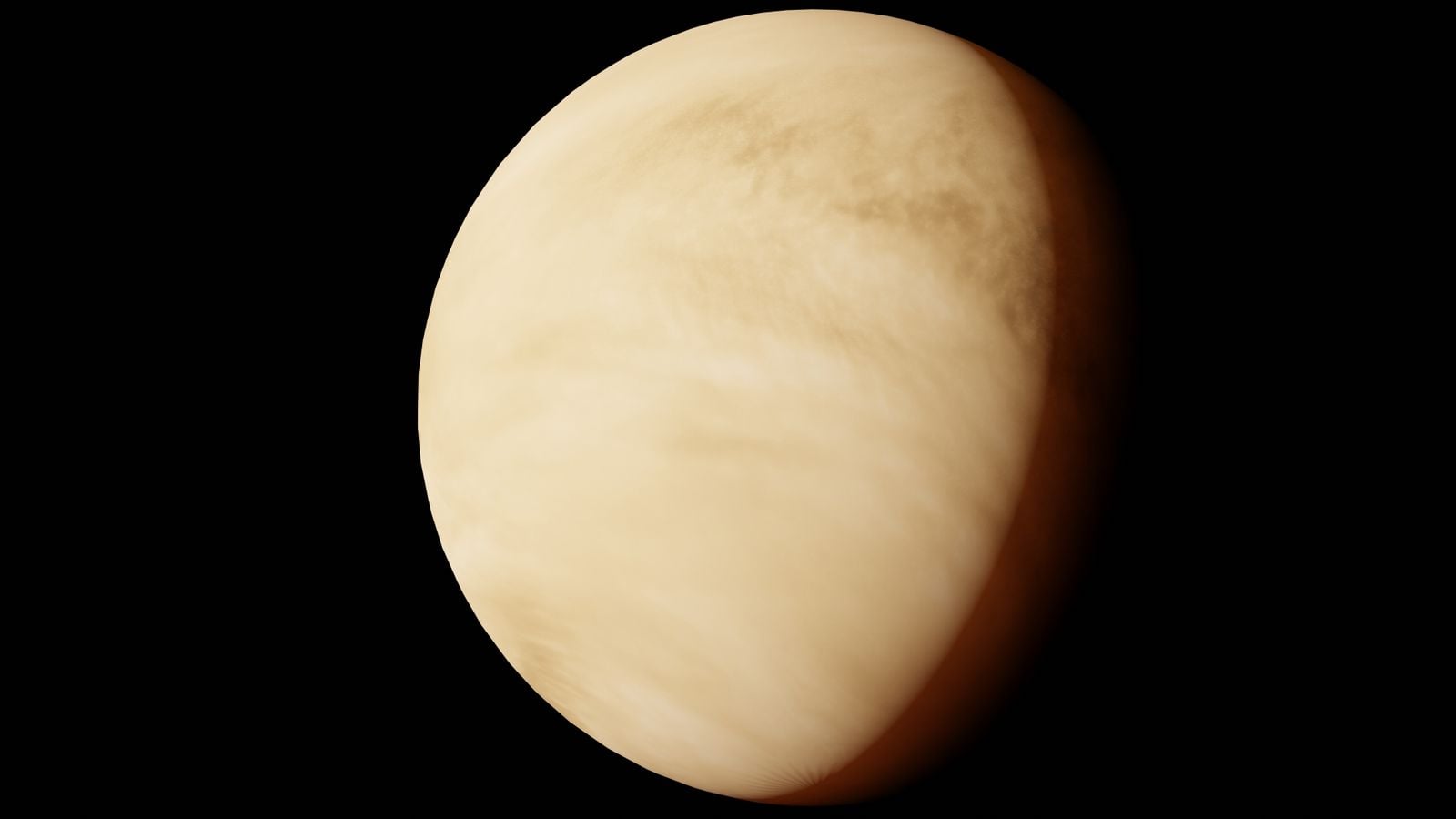
Venera 13 was a titanium pressure sphere wrapped in insulation and bolted to a ring-shaped landing collar, all of it perched atop a cruise stage that had left Baikonur on 30 October 1981. The design lineage ran back through more than a decade of Soviet attempts to make hardware survive the Venusian surface. The first surface photograph from another planet came from Venera 9 in 1975, a grainy black-and-white panorama of sharp-edged rocks that lasted 53 minutes before being crushed.
Venera 13 was built to do more. It carried two camera systems facing opposite directions, an X-ray fluorescence spectrometer fed by a drill, a gas chromatograph, penetrometers, thermometers, a nephelometer for the clouds, and — nearly forgotten in most retellings — a microphone.
The descent
The descent module separated from the cruise stage on approach. It hit the upper atmosphere at around 11.2 kilometres per second, decelerating under a heat shield, then deployed a parachute to slow it through the sulphuric acid cloud deck between about 62 and 47 kilometres in altitude. Below the clouds, in air already hot enough to bake bread, the parachute was jettisoned. The lander fell the rest of the way on aerodynamic braking alone, using the disc-shaped landing collar to shed velocity in the thickening carbon dioxide.
By the time it touched down, the outside air was around 457 degrees Celsius at a pressure of about 89 Earth atmospheres — comparable, as the ECOticias summary of the mission puts it, to being roughly 3,000 feet underwater. The lander had been pre-chilled in the cruise stage to buy thermal margin. Every minute on the surface, heat crept inward through the insulation toward the electronics.
The colour panoramas
Two camera systems — designated V-13-1 and V-13-2, facing opposite directions from the lander body — began scanning as soon as the protective lens covers were pyrotechnically ejected. The images built up in strips, line by line, as the cameras swept back and forth across the horizon.
What came back was a landscape of flat, plate-like basaltic rocks and darker fine-grained soil under a sky rendered orange by the way the thick atmosphere filtered incoming sunlight. Colour reconstruction depends on how the raw data is processed, and different research groups have produced slightly different balances over the decades. The broad impression has never changed: a rocky plain under a heavy, sulphur-tinted sky, with parts of the lander itself — the toothed landing ring, the discarded lens cap — visible in the foreground.
These were the first colour photographs taken from the surface of any planet other than Earth.
The drill, and the rock it found
Roughly two minutes after landing, a mechanical arm swung out and drilled into the surface. It bored to a depth of about three centimetres, extracted a sample, and transferred it into a sealed chamber inside the lander that had been kept at around 30 degrees Celsius and 0.05 atmospheres — a small pocket of Earth conditions surrounded by hell.
Inside that chamber, an X-ray fluorescence spectrometer bombarded the sample and read the fluorescence spectrum of the elements present. The result placed the Venera 13 site among alkaline basalts, chemically distinct from the tholeiitic basalts later analysed at the Venera 14 site about 950 kilometres away. To this day, the Venera and Vega landers remain the only sources of direct, in-situ chemical measurements of the Venusian surface.
The audio nobody talks about
Bolted to the outside of the pressure vessel was a small microphone. It had been included partly to characterise wind speed near the ground and partly to record the acoustic signature of the descent itself — the pyrotechnic firings, the drill, the impact of ejected soil.
On a planet with an atmosphere as dense as shallow seawater, sound behaves strangely. Low frequencies carry differently. The speed of sound changes. A gust that would be a whisper on Earth becomes a shove. The Venera 13 microphone captured the ambient rustle of Venusian wind moving past the lander — a low, grinding hiss — along with the mechanical noise of the probe going about its business.
Forty-four years on, no other spacecraft has repeated the feat on Venus. NASA’s Perseverance rover has since recorded audio on Mars, and Huygens returned acoustic data during its descent through Titan’s atmosphere in 2005, but no mission has again put a working microphone on the surface of Venus. Venera 13’s recording remains the only audio anyone has of that world.
Why 127 minutes and not 32
The 32-minute design life was not pessimism. It was the honest expectation given the thermal load. Venus pushes heat into a lander through every mechanism available — conduction through the landing ring, convection off the dense atmosphere, radiation from the hot ground — and once internal temperatures pass the tolerance of the electronics, everything stops at once.
Venera 13 outperformed its budget by a factor of nearly four. The pressure vessel held. The insulation worked better than modelled. The thermal mass — the raw amount of pre-chilled metal and coolant that had to warm up before the electronics failed — absorbed heat for longer than the engineers had promised themselves it would.
Even so, 127 minutes is what Venus allows. As the Times of India noted in coverage of the wider Venera programme, ten Soviet probes reached the Venusian surface across the 1970s and early 1980s. The longest survivor lasted about two hours. Venera 13 sits at the top of that list.
The ‘scorpion’ that probably wasn’t
Thirty years after the landing, the Venera 13 images had a strange second life. In 2012, Leonid Ksanfomality, a senior researcher at the Space Research Institute of the Russian Academy of Sciences and a veteran of the Venera programme, published a discussion paper in Solar System Research re-examining the panoramas. He argued that several objects in the images resembled living beings — a ‘disk’, a ‘black rag’, and a chevron-shaped structure he called a ‘scorpion’ — that appeared, moved, or disappeared between frames.
Most planetary scientists were unconvinced. The candidate objects sat within the ranges expected for image noise, ejected soil around the landing ring, and detached hardware — a discarded lens cap being the most obvious explanation for the ‘disk’. The Venera 13 site is a place where the air melts lead and dissolves organic chemistry on contact with acid clouds. Life would require a biochemistry the periodic table does not obviously supply.
The episode is worth mentioning less as a claim than as a reminder of how much information is packed into those panoramas — enough that people are still arguing about what is in them four decades later.
Why Venus is the hardest place to land
Mars is cold. The Moon is airless. Titan is frozen. Venus does something worse: it cooks and crushes at the same time. In an essay on why planetary science keeps returning to Venus, researchers describe a world where a runaway greenhouse has driven surface conditions past anything a normal spacecraft can endure. Silicon electronics stop working. Solder softens. Lubricants boil off. Optical windows fog with sulphuric acid on the way down.
Space Daily has explored before how Venus is almost exactly Earth’s size and formed right beside us, yet ended up as the most hostile world in the solar system. The Venera engineers were, in a real sense, designing bathyspheres that also had to survive a blast furnace, and the fact that anything at all came back is a testament — no, is simply astonishing.
What the mission does not show
Venera 13 did not resolve the geology of Venus. It sampled two square metres of a single site. It did not measure the age of the surface, map the volcanic history, or settle whether the planet is currently tectonically active. A 2017 Nature Geoscience commentary on Venus reawakening as a research target pointed out how thin the ground-truth dataset remains: a handful of Soviet landers, none since 1985, and no acoustic, seismic, or long-duration measurements at all.
The panoramas are not a survey. They are a keyhole view. Everything planetary scientists know about the chemistry of the Venusian surface rests on X-ray fluorescence readings from three sites — Venera 13, Venera 14, and Vega 2 — each taken in the last minutes of a dying spacecraft.
What comes next
NASA has since selected two Venus missions, DAVINCI and VERITAS, and ESA is developing EnVision. Researchers at NASA’s Glenn Research Center are testing silicon carbide electronics in chambers that simulate the Venus surface for weeks at a time, hoping to build hardware that lasts not two hours but two months. A KQED feature on the coming return to Venus notes how much of the current work still leans on Venera-era data.
None of the new missions currently plan to carry a surface microphone.
Which means that for the foreseeable future, if you want to hear another planet — not Mars, not Titan, but somewhere else — the only recording that exists is the one Venera 13 made on 1 March 1982, in the 127 minutes between touchdown and the moment the pressure and the heat finally reached the tape.
The signal came home. The lander did not.