

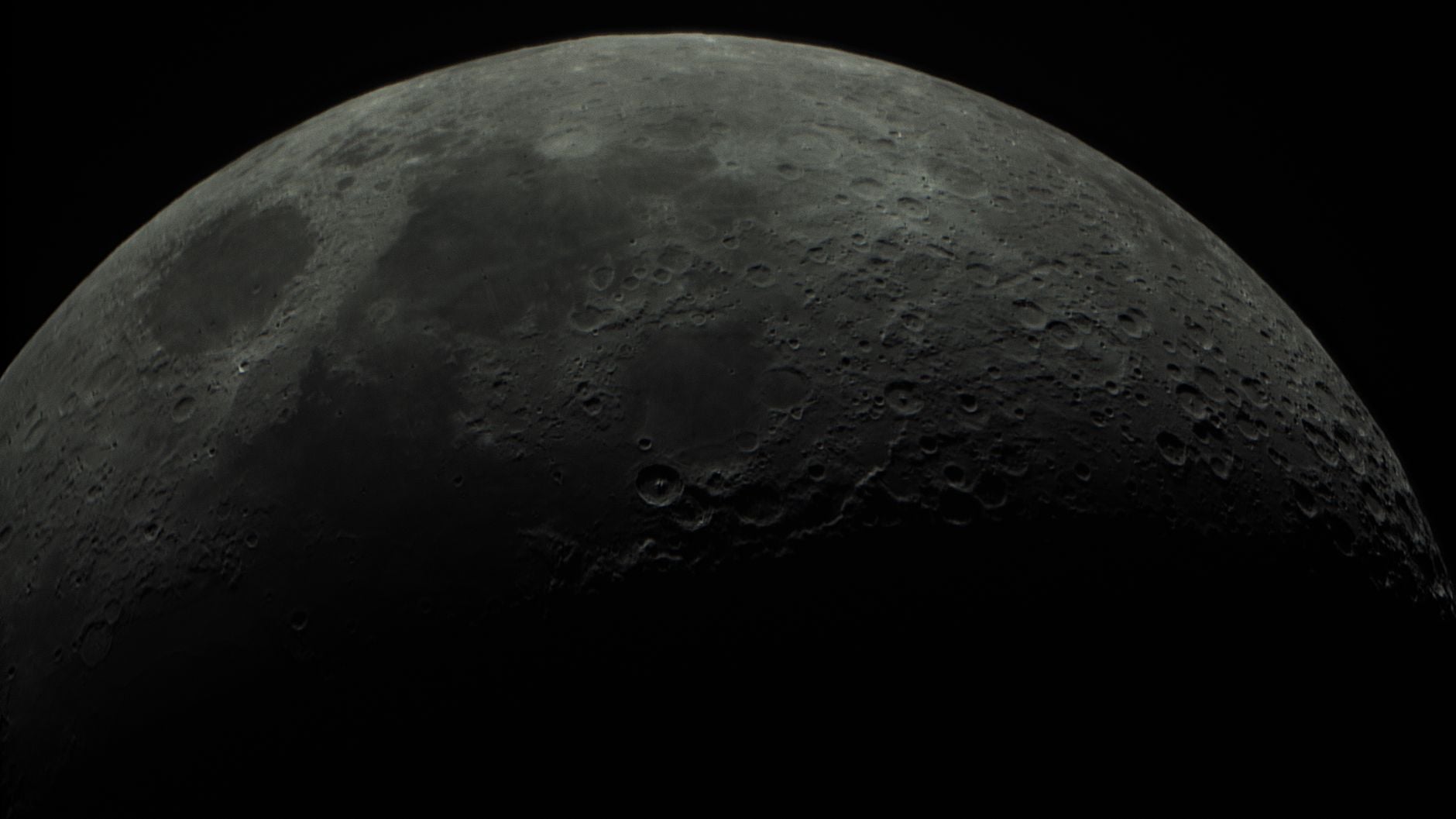
A roughly four-tonne machine built on Earth ended an uncontrolled 18-month journey by striking the Moon on 5 August 2026.
It was the upper stage of the SpaceX Falcon 9 that launched Firefly Aerospace’s Blue Ghost Mission 1 and ispace’s Resilience lander on 15 January 2025. After deploying the two spacecraft into a high, Moon-crossing orbit, the expendable stage could not make the controlled atmospheric re-entry that normally disposes of a Falcon 9 upper stage.
Instead, it spent about 18 months and three weeks moving through cislunar space. Repeated gravitational nudges and the much smaller pressure of sunlight altered its path until it hit near Einstein Crater at about 2.43 kilometres per second, or 8,700 kilometres per hour.
There is one important boundary around the headline number. The impact is confirmed by before-and-after orbital imagery, which shows a fresh dark surface change at the predicted site. The description of a crater tens of metres wide is still based mainly on pre-impact modelling. Published estimates ranged from the high teens to about 40 metres. A precise diameter measured from high-resolution post-impact images has not yet been published.
The launch created three very different endings
The NASA launch record places liftoff at 1:11 a.m. Eastern time from Kennedy Space Center’s Launch Complex 39A. The mission was called Ghost Riders in the Sky, and it carried two commercial Moon landers sharing one rocket.
Blue Ghost went on to make a successful landing in Mare Crisium on 2 March 2025 and completed its planned surface mission. Resilience reached lunar orbit, but crashed during its landing attempt on 5 June. The Falcon 9 stage that had sent both spacecraft on their way followed a third path.
The reusable first stage returned to Earth shortly after launch. The upper stage was expendable. By the time it had supplied the energy needed for the distant deployment, it did not have the propellant margin for the sort of controlled burn that usually sends a Falcon 9 stage into Earth’s atmosphere over an unpopulated area. It remained in a highly elongated Earth orbit that extended to lunar distance, catalogued as 2025-010D.
“Drifting” did not mean moving without rules
The stage is often described as having drifted. That is useful shorthand for the absence of control, but it can give the wrong picture. The rocket body did not float aimlessly. It followed an orbit governed by Earth, the Moon and the Sun.
At lunar distance, that orbit was sensitive. Each close passage could reshape it. Sunlight also exerted a very small force on the broad, tumbling cylinder. The effect of solar radiation pressure is tiny from moment to moment, yet it accumulates over many months and complicated efforts to predict an exact impact point.
Independent orbital tracker Bill Gray explains the changing solution in his Project Pluto record for 2025-010D. Observations gradually narrowed the arrival to shortly after 06:34 UTC on 5 August, near the Moon’s western limb.
The object’s identity was also checked rather than simply assumed. Researchers propagated its orbit backwards to the January 2025 launch and compared its visible and near-infrared spectrum with known spacecraft materials. Their physical-characterisation preprint found absorption features consistent with spacecraft thermal-control coatings and a changing brightness pattern compatible with an elongated, rotating body. The combined orbit, spectrum and shape make the Falcon 9 attribution strong, although the study remains a preprint rather than a peer-reviewed journal paper.
The collision is confirmed more firmly than its dimensions
South Korea’s Danuri lunar orbiter passed over the expected site shortly after the collision and obtained images showing a new dark mark. NASA’s Lunar Reconnaissance Orbiter also examined the area. The before-and-after change is the physical evidence that turns a highly certain forecast into a confirmed impact.
An Associated Press report on Danuri’s images gives the impact speed as 5,400 miles per hour, or about 8,700 kilometres per hour. That is slow compared with many natural meteoroids, which can strike the Moon at tens of kilometres per second, but it is still enough to excavate a substantial volume of regolith.
What the early public images do not yet provide is a clean ruler across the finished crater. A fresh dark patch can include overturned regolith and ejecta beyond the crater rim. Its apparent width can also change with the camera’s resolution, viewing angle and illumination. The orbital scar is real; one exact crater diameter is not yet an observed result.
“Tens of metres” is a model range, not a tape-measure reading
Before impact, researchers published a coordinated observing plan and simulation study. One widely reported calculation put the likely crater near 27 metres across and about five metres deep. Other approaches produced estimates closer to 17 or 18 metres, while the physical-characterisation team discussed a value near 40 metres.
That spread is not evidence that the calculations were careless. It reflects inputs that could not be known exactly. Estimates of the spent stage’s mass ranged from roughly 3,900 to 4,500 kilograms because nobody had a final measurement of residual propellant. The angle and orientation at impact mattered too. A mostly hollow cylinder arriving end-on will not transfer its energy into the ground in quite the same way as one arriving side-on.
The target also matters. Loose regolith, compacted material and exposed rock produce different crater and ejecta patterns. Models have to simplify some of those conditions before the actual site is surveyed.
This is why the event has scientific value despite being unplanned. Researchers know the object’s approximate mass, composition, trajectory and speed far better than they usually know those properties for a natural impactor. When a reliable crater measurement becomes available, it can test how well impact models describe a thin-walled rocket body striking lunar soil at relatively low speed.
A small scar can carry a large operational warning
On the scale of lunar geology, a crater a few tens of metres wide is trivial. The Moon has absorbed billions of natural impacts, including collisions vastly more energetic than this one. There were no people or operating installations near the site, and the event posed no danger to Earth.
The operational concern is different. A four-tonne uncontrolled object repeatedly crossed the region where more nations and companies are placing orbiters, communications relays, landers and eventually crewed systems. The Moon has no dense atmosphere to remove abandoned hardware. Objects on unstable cislunar paths can remain difficult to track and can be redirected by encounters that are hard to forecast years in advance.
SpaceDaily previously reconstructed the unusually complete biography of 2025-010D, from its launch and spectral identification to its predicted arrival. That tracking work was impressive. It also underlines a basic distinction: knowing where an abandoned stage will hit is not the same as placing it on a responsible disposal trajectory.
An accidental impact can sometimes produce useful science, but that benefit should not become an excuse. Deliberate lunar impactors are targeted, coordinated and observed as missions. An uncontrolled stage is an object whose final hazard was accepted before anyone knew exactly where it would go.
Heliocentric disposal removes the stage from the busy corridor
For many low-Earth-orbit missions, the preferred end is atmospheric re-entry. A final burn lowers the stage into the atmosphere, where it breaks apart over a planned remote zone. High-energy lunar missions can make that option difficult because almost all available performance is devoted to the payload.
The other practical route is heliocentric disposal. The stage receives enough energy to leave the Earth-Moon system and continue in orbit around the Sun. NASA has studied the guidance required for upper-stage heliocentric disposal, including trajectories that use a lunar flyby to achieve Earth escape.
There is evidence that later mission planning moved in that direction. The Falcon 9 upper stage from the February 2025 IM-2 lunar launch, catalogued as 2025-038E, is listed in solar orbit rather than a long-lived Moon-crossing Earth orbit. That is one clear later lunar example. Other deep-space launch systems also plan heliocentric disposal for their spent stages.
This evidence supports a shift in practice, but it does not prove that every newer lunar launch now follows the same rule. Disposal depends on payload mass, injection requirements, launch geometry and the propellant left after separation. “Safely” is also relative. A solar orbit does not destroy the stage or guarantee that it can never encounter another body. It moves the hardware into a vastly larger volume and sharply reduces its near-term exposure to Earth, the Moon and operating cislunar spacecraft.
The lesson of 2025-010D is therefore less dramatic than the collision and more useful. The rocket completed its launch mission successfully. The failure came in treating the stage’s post-deployment path as someone else’s future problem. As lunar traffic grows, disposal can no longer be the footnote after payload separation. It has to be one of the trajectories a mission is designed to achieve.