

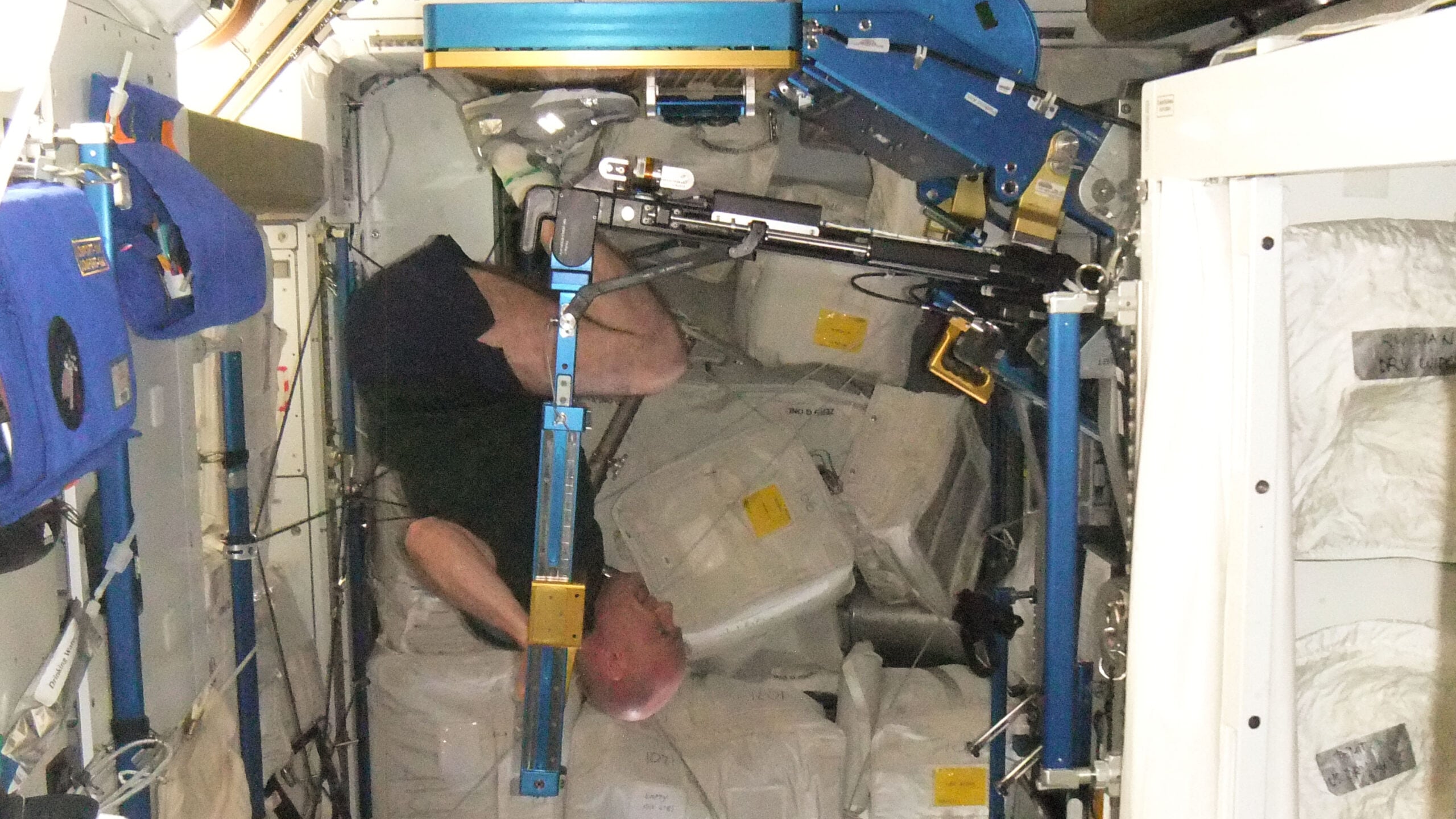
Astronauts do not lose bone evenly in microgravity. The largest changes occur in structures that normally support body weight, particularly the hips, pelvis, legs and spine. Remove the daily forces of standing and walking, and the balance of bone remodelling shifts: cells that build bone slow down while cells that remove old tissue continue working.
NASA’s average of 1 to 1.5 percent mineral-density loss per month gives the Mars problem its scale. A nine-month outbound journey would be longer than the usual six-month space station expedition, and it would end without Earth’s gravity, hospitals or a postflight rehabilitation team waiting beside the capsule.
What the monthly loss figure actually measures
NASA’s current spaceflight bone-risk summary says weight-bearing bones lose between 1 and 1.5 percent of their density each month on average during four-to-six-month missions. The agency’s broader review of the human body in space uses the same range and notes that recovery after return may be incomplete.
This is not a uniform subtraction from the entire skeleton. The skull and arms do not unload in the same way as the hip and lower limbs, and astronauts show substantial individual variation. Bone mineral density measured by scans is also only one contributor to strength. Bone geometry and microscopic structure help determine whether a bone can resist a particular load.
The range remains useful because it is far faster than ordinary age-related loss on Earth. SpaceDaily has previously examined how spaceflight bone research overlaps with osteoporosis research, but a Mars crew faces the additional problem of needing immediate physical capability on another planet.
Nine months is not a simple multiplication
Multiplying the monthly range by nine produces 9 to 13.5 percent. That is a useful warning, but not a reliable prediction for an individual astronaut. The figures come mainly from missions lasting four to six months, and scientists do not yet know whether loss continues linearly, slows or changes in a different way during longer exposure.
A peer-reviewed model of bone mineral density on a human Mars mission emphasised this uncertainty and used a non-linear approach rather than assuming the same amount disappears every month forever. Exercise history, nutrition, sex, age and individual biology all alter the trajectory.
The title therefore says astronauts “could” be substantially deconditioned. It does not claim every crewmember will lose exactly 13.5 percent, or that bone loss alone defines their condition. Muscles, cardiovascular capacity and balance also adapt to weightlessness.
Mars gravity arrives before rehabilitation
On Earth, returning crews are helped from their capsule and begin supervised recovery. Mars offers about 38 percent of Earth’s surface gravity and no recovery team. After months of floating, astronauts may need to tolerate landing forces, leave the vehicle, stand in a pressure suit, move supplies and respond to an emergency.
That transition makes deconditioning an operational problem. A bone does not need to fracture for reduced strength to matter; weak muscles and altered coordination can increase fall risk, while calcium released from bone can contribute to kidney stones. A crew capable of surviving the cruise must also be capable of working after arrival.
NASA research has long treated six to nine months as a plausible interval of outbound microgravity exposure. An agency technical review of artificial gravity and bone health used that range while warning that physiological deconditioning could threaten exploration missions.
Two hours of exercise is the current defence
International Space Station crews exercise for roughly two hours each day. The Advanced Resistive Exercise Device can imitate squats, deadlifts and other loaded movements, while treadmills and cycle ergometers train muscles and cardiovascular capacity. NASA’s review of bone and muscle countermeasures explains why this combination is central to present missions.
The station, however, has far more habitable volume and electrical power than a transit vehicle may provide. Exercise machines must fit within strict limits on mass, space, vibration and maintenance. They must also keep working far from spare parts and ground support.
Nutrition and medication may add protection. Adequate energy, protein, calcium and vitamin D matter, while studies have tested bisphosphonates and other treatments. No single intervention removes the need for mechanical loading, and a countermeasure that preserves one tissue may not preserve every aspect of balance or cardiovascular performance.
Long missions are testing the unknown part of the curve
NASA’s CIPHER research programme compares missions from weeks to a year to determine whether changes in bones, muscles and other systems plateau, continue or interact over time. Those data are necessary because Mars mission planners cannot confidently extend every six-month trend across a multi-year expedition.
Artificial gravity could provide more direct loading by rotating a spacecraft or a smaller exercise system, but it adds structural, control and human-factors challenges. Researchers also do not yet know the best combination of gravity level and exposure time. Mars surface gravity itself may slow further loss, but 38 percent of Earth gravity has never been tested in humans for months.
The 1 to 1.5 percent figure is therefore neither destiny nor a trivial statistic. It defines a serious risk drawn from current flight evidence. A nine-month crew could reach Mars with meaningful skeletal and whole-body deconditioning, so arrival fitness has to be protected throughout the journey, not restored after it.