

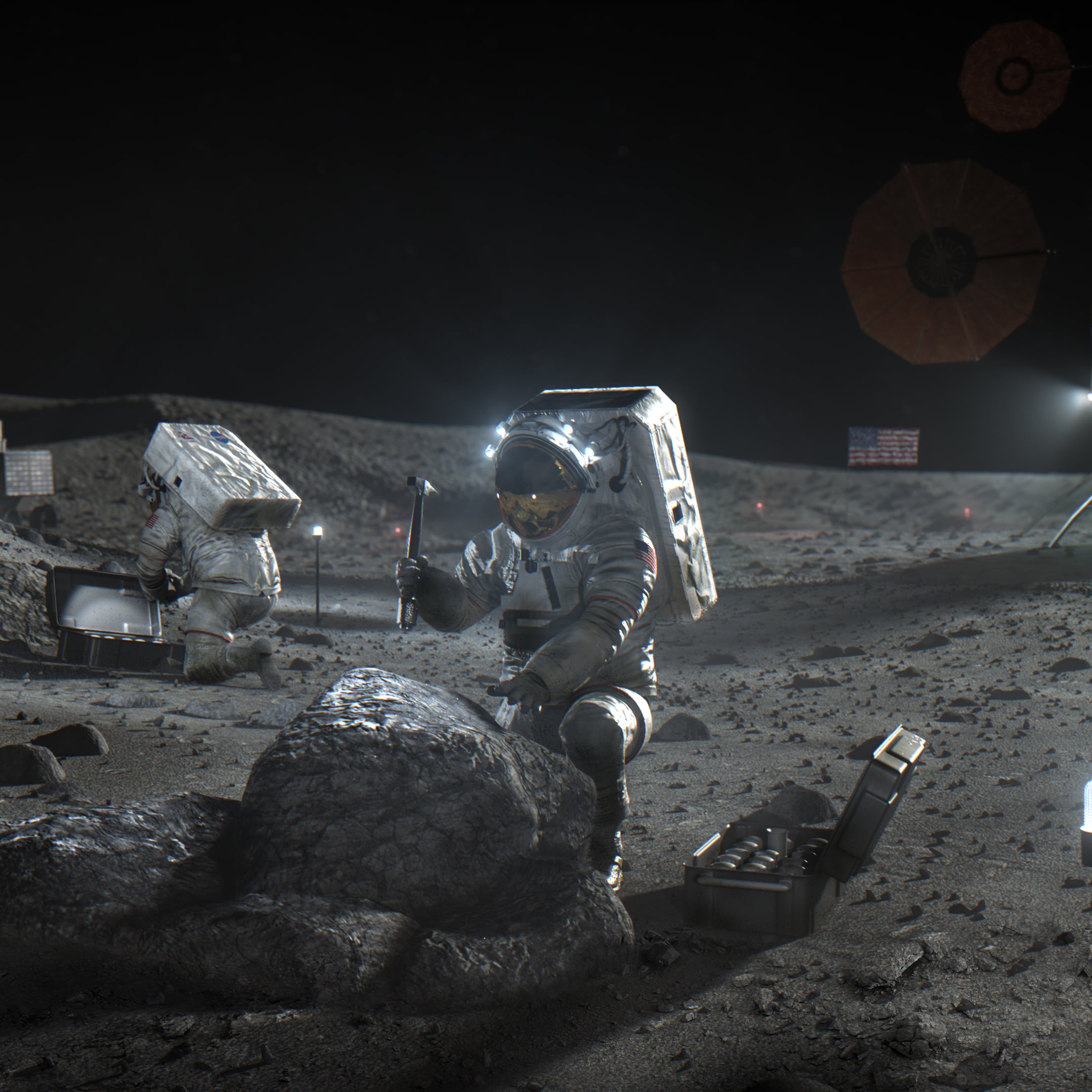
The Moon’s south pole compresses very different environments into a small area. A high ridge may receive long stretches of low-angle sunlight. A nearby crater floor may never see direct sunlight at all. Between them are candidate landing areas that can pass through hours or days of shadow, losing solar power while their surfaces and machinery radiate heat into space.
NASA says some permanently shadowed terrain near the pole reaches about minus 203 degrees Celsius, and instruments have measured still lower temperatures elsewhere in polar craters. At those temperatures, unprotected electronics are not simply inconveniently cold. Circuit boards, cable connections, seals, lubricants and batteries can move outside the conditions in which they were designed to work.
This is the engineering context for Northrop Grumman’s effort to find another use for work completed under the now-paused Gateway programme. The company built the Habitation and Logistics Outpost, known as HALO, and the associated ground hardware and test infrastructure for a station that NASA once intended to assemble in lunar orbit. NASA now wants contractors to preserve useful technology while shifting the Artemis programme toward the surface. The testing value is real, but the eventual fate of the flight module remains unsettled.
The south pole does not have one simple night
At the lunar equator, one cycle of day and night lasts about 29.5 Earth days. Near the pole, that familiar division breaks down. The Moon’s spin axis is tilted by only about 1.5 degrees, so the Sun circles close to the horizon. Local topography then decides whether a particular patch of ground is lit. A ridge can catch the Sun while a crater wall casts a long shadow across terrain only a short distance away.
NASA’s current description of the south-polar environment warns of prolonged darkness, extreme cold, abrasive dust and rough terrain. It gives minus 203 degrees Celsius as a representative low for some permanently shadowed regions and about 54 degrees Celsius for nearby sunlit ground. The point is not that every landing site reaches both limits. It is that surface systems may encounter steep thermal differences as lighting and position change.
That patchwork also complicates mission language. Saying that the south pole can spend days in darkness refers to particular operating sites and shadow intervals, not the whole region going dark together. Some crater interiors have been dark for billions of years. Some elevated areas receive sunlight for most of the year. Engineers need illumination maps for the precise route and site, not a single polar-night number.
Electronics fail through the surrounding system
The simplest picture is a frozen computer that refuses to turn on. Real failures are more varied. Batteries deliver less usable energy in deep cold. Lubricants thicken. Polymers and rubber can become brittle. Materials contract by different amounts, placing stress on solder joints, circuit boards and connectors. A mechanism that works after one cold soak may degrade after many heating and cooling cycles.
Thermal protection also creates opposing demands. Insulation and survival heaters help a vehicle retain heat during darkness, but the same vehicle must reject internally generated and solar heat when illuminated. Adding battery capacity and heaters adds mass, while keeping equipment warm consumes energy that cannot be used for driving, drilling, communications or science.
NASA’s Glenn Research Center built the Lunar Environment Structural Test Rig to expose materials, electronics and other hardware to vacuum and temperatures down to 40 kelvin. NASA says the rig can reveal failures that ordinary room-temperature structural testing will miss. It is a useful reminder that cold survival has to be demonstrated at the level of assemblies and interfaces, not inferred from a component data sheet.
Gateway’s pause changed the purpose of the hardware
Gateway was designed as a small station in a highly elliptical lunar orbit. HALO would have provided pressurised volume, command and control, power distribution, thermal regulation and docking interfaces. Northrop Grumman based much of its design heritage on the Cygnus cargo vehicle used to supply the International Space Station.
That plan changed in March 2026. NASA said it would pause Gateway in its current form and concentrate on infrastructure that supports sustained surface operations. The phrasing matters. It leaves room for reuse without promising that the original station will be completed.
Northrop Grumman has argued that HALO is mature technology with possible uses across lunar missions. The company also operates thermal-vacuum, structural and dynamic test facilities for spacecraft hardware. Gateway-developed test articles, avionics layouts, power interfaces and thermal-control work can therefore become inputs to lunar-surface experiments even if the station’s original flight sequence is abandoned.
Repurposing is an engineering programme, not a label
An orbital module cannot be placed on the Moon by changing its name. HALO was designed to operate in microgravity, dock with visiting vehicles and radiate heat in space. A surface habitat or equipment shelter would need a landing system, supports for lunar gravity, protection from abrasive electrostatically charged dust and a way to conduct or isolate heat at the ground interface.
The agency’s own oversight record makes the uncertainty plain. A June 2026 NASA inspector-general review said officials were evaluating whether HALO could be repurposed for lunar-surface applications, but had not finalised what would be reused or how. The review also described a programme whose costs and schedule had moved far beyond its early baseline.
Northrop told Ars Technica in June that HALO could support a variety of lunar missions. That is a company position, not an approved surface-habitat design. For now, the most defensible meaning of repurposing is broader: preserve useful hardware, reuse test assets, carry forward qualified components where their requirements still match, and use the old programme’s engineering evidence to expose risks in the new one.
The 2028 date raises the value of ground testing
NASA’s Artemis IV mission page targets an early 2028 launch. Under the revised sequence, two astronauts would descend from lunar orbit and spend about a week near the south pole. The landing date remains a target. Lander readiness, spacesuits, Orion, the launch vehicle and ground systems all have to converge before a crew can go.
A week-long crew visit does not by itself solve long-term survival. Equipment intended to remain after departure may sit unmaintained through changing light and temperature. A rover that finishes its first traverse but cannot wake after a cold interval is not a durable surface asset. A communications unit that survives cold only by consuming most of its stored energy leaves little margin for operations.
This is why the lunar-night problem appears repeatedly across otherwise different projects. Space Daily has previously examined NASA’s proposal to send PROMISE, a nuclear-powered rover testbed, to the south pole. Solar power, batteries, radioisotope heating, insulation and operational planning are not competing slogans. They are parts of a site-specific survival design.
The useful inheritance is evidence
Large aerospace programmes often leave behind more than a finished vehicle or a warehouse of unusable parts. They produce pressure vessels, engineering units, simulators, interface specifications, software, thermal models, failure reports and teams that understand why particular design choices were made. Some of those assets can transfer cleanly. Others will prove too specialised for the new mission.
The right test for Gateway reuse is therefore not whether it makes past spending look justified. It is whether a particular asset reduces the cost, time or uncertainty of building systems that can actually work on the lunar surface. A HALO-derived avionics rack that reveals a cold-soak failure in Arizona may be more valuable to the revised programme than a partially completed orbital module forced into an unsuitable role.
Northrop Grumman’s work can help answer that question, provided its limits remain visible. The 2028 landing target is a schedule goal, the Gateway reuse plan is still being defined, and a test article is not a flight-ready Moon base. What the hardware can deliver now is disciplined evidence about where electronics, power systems and thermal controls fail. At the south pole, finding those limits on Earth is considerably better than discovering them after the Sun drops behind a crater rim.