

Most people pass their lives inside a planetary defence system they never feel. Charged particles stream from the Sun, energetic nuclei arrive from beyond the Solar System, and Earth’s magnetic environment diverts or traps much of that traffic before it can reach the lower atmosphere. The atmosphere then provides another thick layer of protection.
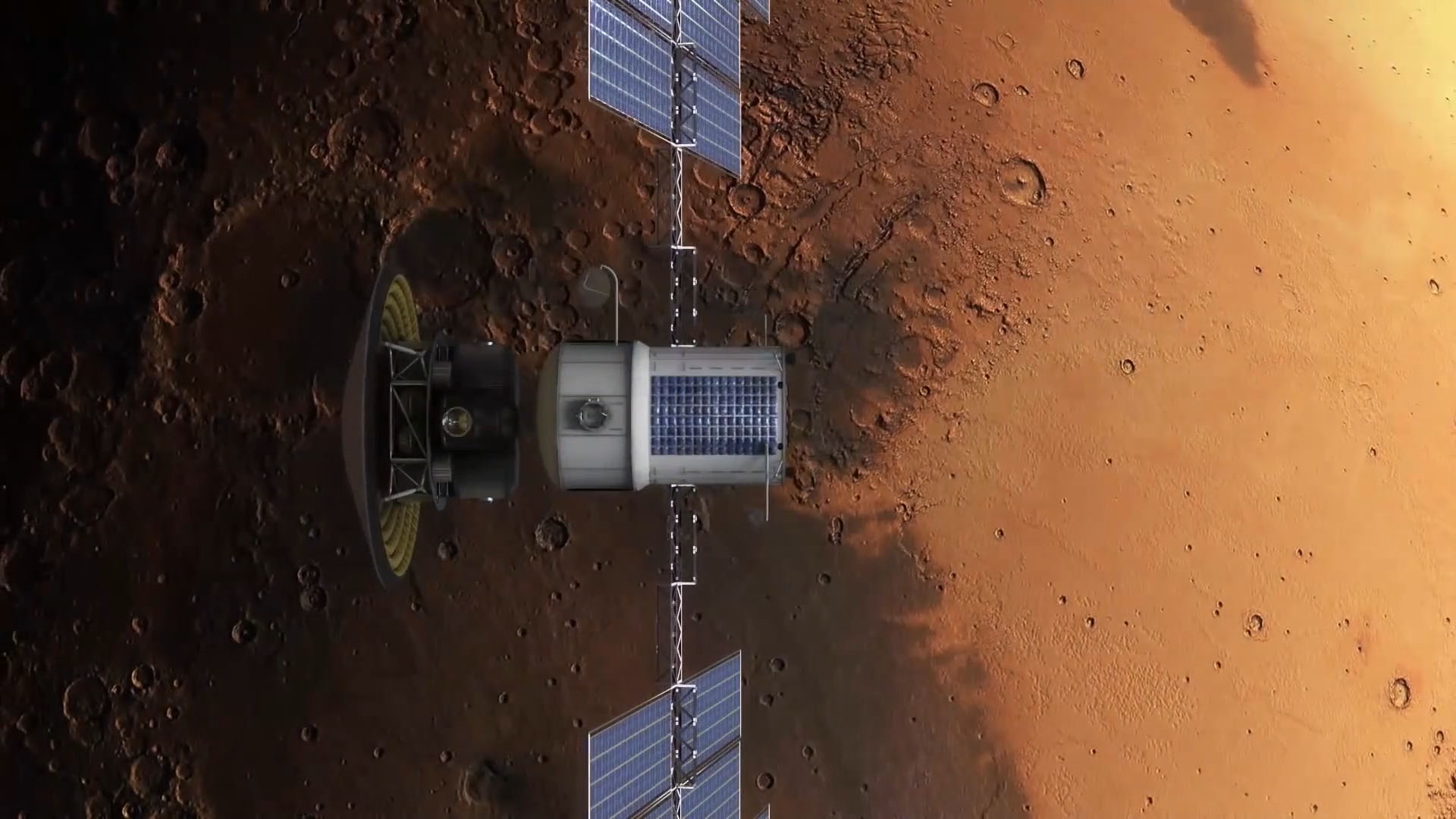
A crew leaving for Mars would move beyond that arrangement. For most of the journey, the astronauts would have only their vehicle, their operating procedures and the material placed around them between their bodies and the radiation environment of interplanetary space. Mars would not restore Earth’s protection at the other end.
This is reporting about occupational spaceflight risk, not personal medical guidance. “Nearly three years” is a plausible mission class rather than a fixed timetable: NASA planning examples range from about 860 days to more than 1,200, depending on the route, propulsion and surface stay.
The magnetosphere is a shield, not a sealed wall
Most of Earth’s magnetic field is generated by electrically conducting fluid moving in the planet’s outer core. Far above the surface, the field defines a region called the magnetosphere. The solar wind compresses its Sun-facing side and stretches the nightside into a long magnetotail.
Charged particles do not usually travel in straight lines through a magnetic field. Their paths bend, which allows the magnetosphere to deflect much of the solar wind and redirect or trap other particles. NASA’s overview of Earth’s magnetosphere describes it as a gatekeeper against solar particle radiation, material from coronal mass ejections and some cosmic radiation.
“Deflecting” is more accurate than “blocking everything”. The magnetosphere changes shape with solar conditions, funnels particles towards polar regions and stores energetic particles in the Van Allen belts. Some exceptionally energetic particles penetrate it. Magnetic reconnection can also transfer solar-wind energy into near-Earth space, helping to produce auroras and geomagnetic storms.
The protection is therefore active, variable and incomplete. It is still working around every person on the planet now, even though neither the field nor the incoming particles are perceptible to human senses.
The atmosphere is the other half of Earth’s protection
The headline singles out the magnetic field, but a body at ground level benefits from two planetary shields. The magnetosphere turns away or traps many charged particles. The atmosphere absorbs and transforms much of the energetic radiation that makes it farther in, producing showers of secondary particles whose intensity falls as they travel through air.
This is why being inside the magnetosphere is not the same as standing on Earth’s surface. The International Space Station orbits within Earth’s magnetic protection, yet NASA says its crews receive more than ten times the radiation typical at ground level. Most of the atmosphere is below the station, and its orbit passes through a complex environment that includes trapped particles and the South Atlantic Anomaly.
NASA’s current space-radiation hazard page consistently names both the magnetic field and atmosphere. Their combined effect creates the familiar terrestrial baseline. Remove the air but retain much of the field, as at the station, and exposure rises. Leave both behind, and the problem changes again.
Deep space brings two different particle problems
A Mars crew would mainly contend with solar energetic particles and galactic cosmic rays. Solar particle events are episodic. An eruption can accelerate large numbers of protons and other ions, sometimes creating an intense exposure over hours or days. Forecasting, onboard measurements and a compact storm shelter can help a crew respond.
Galactic cosmic rays are chronic rather than storm-like. They include protons and the nuclei of heavier elements accelerated to extreme energies by events elsewhere in the galaxy. Their energy makes them difficult to stop. NASA’s account of radiation mitigation notes that these particles can pass through metal, plastic, water and living tissue. Collisions inside shielding can generate secondary neutrons, protons and other particles.
That is why a thicker metal wall is not automatically a complete answer. Shield design has to consider the original radiation and the particle cascade created when radiation strikes the vehicle. Hydrogen-rich materials, water, food and other stores can be arranged to add useful shielding without carrying mass that serves no other purpose.
Radiation is invisible and generally cannot be felt while exposure is occurring. NASA treats it as an occupational hazard because ionising particles can damage DNA and cells, raising long-term cancer and other health risks. The size of that risk depends on dose, particle type, exposure rate, age, individual biology and substantial uncertainties in translating available evidence to deep-space crews.
“Nearly three years” belongs to one family of missions
There is no booked Mars itinerary. Orbital mechanics create launch opportunities roughly every 26 months, and the same geometry can make a long surface stay more efficient than turning around quickly. A conventional conjunction-class mission may spend months travelling each way and roughly 500 days waiting on Mars for a favourable return alignment.
NASA’s Office of the Chief Health and Medical Officer says explorers would leave Earth for roughly three years. A familiar reference profile is more specific: 180 days outbound, 500 days on the surface and 180 days home, for 860 days or about 2.35 years. A 2024 NASA advisory presentation gives a wider planning range of 870 to 1,250 days, approximately 2.4 to 3.4 years.
The title’s “nearly three years” sits plausibly inside that range. It should not be read as a duration that every Mars architecture must use. Faster propulsion, a shorter stay, a flyby, mission-abort provisions and the alignment of the planets all change the calendar. They also change cumulative radiation exposure, which gives mission duration a direct role in shielding trades.
One estimate approaches a sievert, not a universal dose
The Radiation Assessment Detector travelled to Mars inside the Curiosity rover’s cruise spacecraft and has continued measuring the surface environment. Using those observations, NASA published a reference estimate of about one sievert for the 860-day profile, with roughly equal contributions from the outbound transit, 500-day surface stay and return transit.
A sievert is a unit weighted to represent the biological effect of ionising radiation. The estimate is useful for showing the scale of the engineering problem, but it is not a forecast for a named crew. It assumes a particular duration and shielding environment, while the solar cycle, solar storms, vehicle mass distribution, habitat design and time spent outside all affect exposure.
Mars itself provides partial protection. Its thin atmosphere removes some incoming radiation, and the solid planet blocks particles from below. Terrain, caves or material placed over a habitat could add shielding. But Mars has no present global magnetic field comparable to Earth’s. Our earlier examination of how Mars lost its global field and much of its atmosphere explains why local crustal magnetism is not a replacement for a planet-wide magnetosphere.
A Mars vehicle must carry a smaller defence system
No single technology reproduces Earth. Current planning combines passive shielding, personal and area dosimeters, solar monitoring, warning systems, operational limits and a storm shelter. Surface habitats can use water, supplies or Martian material as protective mass. Faster transit reduces the time over which the chronic dose accumulates.
These measures work differently against different radiation. A well-positioned shelter can substantially reduce exposure from many solar particle events. Galactic cosmic rays remain harder because of their energy and their ability to generate secondary radiation. Active magnetic shielding has been studied, but producing a useful field around a spacecraft without excessive mass, power and engineering complexity remains a demanding proposition.
The comparison with life on Earth is not that the planet makes radiation disappear. It supplies an enormous, layered system that a spacecraft cannot fully imitate: a dynamic magnetic bubble, a deep atmosphere and a whole planet beneath our feet.
An astronaut heading to Mars would cross out of that shelter early in the mission and regain it only near homecoming. The particles would still be invisible. What changes is that every gram of shielding, every day in transit and every warning before a solar storm becomes part of the crew’s substitute for the planetary protection the rest of us receive without noticing.