

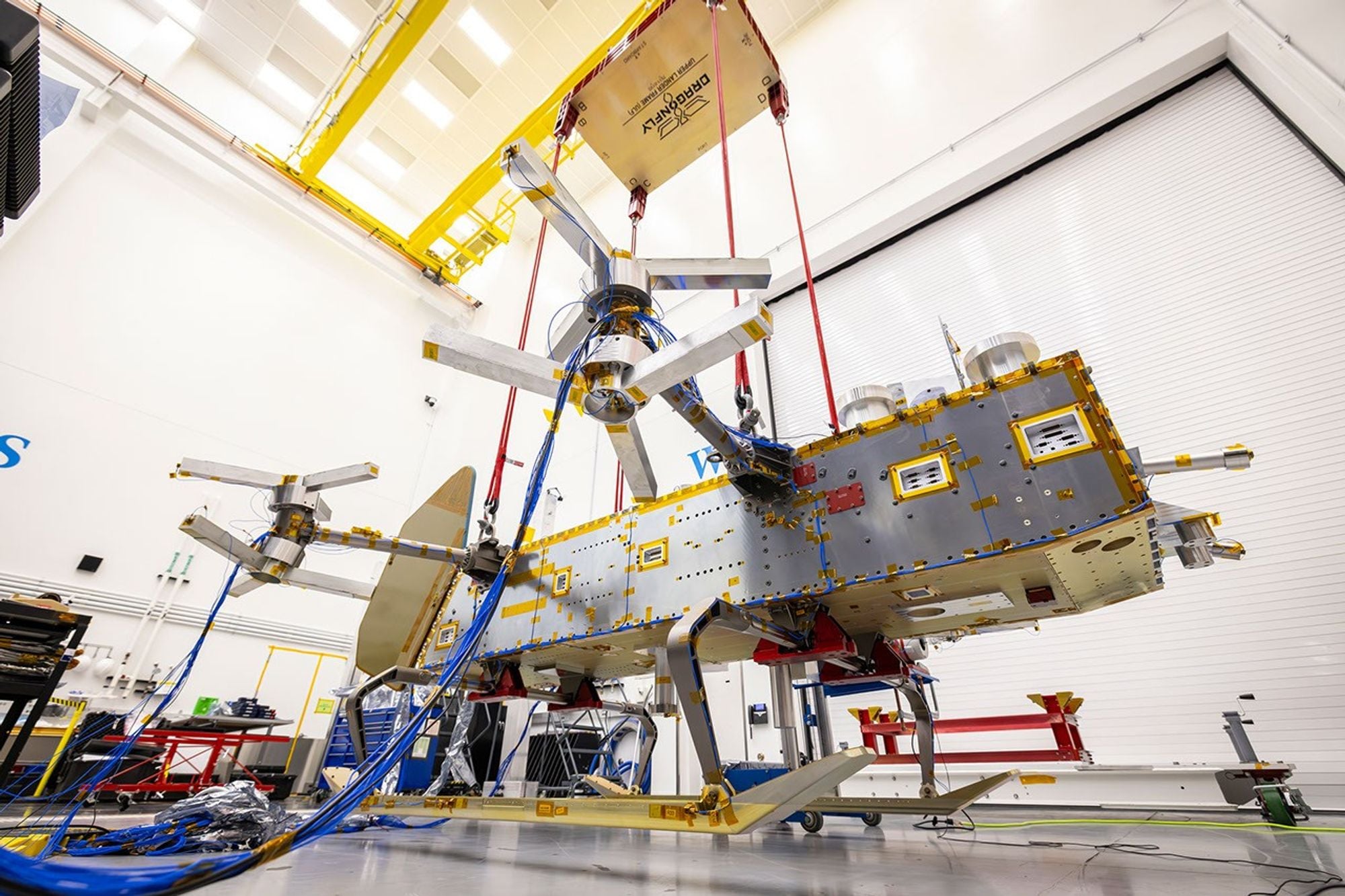
Dragonfly is no longer just a spacecraft drawing or a rotor test article. NASA’s car-sized Titan aircraft now has a nearly four-metre flight fuselage, and engineers at the Johns Hopkins Applied Physics Laboratory in Laurel, Maryland, are installing the mechanical, thermal and electrical systems that will turn it into a working spacecraft.
The phrase “nuclear-powered octocopter” is accurate, but it needs one useful qualification. A radioisotope generator will provide heat and steady electrical power, while rechargeable batteries will deliver the short, high-power bursts needed to turn the rotors. The physics of Titan then makes those rotors far more effective than the same arrangement would be on Earth.
Dragonfly’s flight structure is now being assembled
NASA’s 9 July assembly update says the team delivered Dragonfly’s nearly 13-foot-long fuselage for spacecraft integration on 29 June. Mechanical, thermal and electrical integration began on 1 July. Bulkheads, wiring harnesses, cables, connectors, avionics and science instruments are being added as their own test campaigns finish.
Before that handover, engineers suspended the structure from bungee cords and measured how vibrations travelled through it. They also pressurised the shell to find leaks that could admit Titan’s dense, frigid atmosphere. Those are not cosmetic trials. Rotor vibrations can disturb instruments and structures, while leakage determines how hard the thermal system must work to protect electronics in an environment near minus 179 degrees Celsius.
Titan gives a heavy aircraft an unusually easy atmosphere
At Titan’s surface, atmospheric density is roughly 4.5 times the value near sea level on Earth, while surface gravity is about one-seventh of Earth’s. Those two numbers do different jobs. Dense air gives a rotor more mass to push downward. Low gravity means a spacecraft of a given mass has much less weight for the rotors to support.
Penn State aerospace engineer Jack Langelaan, a member of the mission’s flight team, summarises the result on his Dragonfly engineering page: sustaining hover on Titan requires approximately 40 times less power than an equivalent comparison on Earth. This is why the title refers to density, not merely Titan’s roughly 1.5-Earth-atmosphere surface pressure. Pressure and density are related, but they are not interchangeable.
Where the factor of 40 comes from
The estimate follows the ideal momentum theory used as a first approximation for hovering rotors. Induced power scales with the weight raised to the three-halves power, then falls with the square root of air density and total rotor-disc area. Weight itself is mass multiplied by local gravity.
In plain terms, Titan offers a double advantage. Dividing gravity by about seven greatly reduces the force the aircraft must hold up. Multiplying atmospheric density by more than four lets the rotor produce that lift by accelerating a larger mass of gas through a smaller change in velocity. When the same-mass, similar-rotor comparison is made, those effects produce the approximate 40-to-one reduction.
The number is therefore a calculated physical comparison, not a direct measurement of the completed spacecraft flying on Titan. It is also not a claim that every electrical load aboard Dragonfly falls by the same factor.
Real flight is harder than ideal hover
Dragonfly has eight rotors arranged as four coaxial pairs. The upper and lower rotor in each pair share an axis, so their wakes interact. Real blades also create profile drag; motors and transmissions lose energy; and an aircraft must climb, descend, translate, turn and respond to winds rather than remain in a perfect stationary hover.
That is why the mission has conducted full-scale rotor trials in NASA Langley’s heavy-gas Transonic Dynamics Tunnel and further tests described in NASA’s current flight-engineering account. The 40-times figure explains why the concept closes at all. Wind-tunnel data and detailed models determine whether the actual design closes with adequate control authority and margin.
The nuclear source charges batteries and keeps the craft warm
Dragonfly’s multi-mission radioisotope thermoelectric generator, or MMRTG, converts heat from the natural decay of plutonium-238 into electricity. It is not a fission reactor, and it does not mechanically drive the rotors. NASA’s explanation of radioisotope power for Dragonfly says the generator will recharge the lander’s battery; the battery will supply flight and demanding science activities.
The other product, heat, is equally important. Sunlight at Saturn is weak and filtered by Titan’s haze, while the surface is cold enough to turn water ice into rock-hard terrain. Waste heat from the MMRTG will keep instruments and electronics within operating temperatures while the generator steadily restores charge between flights.
Eight rotors let one lander become a regional explorer
Flight changes the geography of a landed mission. Dragonfly can sample one location, scout a route from the air and move several miles to a different chemical and geological setting. NASA’s current mission profile calls for a planned 3.3-year surface mission, with flights generally separated by one or two Titan days. One Titan day lasts about 16 Earth days.
The intended route begins among equatorial dunes rich in organic material and extends toward Selk crater, where an ancient impact may once have mixed liquid water with surface organics. Dragonfly is designed to investigate habitability and the chemistry that precedes biology, not simply to announce that it has found life. For a broader account of the destination and instrument goals, SpaceDaily has an earlier Dragonfly explainer.
Late 2034 is the current target, not a promise
NASA currently lists launch no earlier than July 2028 and arrival at Titan in late 2034. The six-year cruise is only one part of the job. Dragonfly must launch inside a cruise stage and aeroshell, survive interplanetary space, enter Titan’s atmosphere, descend under parachutes and separate for powered flight before reaching the surface.
Schedules for planetary missions can move as hardware, budgets and launch readiness change. Still, the start of flight-system integration marks a clear transition. Dragonfly is now a spacecraft being assembled and tested, not merely a mission awaiting construction.
Titan’s air and gravity make rotorcraft flight remarkably forgiving. They do not make the spacecraft simple. The engineering achievement is to use that favourable physics while building a machine capable of surviving everything between a Maryland cleanroom and a landing more than a billion kilometres away.