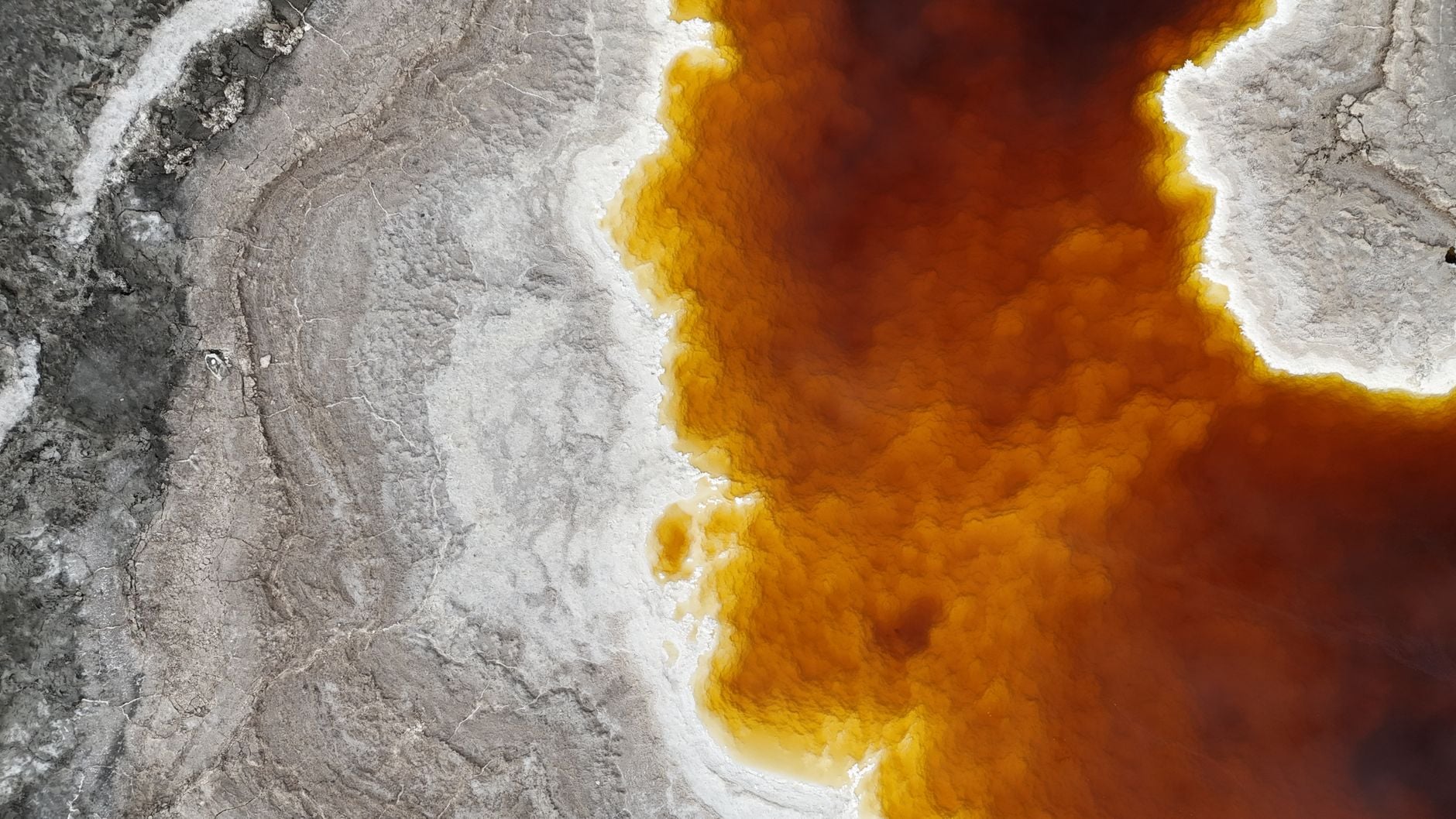
I keep coming back to Titan because it takes an Earth-like landscape and changes the identity of almost every material in it. There are clouds, rainfall, branching rivers, shorelines and seas. Yet water is not the liquid moving through that landscape. Water is the ground. Methane and ethane do the flowing above it.
I wrote a shorter piece earlier asking how a moon about 1.4 billion kilometres from the Sun can have rivers without liquid water. The simple answer is temperature. The fuller answer is more interesting, because Titan’s liquid cycle is not merely Earth’s water cycle with one chemical name swapped for another. The atmosphere, seasons, gravity, sediment and geography all change how it works.
There is also a useful limit to what we should claim. No spacecraft has watched a marked drop of methane make a complete trip from sea to cloud to rain to river and back again. The cycle is a physical picture assembled from several strong lines of evidence. Cassini mapped lakes, seas and channels. Huygens photographed a landscape altered by flowing liquid. Telescopes have watched clouds develop and change. Methane’s behaviour under Titan’s temperature and pressure connects those observations.
Why methane can flow while water becomes stone
NASA gives Titan’s typical surface temperature as about minus 179 degrees Celsius, or roughly 94 kelvins. Its surface pressure is around one and a half times the pressure at sea level on Earth. Under those conditions, methane that would disperse as a gas here can remain liquid there.
Water moves in the opposite direction. At 94 kelvins it is not soft, temporary ice of the kind we scrape from a freezer. It forms much of Titan’s outer crust and behaves as geological material. NASA’s shorthand is that water ice plays the role of rock. Hills, cliffs, channels and cobbles can all be made from it.
This is the foundational reversal. On Earth, silicate rock supports a cycle of liquid water. On Titan, solid water ice supports a cycle of liquid hydrocarbons. The analogy works because evaporation, condensation, rainfall and gravity do not belong exclusively to H2O. They can operate with another substance when temperature and pressure place that substance near the boundary between liquid and gas.
The atmosphere is mostly nitrogen, not methane
Titan is the only moon in the solar system with a substantial atmosphere. It is about 95 percent nitrogen near the surface, with methane contributing roughly 5 percent and other carbon-rich compounds present in smaller amounts. Calling it a methane atmosphere can therefore be misleading. Methane drives much of the weather and chemistry, but nitrogen provides most of the air.
Liquid methane evaporates from the surface and mixes into that atmosphere. When moist air rises and cools, methane can condense into clouds. Under the right conditions, droplets grow and fall as rain. Some storms may be intense enough to produce rapid runoff even though long intervals between them leave large areas dry.
Recent observations have strengthened this picture. In 2022 and 2023, the James Webb Space Telescope and the Keck Observatory tracked methane clouds in Titan’s northern hemisphere. NASA’s report on the work described apparent convection, with clouds seen at different altitudes over time. It was the first evidence of this kind of cloud convection in the north, where most of Titan’s lakes and seas are found.
That is not direct footage of rain striking the ground. It is evidence that the atmosphere is doing the vertical work needed to build rain-producing weather. On a world this distant, viewed through a dense orange haze, that distinction matters.
Titan’s seasons run on a 29-year clock
Titan’s weather is seasonal, but its calendar is stretched. Saturn takes about 29 Earth years to orbit the Sun, and Titan’s seasons follow Saturn’s axial tilt. Each season lasts more than seven Earth years.
Cassini arrived in 2004, watched the Saturn system through its 2009 equinox, and continued until 2017. That gave the mission an extraordinary thirteen-year record, but still less than half a Titan year. It saw cloud systems shift, polar weather change and signs of rainfall darkening parts of the surface. Even that long mission captured only part of the climate cycle.
The slow seasons help explain why Titan can look quiet for years and then change. Methane is transported between hemispheres as solar heating shifts. The polar reservoirs are not simply static lakes left over from the distant past. They participate in a climate system whose most obvious changes unfold on timescales longer than many space missions.
Huygens descended into a landscape shaped by flow
The most direct encounter came on 14 January 2005, when the European Space Agency’s Huygens probe descended through the haze and landed on Titan. Its cameras showed bright uplands cut by branching drainage channels leading toward darker lowlands. Near the landing site, rounded objects looked like river stones but were consistent with water ice.
ESA’s reconstruction of the region described a broad plain of dirty water ice covered with organic deposits. Long branching channels appeared consistent with runoff from methane rain. Shorter, steeper channels may have formed where methane emerged from below the surface as springs.
Huygens did not splash into a lake. It landed on material that behaved more like damp sand or soft clay, in a setting resembling a dry floodplain or riverbed. That is an important part of Titan’s story. An active liquid cycle does not mean every channel is always full or every landscape is soaked. Earth’s deserts still belong to Earth’s water cycle. Titan can have dry channels between methane storms too.
The ground is icy, but it is not clean white ice everywhere
Saying the ground is water ice is a statement about Titan’s crust and bedrock, not a claim that every visible surface is a polished skating rink. The atmosphere is a chemical factory. Ultraviolet light and energetic particles break methane and nitrogen apart, and the fragments recombine into ethane and more complex carbon-bearing molecules.
Some of those products form the thick haze that hides the surface in visible light. Heavier particles settle onto the ground. Around the equator, winds organise organic-rich grains into vast dune fields. Elsewhere, sediments moved by rivers and floods can cover the icy foundation.
Water ice still matters mechanically. NASA’s review of the Cassini mission notes that flowing hydrocarbons cut steep canyons into rock-hard ice and tumble water-ice fragments into rounded pebbles. But a better mental picture is icy geology under a variable cover of dark organic material, not a uniformly bright frozen moon.
The seas are mixtures, and they are concentrated in the north
Cassini’s radar pierced the haze and revealed most of Titan’s large seas near the north pole. The three great northern bodies are Kraken Mare, Ligeia Mare and Punga Mare. Smaller lakes surround them, while Ontario Lacus is the major lake in the south.
These liquids are not pure methane. They contain methane, ethane and dissolved nitrogen, with proportions that vary among locations. Cassini radar measurements showed that some smaller northern lakes are more than 100 metres deep and filled mostly with methane. In exceptionally transparent Ligeia Mare, radar energy passed through the surface strongly enough to return from the seabed.
I previously dug into a separate Cassini experiment that bounced radio waves off Titan’s three largest seas. The open surfaces were mirror-smooth at the moments measured, with roughness no greater than 3.3 millimetres RMS. Rougher estuaries may have marked methane-rich river water entering seas with more ethane.
That does not mean Titan’s seas never have waves. It means Cassini found them remarkably calm during those observations. Wind, rain and changing seasons should all be capable of disturbing them, but a single measurement is a weather report, not a permanent law.
Rivers carve familiar shapes under different physics
Titan’s river networks can run for hundreds of kilometres. Some meander, some braid, and some cut deep canyons. Their geometry can look startlingly terrestrial because gravity-driven flow tends to organise channels in recognisable ways.
The resemblance is not perfect. Liquid methane is less dense and less viscous than water. Titan’s surface gravity is only about one-seventh of Earth’s. The sediment could include water-ice grains, solid organic material or mixtures of both. Rain falls through a thicker atmosphere and runoff moves across a colder, mechanically different substrate.
One of the clearest signs that the analogy eventually breaks is the shortage of deltas. I wrote earlier about a 2025 study finding that only about 1.3 percent of Titan’s large coastal rivers appear to form deltas. On Earth, nearly every river of comparable size does.
The researchers tested whether Cassini’s radar would simply miss ordinary deltas and found that many should have been visible. Perhaps Titan’s sediments behave differently, perhaps shorelines erase deltas, or perhaps the deltas have unfamiliar forms. The honest answer is that nobody yet knows.
The methane is being consumed
Titan’s cycle cannot be understood only as weather because methane is not conserved indefinitely. High in the atmosphere, sunlight and energetic electrons break methane molecules apart. Some fragments become ethane and heavier organic compounds that settle toward the surface. Some hydrogen ultimately escapes into space.
If nothing replaced the destroyed methane, the atmosphere would gradually lose the ingredient that makes its clouds, rain and seas possible. Yet methane is still present. Something must have supplied it in the past and may still be supplying it now.
Possible explanations include methane stored inside Titan and released through geological processes. Impacts can liberate some methane too, but they do not seem sufficient. In another article, I looked at a 2025 model that tested whether large impacts could keep Titan’s methane atmosphere alive. Even favourable impact histories extended its lifetime by no more than a few percent.
This unresolved source is not a side issue. It may determine whether Titan’s present climate has persisted for much of the moon’s history or represents one episode in a longer sequence of wet and dry eras.
Water may still move far below the frozen surface
Water is excluded from Titan’s surface weather, but it is not scarce. The moon contains enormous quantities of it, most visibly as the icy shell beneath the organic landscape. Deeper inside, the situation is less settled.
Cassini gravity and tidal measurements were long interpreted as evidence for a global subsurface ocean. A 2025 reanalysis by NASA and international researchers argued that Titan’s interior may instead contain layers of slush and local pockets of warm water near the rocky core. That newer model has not turned the interior into a solved problem. It has made the problem more complicated.
So Titan may contain two very different liquid environments: hydrocarbon lakes and seas exposed at the surface, and water-rich liquid or slush buried deep inside. Whether those environments ever exchange material is a major question for chemistry and habitability. There is no evidence of life on Titan, and an active methane cycle by itself is not evidence for it.
Dragonfly will sample the world the weather has built
The next decisive measurements should come from NASA’s Dragonfly mission. The car-sized, nuclear-powered rotorcraft is scheduled to launch no earlier than July 2028 and arrive at Titan in late 2034. It will fly between sites during a planned 3.3-year mission, examining dunes, impact material and the terrain around Selk Crater.
NASA is explicit that Dragonfly is not a life-detection mission. Its job is to study Titan’s chemistry, geology and habitability, including the chemical steps that may precede biology. It will not sail the northern seas, but it will analyse the solid materials produced, deposited and altered within the broader methane-driven environment.
I find that distinction more interesting than a promise to “find life.” Dragonfly is designed to ask what is actually there, how far complex chemistry has progressed, and how the surface records interactions among atmosphere, organics, ice and occasional liquid.
The careful version is still extraordinary
Titan is the only world besides Earth known to have this complete family of active surface-liquid features: clouds, rainfall, rivers, lakes and seas. The evidence for a methane cycle is strong, but it comes from many observations joined together rather than one continuously watched loop. Its seas are chemical mixtures. Its channels can sit dry between storms. Its icy crust is often buried beneath sediments and organic material. The source that maintains atmospheric methane remains unknown.
None of those qualifications weaken the central picture. They make it real.
Far beyond Earth, cold has reassigned the roles of familiar substances. Water has become stone. Methane has become weather. Sunlight, faint though it is, helps build clouds and more complicated organic chemistry. Rain cuts channels through frozen ground, rivers deliver liquid to polar seas, and evaporation begins the atmospheric part of the cycle again.
The more carefully I read the evidence, the less Titan feels like a simple “second Earth.” It is something more useful scientifically: an independent experiment in how a world can organise weather and geology when the temperature, materials and timescales are entirely different from our own.