

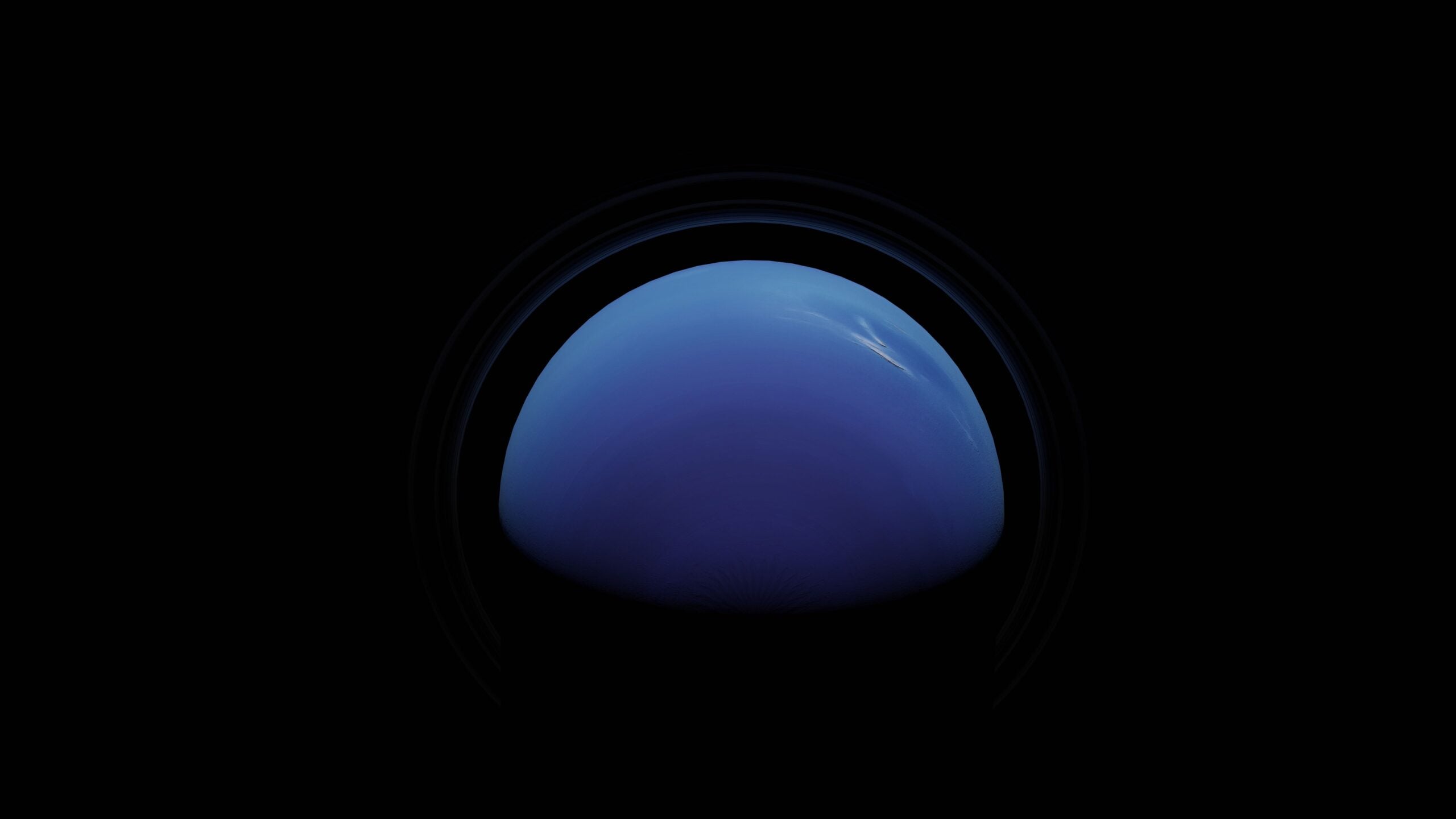
In 1989, Voyager 2 measured winds up to 2,100 kilometres an hour circling an Earth-sized storm on Neptune. By 1994, when Hubble looked again, the storm had simply vanished, unlike Jupiter’s Great Red Spot, which has raged for more than a century.
A storm the size of a planet, gone within five years
Voyager 2’s only flyby of Neptune, on 25 August 1989, caught an oval, dark storm in the planet’s southern hemisphere that measured roughly 13,000 by 6,600 kilometres, big enough to swallow the entire Earth along its longer axis. Scientists named it the Great Dark Spot. Around its edges, Voyager measured winds reaching 2,100 kilometres an hour, among the fastest ever recorded anywhere in the solar system. A second, smaller storm nearby got the far less poetic name Dark Spot 2.
Five years later, NASA pointed the newly launched Hubble Space Telescope at Neptune expecting to check in on both storms. Neither was there. Amy Simon, a planetary scientist at NASA’s Goddard Space Flight Center, has described the disappearance as a genuine surprise to a field accustomed to a very different kind of storm. Jupiter’s Great Red Spot, by contrast, was first spotted through amateur telescopes in the 1830s and has been under continuous watch since the 1870s, comfortably outliving everyone who has ever studied it.
Storms that come and go on a human timescale
Neptune didn’t stop making dark spots after 1989, it just kept losing them. Hubble has since caught four more, bringing the total spotted so far to six, and in 2015 the Outer Planet Atmospheres Legacy programme, an annual Hubble survey of the outer planets, began tracking one closely enough to watch it die in real time for the first time, an oval storm that shrank from about 4,990 kilometres across to roughly 3,700 before fading out. Researchers now estimate a typical dark spot survives somewhere between one and six years, with two years the more common lifespan, and that new ones tend to form roughly every four to six years somewhere on the planet.
One clue turned up almost by accident. While the OPAL team was busy watching that 2015 storm shrink, they noticed small, bright clouds made of methane ice appearing in a completely different spot on the planet. Two years later, in 2018, a new Great Dark Spot formed almost exactly where those clouds had been, nearly identical in size and shape to the one Voyager saw in 1989, just at a different latitude. The bright clouds, it turned out, were an early warning sign appearing years before the storm itself became visible, giving researchers something to watch for the next time rather than waiting to stumble across a fully formed storm by chance.
Michael Wong, a planetary scientist at the University of California, Berkeley, has said researchers have never directly measured wind speeds inside one of these dark vortices the way Voyager measured winds around the Great Dark Spot’s edges, but modelling puts the internal speed at roughly 100 metres a second, close to 360 kilometres an hour, in the same range as conditions inside Jupiter’s Great Red Spot.
Why Neptune’s storms don’t stick around
Neptune’s dark spots, like Jupiter’s Great Red Spot, form in regions of high atmospheric pressure, the opposite of how a storm forms on Earth. What seems to end them is Neptune’s own turbulence. The planet radiates far more heat than it receives from the Sun, and that internal heat drives vigorous convection and fast east-west jet streams that appear to erode an isolated vortex over just a few years, long before it can settle in the way Jupiter’s far larger, more stable storm system has.
What I find genuinely odd about this
Neptune has spent, by one estimate, more than half the time anyone has been able to observe it hosting at least one of these storms, and yet no single one has stuck around long enough to become a landmark the way Jupiter’s has. It’s an entire planet that seems constitutionally unable to hold onto a storm, generating something planet-sized every few years only to dissolve it again before it can become a fixture, on a world so far from the Sun that daylight there barely qualifies as daylight at all. We’ve now watched this happen enough times, Voyager’s original pair, four more caught by Hubble, one tracked all the way through its own death, that it looks less like an anomaly and more like simply how weather works on a planet built the way Neptune is.