

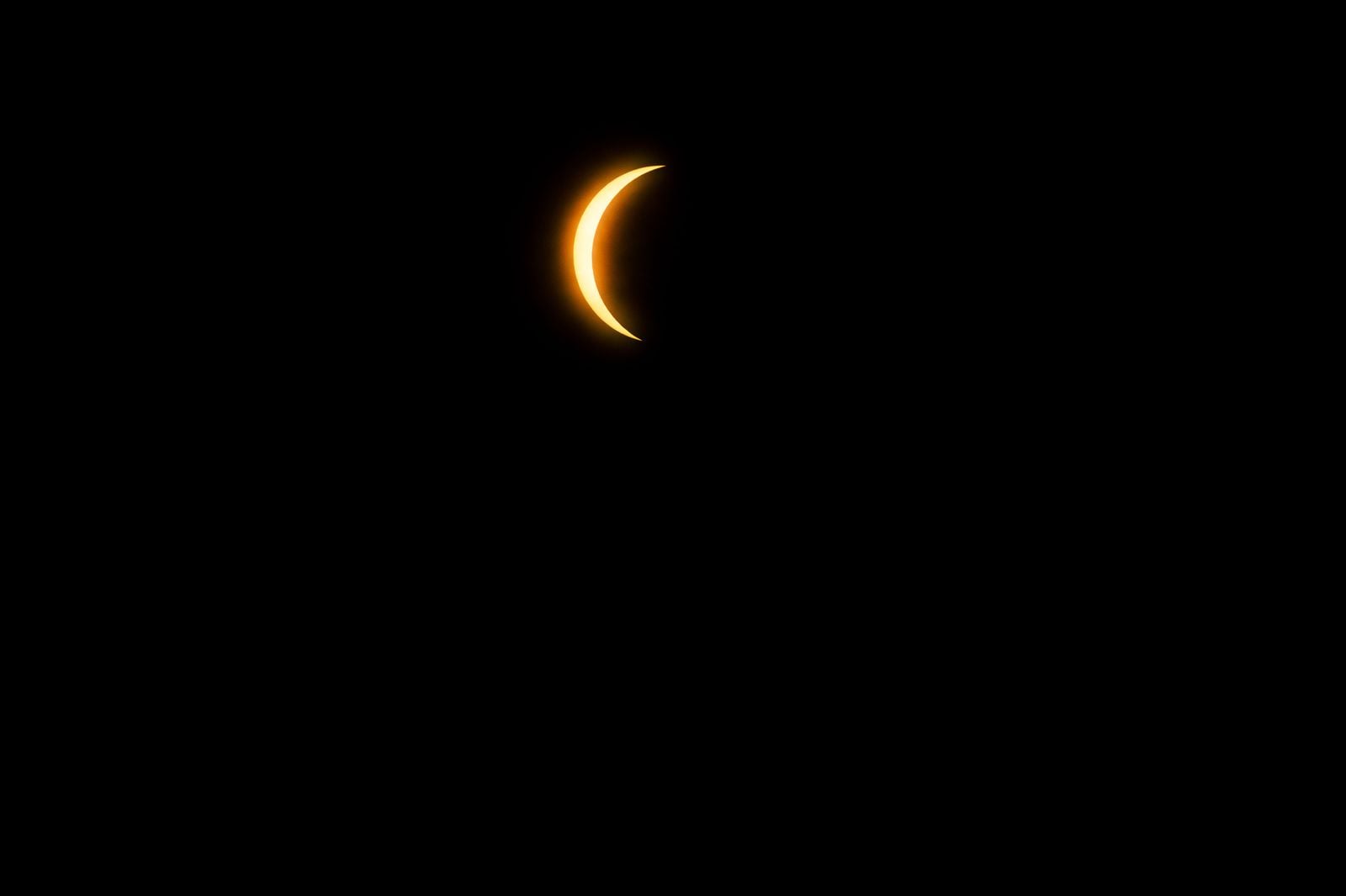
On 18 August 1868, a French astronomer named Pierre Janssen stood in Guntur, on the eastern coast of India, and watched the Moon slide across the Sun. Totality ran for roughly six minutes, an exceptionally long window by the standards of eclipse work. He pointed a spectroscope at a solar prominence — one of those enormous loops of glowing gas that arc off the Sun’s edge — and split its light into a rainbow of thin coloured lines. Among them was a bright yellow line at 587.5 nanometres that matched nothing in any laboratory on Earth.
The gas that produced that line would not be isolated on this planet for another 27 years.
When it finally was — coaxed from a lump of uranium ore by a Scottish chemist named William Ramsay in 1895 — it was named for the place where it had first been seen. Helios. The Sun. Helium is the only element on the periodic table first discovered somewhere other than Earth.
What Janssen actually saw
The instrument Janssen carried to Guntur was a spectroscope — a prism, essentially, mounted so that sunlight passing through it fanned out into a spectrum. Nine years earlier, the German physicist Gustav Kirchhoff, working with the chemist Robert Bunsen, had shown that each element, when heated, emits light at its own signature set of wavelengths. Sodium glows a particular yellow. Hydrogen glows a particular red. If you could split the light of a distant object and read the pattern, you could read its chemistry.
Astronomers had been waiting for a total eclipse to try this on the Sun. The corona and the pink prominences at the Sun’s edge are normally drowned out by the glare of the disk. Only when the Moon covers that disk do they become visible, and on most eclipse days that window is two or three minutes at best.
Janssen got six. In the spectrum of a solar prominence he saw a bright yellow line sitting near, but not quite on, the familiar sodium doublet. According to the account preserved by Science Friday, the line was so bright that Janssen suspected it might be observable in ordinary daylight, without waiting for another eclipse.
He was right, and he did not wait long to prove it. By ten o’clock the next morning, 19 August 1868, he was observing prominences against the undarkened Sun, using the spectroscope alone to isolate their light from the glare — a result documented in Françoise Launay’s study of the Guntoor observations in the Journal of Astronomical History and Heritage.
The Englishman who arrived at the same line
Five thousand miles away in England, Joseph Norman Lockyer had been working on the same problem — how to see prominences without an eclipse — and had arrived at the same technique independently. On 20 October 1868, two months after Janssen’s observations in India, Lockyer saw the same yellow line in ordinary daylight.
Both men’s reports reached the French Academy of Sciences on the same day. The Academy struck a commemorative medal carrying both their profiles, with Apollo’s chariot crossing the face of the Sun.
Lockyer went further than Janssen in one respect. After failing, with the chemist Edward Frankland, to reproduce the line in the laboratory, he proposed that it came from an element that did not exist — or had not yet been found — on Earth. He gave it a name: helium, from helios, the Greek word for the Sun.
Naming an element on the basis of a single unexplained line was audacious, and Lockyer knew it. In print he mostly called the line D3, after its position beside the sodium D1 and D2 lines. For the next quarter century, plenty of chemists refused to accept there was an element behind it at all.
Why chemists would not accept it
The problem was not that Lockyer’s spectroscopy was wrong. The problem was that no one could put the gas on a bench.
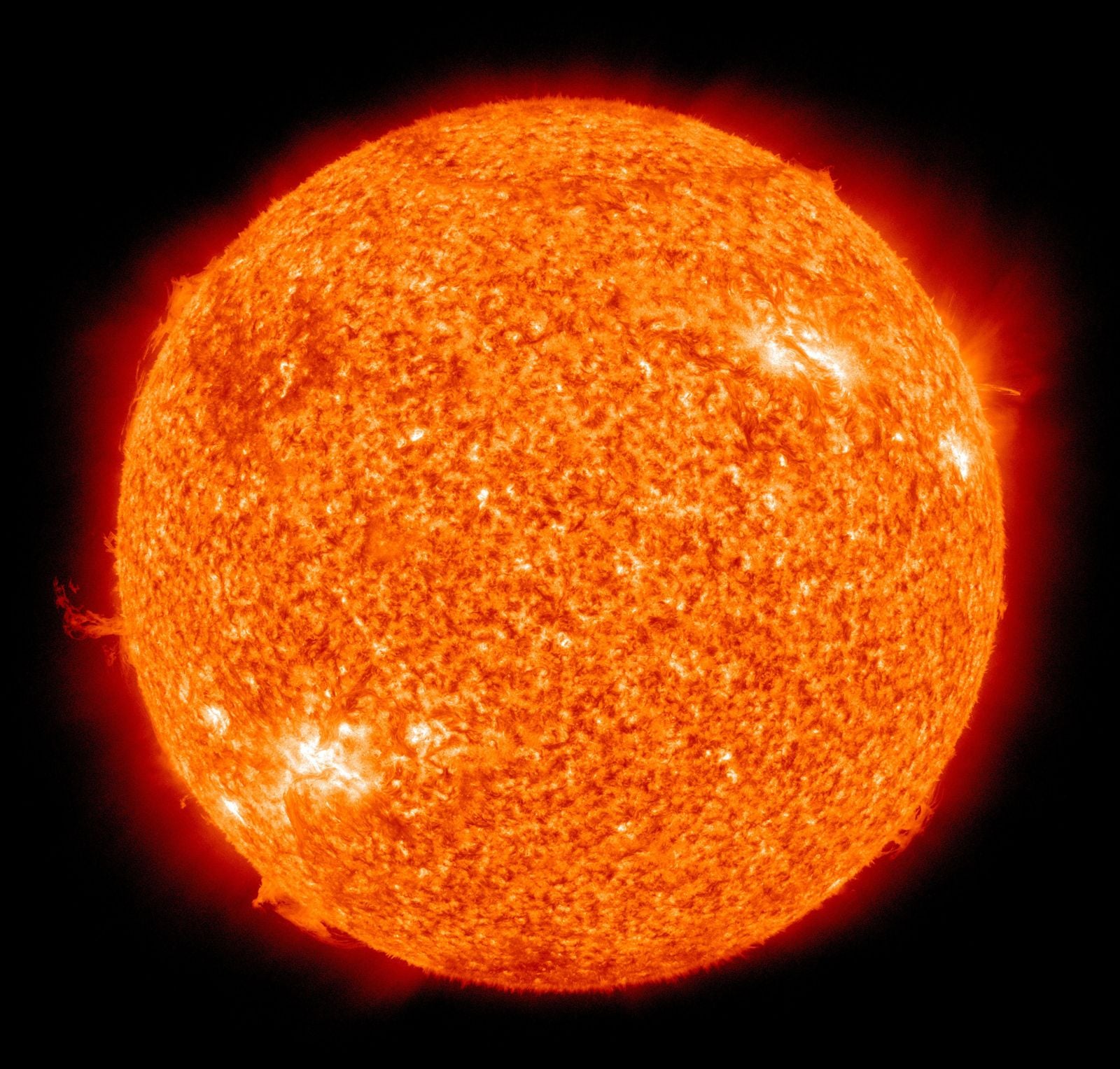
Nineteenth-century chemistry was built on samples you could weigh, dissolve, heat, and combine. An element you could only see in the light of a body 150 million kilometres away was, to many working chemists, not really an element at all. It was a line. The line might belong to some familiar element behaving strangely at high temperature. It might belong to something in the Earth’s atmosphere that the light had passed through on its way to the spectroscope. It might belong to an instrumental artefact.
The 27-year figure also flattens a middle chapter. As Space Daily has noted in its account of the gap between helium’s detection and its terrestrial isolation, the Italian physicist Luigi Palmieri recorded the same 587.5-nanometre line in Vesuvian lava in 1882. That was the first sighting of helium in earthly material. What nobody had, for another thirteen years, was the gas itself.
Janssen, meanwhile, kept chasing eclipses. In 1870, hoping to observe totality from Algeria while Paris was under siege in the Franco-Prussian War, he escaped the city by balloon. Clouds obscured his view.
The uranium ore that finally settled it
The gas came out of a rock.
In 1895, in London, William Ramsay was hunting for argon in minerals when he turned to cleveite, a variety of uraninite that released an unknown gas when treated with acid. An American chemist, William Francis Hillebrand, had already noticed the gas a few years earlier and taken it for nitrogen. Ramsay ran it through a spectroscope.
There was the yellow line.
Ramsay sent a sample to Lockyer for confirmation. Lockyer wrote of watching the discharge tube light up: “When I received it from him, the glorious yellow effulgence of the capillary, while the current was passing, was a sight to see.” The element named for the Sun had been sitting inside a lump of ore dug out of a Norwegian mine.
What Ramsay was really seeing, though no one at the time understood it in these terms, was radioactive decay. Uranium and thorium atoms in the Earth’s crust break down slowly over hundreds of millions of years, and one product of that decay is an alpha particle — which, once it captures a pair of electrons, is a helium atom. The helium in Ramsay’s flask had been accumulating in the ore since the rock formed.
The sequence that followed rearranged the periodic table, though helium was not the element that cracked it open. Argon came first: Ramsay and Lord Rayleigh announced it in August 1894, and it fit nowhere in Mendeleev’s 1869 chart. Helium, isolated seven months later, told Ramsay that argon was not an anomaly but the second member of a family. Working with Morris Travers, he pulled neon, krypton and xenon out of liquefied air in the summer of 1898, and took the 1904 Nobel Prize in Chemistry for the whole column.
The chemistry of a solitary yellow line in an Indian sky turned out to be the chemistry of an entire family of elements no one had suspected existed.
Why helium was hiding on Earth
Helium is the second most abundant element in the universe — roughly 24% of ordinary matter by mass, behind hydrogen’s 75%. Almost everything else, from the iron in blood to the oxygen in the air, makes up the remaining one to two per cent.
On Earth it is vanishingly rare. Helium makes up about 5 parts per million of the atmosphere, roughly 0.0005%. The reason is gravity. Helium atoms are so light and so fast that in the thin upper atmosphere a steady fraction of them exceed escape velocity and drift off into space. The Earth cannot hold on to them.
What helium exists here is trapped underground, produced by the same radioactive decay that filled Ramsay’s flask and captured in the same geological formations that trap natural gas. Nearly all commercial helium is separated from that gas, a by-product of drilling for methane. The United States, Qatar, Algeria and Russia dominate supply, and the chain is brittle: when Qatar was blockaded in 2017, laboratories and hospitals began running down stocks within weeks.
The strange thing about the element named for the Sun is that most of what modern civilisation uses it for happens near absolute zero. Liquid helium boils at 4.2 kelvin, about −269°C, lower than any other substance. That makes it the only practical coolant for the superconducting magnets inside MRI scanners, NMR spectrometers, and particle accelerators like the Large Hadron Collider. A conventional hospital MRI holds somewhere between 1,500 and 1,700 litres of liquid helium in a cryostat wrapped around its main magnet. Let the magnet warm and it loses superconductivity, and the machine stops working.
Spacecraft use it too. Rocket engines are purged with helium before and after firing to clear residual fuel and oxidiser, and liquid hydrogen tanks are pressurised with it. The Saturn V used helium to pressurise the tanks that carried Apollo to the Moon. SpaceX’s Falcon 9 uses helium for the same job, stored in composite overwrapped pressure vessels; the failure of one such vessel inside the second-stage liquid oxygen tank destroyed a Falcon 9 and the Amos-6 satellite on the pad at Cape Canaveral on 1 September 2016, during propellant loading ahead of a static fire test.
Balloons are the least of it.
The eclipse legacy
Janssen’s 1868 observation began a tradition. Total solar eclipses became laboratories. In 1919, British teams organised by Frank Watson Dyson and Arthur Eddington photographed stars near the eclipsed Sun from two sites, Príncipe off West Africa and Sobral in Brazil, and measured the deflection of their light by the Sun’s gravity. The error bars were wide and the precise confirmation would take decades more, but the result supported Einstein’s general theory of relativity and made him a public figure almost overnight.
The son of Norman Lockyer, W. J. S. Lockyer, was quoted in The New York Times after the 1919 result, dismissing its practical importance: the discoveries, he said, did not personally concern ordinary human beings, and only astronomers were affected. General relativity is now the correction that keeps GPS satellites accurate. Every smartphone navigation fix depends on it.
Eclipses had produced, within a fifty-year span, a new element and a new theory of gravity. And the technique Janssen used — splitting the light of a distant object to read its chemistry — is now the backbone of astronomy. Every exoplanet atmosphere characterised by the James Webb Space Telescope, every distant quasar analysed for its composition, every star sorted by spectral type, is being read by the method he pointed at a solar prominence in Guntur.
The gas he identified is now leaking, atom by atom, out of the Earth’s atmosphere and back into space. Some of it drifted up from balloons at children’s birthdays. Some of it boiled off from MRI machines in hospital basements. Some of it vented from rocket pads at Cape Canaveral. All of it is going the same place — up, and out, and eventually back toward the Sun that gave it its name.