
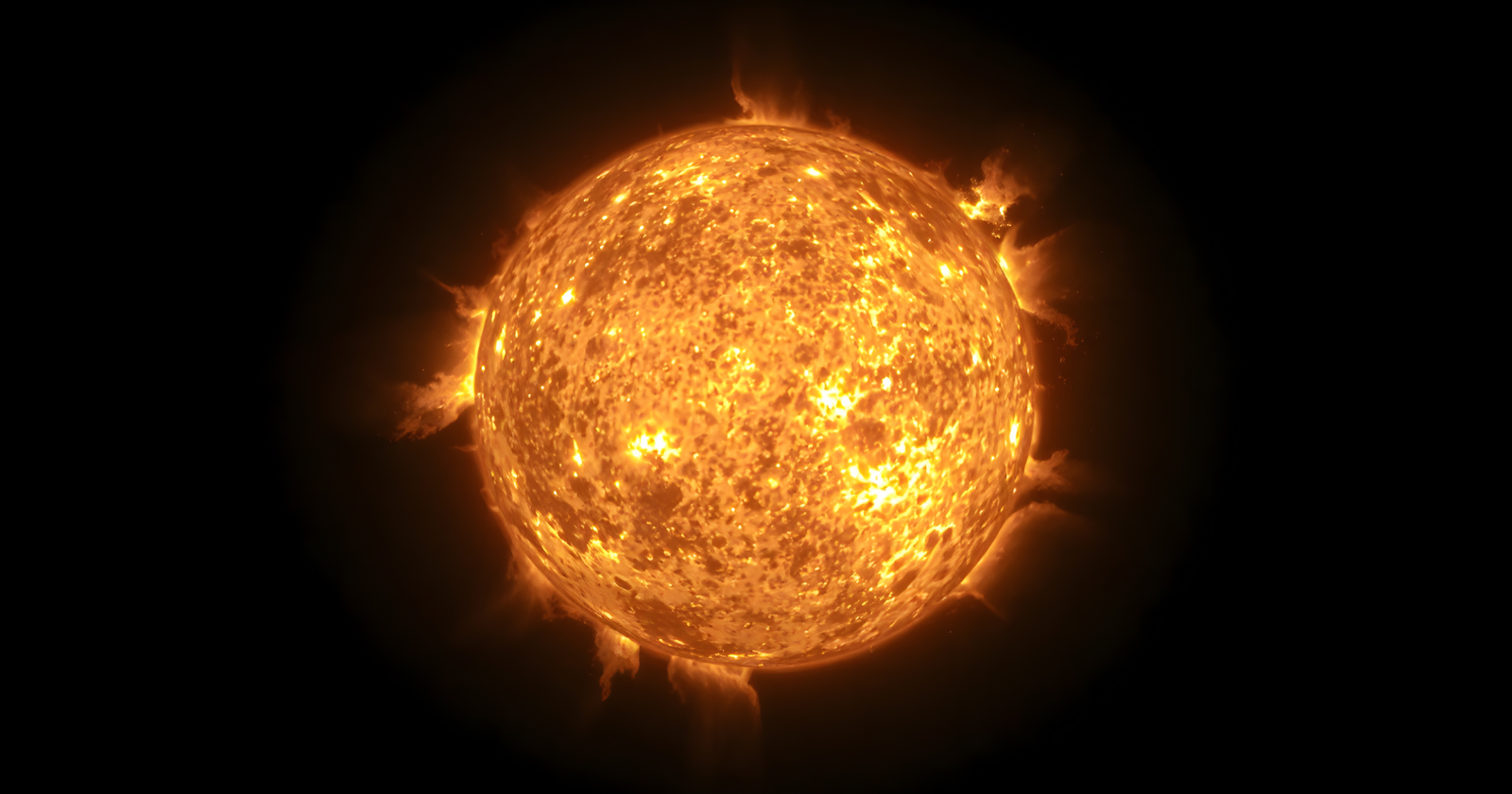
On 18 August 1868, the French astronomer Pierre Janssen observed a total solar eclipse from Guntur, in India. Pointing a spectroscope at the Sun’s chromosphere, the thin layer just above its visible surface, he recorded a bright yellow line at a wavelength of about 587.5 nanometres.
A spectral line is a fingerprint. Each chemical element, when hot, emits light at a specific set of wavelengths, and by 1868 astronomers could already use those lines to work out what stars were made of. The technique was less than a decade old, established by Gustav Kirchhoff and Robert Bunsen in 1859.
Janssen’s yellow line was close to a pair of known lines produced by sodium. But it did not quite match either of them. It sat slightly to one side, at a wavelength that no element measured in any laboratory on Earth was known to produce.
Naming an element nobody had touched
Two months later, working in England, the astronomer Norman Lockyer independently observed the same yellow line in sunlight, having developed a method to study the Sun’s spectrum without waiting for an eclipse. Lockyer labelled the line D3, because it sat near the sodium lines already called D1 and D2.
Lockyer then took the further step. After failing, with the chemist Edward Frankland, to reproduce the line in the laboratory, he proposed that it came from an element present in the Sun and not yet known on Earth. He named it helium, after Helios, the Greek personification of the Sun.
This was a bold claim, and worth recognising as such. Lockyer was asserting the existence of a new element on the strength of a single unexplained line in sunlight, with no sample and no measured weight. For some years the claim was treated with caution by chemists, for the understandable reason that an element known only as a colour in a spectrum is a long way from an element you can hold.
Credit for the discovery is usually shared between Janssen, who first recorded the line, and Lockyer, who first argued it meant a new element. Their reports reached the French Academy of Sciences at close to the same time.
How long until it was found on Earth
The prompt for this piece, and many popular accounts, give a figure of 27 years between the solar discovery and the discovery of helium on Earth. That number is defensible, but it is worth being precise, because the gap has more than one reasonable endpoint.
In 1882, the Italian physicist Luigi Palmieri analysed lava from Mount Vesuvius and recorded the same 587.5-nanometre line. This is generally regarded as the first detection of helium in terrestrial material. By that measure, the gap was about 14 years.
In 1895, the Scottish chemist William Ramsay isolated helium gas itself, obtaining it from a uranium-bearing mineral and confirming, by its spectrum, that the gas long known on the Sun was the same element. Ramsay’s work is the point at which helium on Earth stopped being a line in a spectrum and became a substance in a jar. By that measure, the gap was about 27 years.
So the honest version is that helium was detected on the Sun in 1868, detected in earthly material in 1882, and isolated as a gas in 1895. The headline figure of 27 years measures from the solar discovery to the isolation of the pure gas. It is correct, as long as it is clear which endpoint it is using.
Why it happened in that order
It is a genuinely odd sequence, an element identified on a body 150 million kilometres away before anyone confirmed it underfoot. But there are concrete reasons it ran that way, and they are worth stating, because they make the story less of a curiosity and more of a consequence.
The first reason is that the Sun is an excellent place to see helium. Helium emits its characteristic light strongly when it is very hot, and the Sun’s chromosphere is both extremely hot and extremely large. The yellow line was, in effect, being broadcast.
The second reason is that helium is genuinely scarce and elusive at the Earth’s surface. It is the second most abundant element in the universe, but on Earth it is rare. It is produced underground by the radioactive decay of elements such as uranium, and because it is a light, unreactive gas, any helium that reaches the open air tends to escape upward and, eventually, off the planet entirely. It forms no minerals and no compounds. There was no obvious earthly substance for a nineteenth-century chemist to point a spectroscope at and expect to find it.
So the order of discovery was not a fluke of who looked where. A hot, enormous, helium-rich object in the sky was easier to read than a cool, helium-poor planet on which the gas hides underground and leaks away. The Sun showed its hand first because the Sun was, for this particular element, the clearer page.
