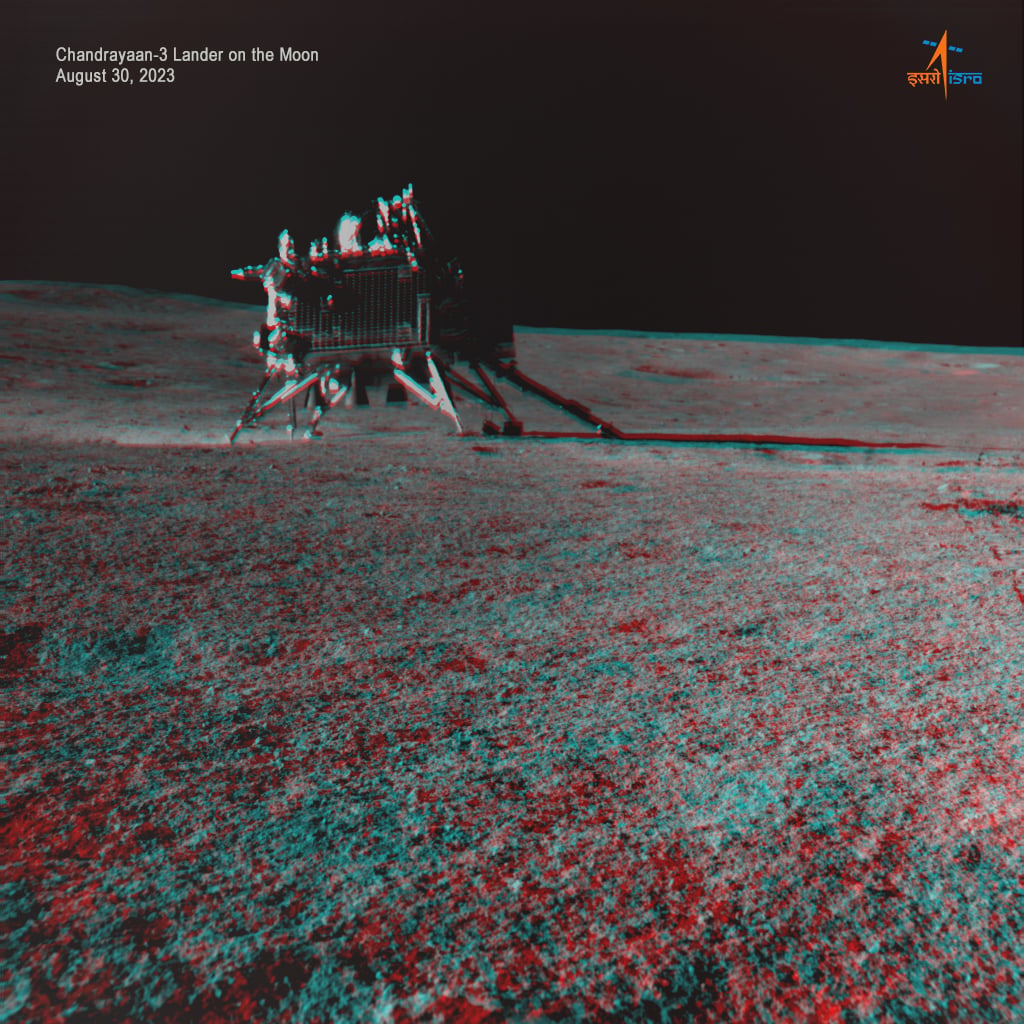
India’s Chandrayaan-3 lander touched down on the Moon at 6:04 pm Indian time on 23 August 2023. It made India the fourth country to complete a controlled lunar landing and the first to do so in the Moon’s southern polar region.
The number that travelled almost as widely as the landing footage was the price: 6.15 billion rupees, commonly converted at the time to about US$75 million. That was less than the reported production budgets of Gravity, The Martian, Passengers and Interstellar.
I understand why the comparison stuck. One sum paid for a fictional journey; the smaller one put a working lander and rover on another world. The number becomes more interesting when we ask what it includes.
The $75 million figure has an official basis
Before launch, India’s Department of Space told Parliament that the approved spacecraft cost was 2.5 billion rupees, excluding the launch vehicle. A later government publication said 6.0134 billion rupees had been spent by June 2023 and gave the complete mission budget, including the rocket, as 6.15 billion rupees.
The dollar figure is consequently an exchange-rate conversion, not the unit in which the mission was budgeted. Depending on the date and rate chosen, reports placed it near $74 million or $75 million. The underlying official number is ₹615 crore.
The widely repeated comparison therefore used the Indian government’s published total, including the LVM3 launch rocket, rather than the spacecraft-only figure.
Near the south pole does not mean beside it
Chandrayaan-3 landed at 69.37 degrees south and 32.35 degrees east. At the Moon’s radius, that latitude is roughly 600 kilometres from the geographic south pole. ISRO now describes the site as southern high latitudes on the near side.
Calling it a south-pole landing is common, including in Indian government material, but “near the southern polar region” is more precise. The lander did not descend into one of the permanently shadowed craters close to 90 degrees south where water ice can survive.
The site was still farther south than any previous soft landing, placing instruments in a part of the lunar surface never previously explored on the ground.
Chandrayaan-3 was not built from nothing
The mission followed Chandrayaan-2, whose orbiter reached the Moon successfully in 2019 but whose Vikram lander crashed during descent. Chandrayaan-3 was deliberately narrower. Its central goals were to demonstrate a safe landing, show a rover moving on the surface and conduct local experiments.
ISRO strengthened the landing system with more fuel, wider landing tolerances, revised software, added redundancy and extensive ground tests. It did not need to build another large scientific lunar orbiter. The working Chandrayaan-2 orbiter could provide a contingency communications link, while Chandrayaan-3 carried a simpler propulsion module to deliver the lander into lunar orbit.
That inheritance matters when discussing cost. Chandrayaan-3 benefited from tracking stations, laboratories, suppliers and knowledge developed through earlier missions. Its budget is not the price of creating a national space programme from nothing.
ISRO traded speed for a practical route
Chandrayaan-3 launched on 14 July and took 40 days to land. The LVM3 placed it in a highly elliptical Earth orbit rather than sending it directly to the Moon. The spacecraft then fired its own engine repeatedly near Earth, raising the far end of its orbit until a translunar injection on 1 August carried it towards the Moon.
It entered lunar orbit on 5 August, gradually lowered that orbit, separated the lander on 17 August and began powered descent six days later. ISRO’s mission timeline records each of those steps. This was not simply a slow flight chosen to save money, but it shows the design philosophy clearly: use a proven launch system and careful orbital manoeuvres rather than demand the most energetic direct departure.
Reuters reported that ISRO and its suppliers also controlled costs through domestic manufacturing, limited numbers of prototypes and comparatively low engineering and production costs. None of those choices made the navigation, software or landing physics easier. They changed what India had to pay to solve them.
The movie comparison is vivid, not an audit
An Indian parliamentary debate later put Interstellar at $165 million, Passengers at $110 million, The Martian at $108 million and Gravity at $100 million. On those reported figures, each film cost more to produce than the full Chandrayaan-3 mission.
Still, these budgets come from different accounting worlds. A film’s quoted production budget may exclude marketing and distribution. A mission total may rely on public infrastructure, previous research and facilities funded under other programmes. Wages, purchasing power and the year of conversion further complicate a direct dollar comparison.
So I would not turn the claim into a formal ranking of the cheapest journeys ever made to another world. Space agencies do not report costs in a standardised global ledger. It is safer to call Chandrayaan-3 one of the clearest examples of a comparatively low-cost robotic landing.
The inexpensive mission still did real science
Vikram deployed the 26-kilogram Pragyan rover shortly after landing. For one lunar day, about 14 Earth days, the two machines measured surface temperatures, the thin near-surface plasma environment, vibrations in the ground and the elemental composition of local soil and rocks. Pragyan made an unambiguous in-place detection of sulphur.
The landing also illustrates something I explored in an earlier article about the Moon’s extremely thin exosphere: on a world with almost no atmosphere, exhaust released by one arriving spacecraft can briefly become an important part of the gas nearby. Even a small, efficient mission changes its immediate environment as it measures it.
ISRO did not make spaceflight cheap. Seventy-five million dollars is still a large public investment built on decades of institutional work. India made a lunar landing cost less than many people assumed such a mission must cost.
The Hollywood comparison gave that achievement a memorable scale. The more durable story is how a focused objective, inherited hardware, domestic capability and a deliberately patient flight plan turned ₹615 crore into a functioning laboratory on the Moon.