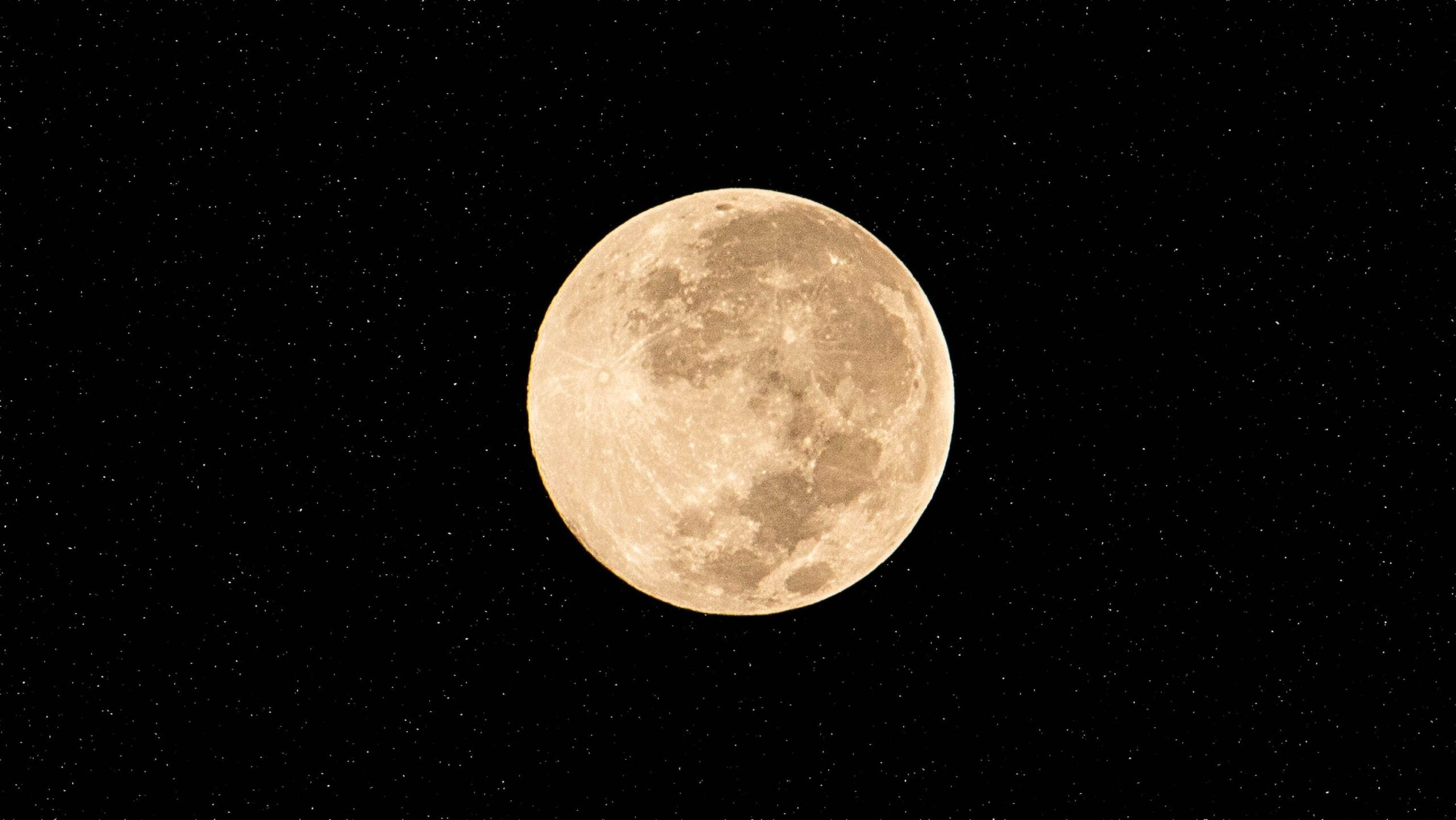
The Moon looks like the definition of an airless world. Its sky remains black in daylight, flags do not flutter without a supporting rod, and an astronaut outside a spacecraft cannot breathe. Yet “airless” is not literally correct.
The Moon has an atmosphere, although it is so sparse that scientists give it a more precise name: an exosphere.
According to NASA’s current account of the lunar atmosphere, this exosphere consists mainly of helium, neon and argon, with smaller amounts of other atoms and molecules. Each cubic centimetre above the surface contains about one quadrillionth as many molecules as the same volume of Earth’s atmosphere at sea level.
That enormous difference changes almost everything. The lunar exosphere cannot carry sound, produce weather or protect the surface as Earth’s atmosphere does. But it is measurable, it changes over time, and future spacecraft will add gases of their own.
Why the Moon’s atmosphere is called an exosphere
Near Earth’s surface, air molecules constantly collide. Those collisions allow pressure, wind and weather to emerge from the behaviour of a vast crowd of particles.
The particles around the Moon are too widely separated for that. A helium atom or water molecule can travel a long distance without striking another particle. It may instead follow a ballistic arc, hit the ground, bounce away again, stick to the surface or escape into space.
This is why describing the Moon as having “air” can mislead. Its exosphere is better understood as a shifting population of individual particles moving above and interacting with the surface. There is no distinct atmospheric ceiling and no useful reservoir for breathing. A spacesuit remains essential.
The surface also experiences temperature swings that would be softened by a thick atmosphere. With almost nothing to circulate heat, sunlit ground can become intensely hot while permanently shadowed polar craters remain cold enough to preserve volatile compounds.
Where helium, neon and argon come from
Some lunar gases arrive from outside. The solar wind, a stream of charged particles flowing from the Sun, implants helium and neon into the uppermost grains of lunar soil. Those atoms can later be released back above the surface.
Argon has a different story. Radioactive potassium inside lunar rocks decays and produces argon-40, which can work its way out of the ground. The exosphere therefore carries signals from both the Sun and the Moon’s interior.
NASA’s Lunar Atmosphere and Dust Environment Explorer, known as LADEE, measured this environment from October 2013 until April 2014. The spacecraft gathered more than 700,000 mass spectra and registered over 11,000 dust impacts before controllers deliberately sent it into the lunar surface at the end of the mission.
LADEE provided the first unambiguous detection of neon in the lunar exosphere. NASA’s report on that result names Mehdi Benna of NASA’s Goddard Space Flight Center as lead author of the study, which appeared in Geophysical Research Letters. The measurements also showed that the relative amounts of helium, neon and argon vary with lunar local time.
The result was not a discovery of a stable shell of gas. It revealed an active balance between particles arriving, being released, migrating across the surface and leaving the Moon.
The Moon continually rebuilds its exosphere
The solar wind is only one source. Tiny meteoroids strike the Moon at high speed and vaporise small amounts of surface material. Sunlight can knock particles loose or supply enough energy for some adsorbed molecules to leave the soil. Radioactive decay continues to generate argon beneath the surface.
Loss happens at the same time. Weak lunar gravity allows faster particles to escape, while others are ionised and swept away by the solar wind. Some land in colder regions and remain trapped for long periods. The exosphere exists because these source and loss processes never quite stop.
Water is especially important. There is no global layer of water vapour comparable to Earth’s, but water and hydroxyl have been detected in and around the lunar surface. Some molecules may make a series of hops towards colder ground, although scientists are still working out how efficiently this transport occurs and how much water reaches polar cold traps.
That uncertainty makes clean measurements valuable. It also makes a busier Moon scientifically complicated.
Why one lander can dominate the gas nearby
A landing spacecraft releases exhaust as it slows. Crewed vehicles can also leak or vent water from life-support systems, airlocks and spacesuits. On Earth, these gases disappear into an immense atmosphere. On the Moon, the artificial contribution can exceed the natural background nearby.
A 2024 modelling study in Advances in Space Research examined temporary lunar atmospheres produced by human activity. Rosemary Killen of NASA Goddard, Benjamin Sprague and William Farrell modelled water released by sources including spacesuits, airlocks and a large landing vehicle.
The researchers estimated that water densities close to an active source could exceed 10 million molecules per cubic centimetre. They compared that with a lower limit of roughly three water molecules per cubic centimetre derived from LADEE observations. Under those assumptions, the local artificial water signal could be more than a million times stronger than the natural background.
Those figures are model outputs, not a universal measurement for every mission. The result depends on how much gas is released, where it is released, surface temperature and the distance from the source. The study nevertheless demonstrates the scale of the measurement problem. In such a thin natural environment, even a small human source is large.
The effect is expected to be local and temporary rather than a permanent, Moon-wide atmosphere. The paper discusses enhanced gas within roughly 100 kilometres of some sources and decay after the release ends. Molecules can freeze onto the surface, migrate, break apart or escape.
Returning to the Moon changes what instruments will measure
LADEE completed its mission before the present push towards sustained lunar activity. Its measurements now serve as a valuable baseline from a relatively quiet period.
Future researchers will need to distinguish gases produced naturally from those delivered by engines and people. Timing matters. An instrument operating soon after a landing may be studying the spacecraft’s exhaust plume as much as the ambient exosphere. Chemical and isotopic clues may help separate sources, but only if missions are designed with contamination in mind.
This is not an argument against lunar exploration. It is a reason to coordinate landings, monitor releases and place sensitive instruments far enough from obvious contamination sources. Measurements taken before, during and after a nearby landing could even turn the disturbance into an experiment, revealing how gas moves and disappears across the lunar surface.
The Moon will remain effectively airless for astronauts. No plausible schedule of landings will give it breathable air or Earth-like weather.
Scientifically, though, its exosphere is real. It records material from the solar wind, impacts and the lunar interior, particle by particle. As more spacecraft arrive, it will also record us.