
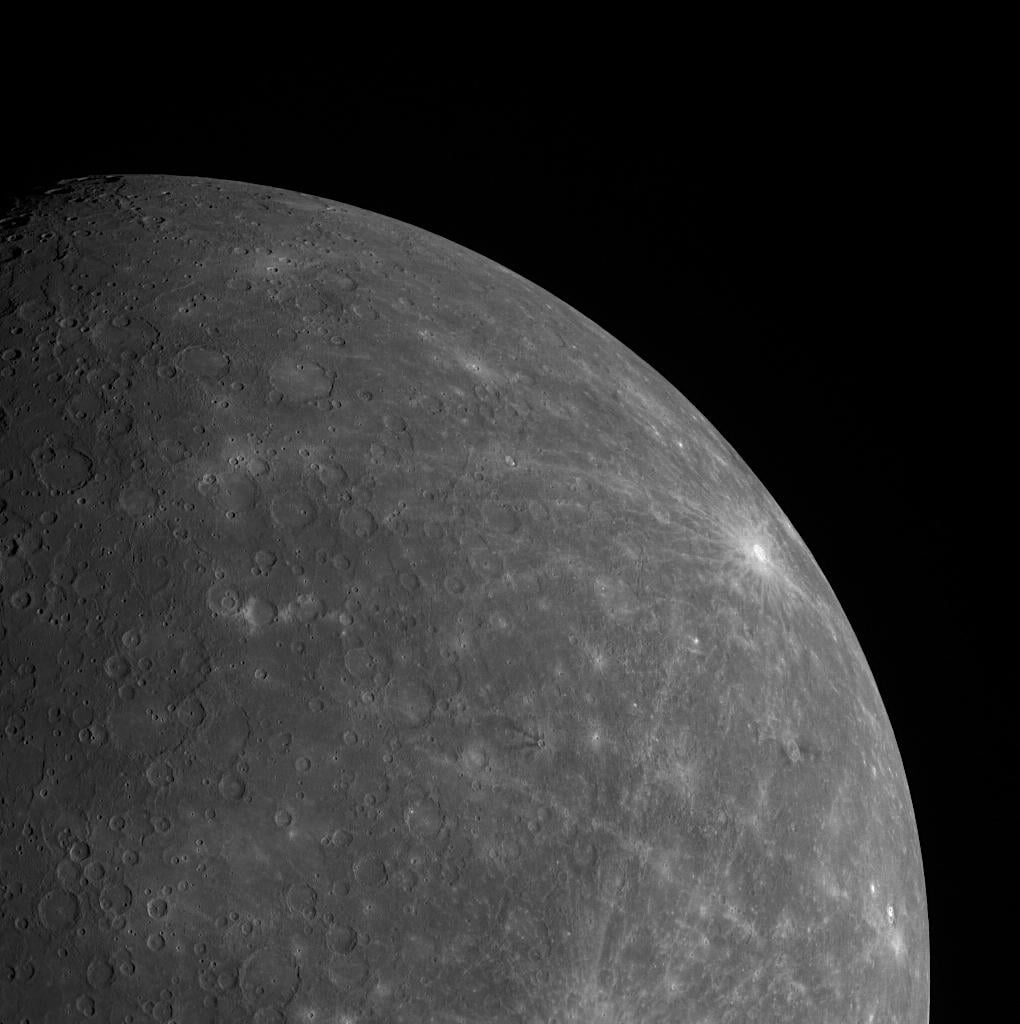
Venus comes closer to Earth than any other planet. Over long periods, however, Mercury spends more time nearer to us and has the smaller average separation. The apparent contradiction comes from using the word closest for two different measurements.
A 2019 analysis by Tom Stockman, Gabriel Monroe and Samuel Cordner in Physics Today calculated that Earth is about 1.04 astronomical units from Mercury on average, compared with 1.14 astronomical units from Venus. The authors then tested the result in a 10,000-year orbital simulation. This is one study, not settled consensus, and it appeared as an opinion article rather than a peer-reviewed research paper. Its central distinction is nonetheless mathematically clear, and NASA’s current Venus facts page now makes the same point.
Three meanings of nearest
Ask which planet is Earth’s nearest neighbour and at least three questions could be hiding inside the sentence.
The first is which planet can make the closest approach. That is Venus. When Venus passes between Earth and the Sun at a favourable inferior conjunction, the separation can fall to roughly 38 million kilometres. Mars and Mercury do not come as close.
The second is which planet is closest at a particular moment. That answer changes as all the planets move around the Sun.
The third asks which planet has the smallest average distance from Earth when positions are sampled over a long period. Under that definition, the Physics Today calculation identifies Mercury. It also found Mercury to be Earth’s nearest planet more often than either Venus or Mars.
Textbook-style descriptions usually mean the first definition. Trouble starts when the difference between orbital radii is labelled an average planet-to-planet distance.
The subtraction that creates the familiar answer
Earth orbits at an average radius of 1 astronomical unit, or AU. Venus orbits at roughly 0.72 AU. Subtract the two and the answer is 0.28 AU, about 42 million kilometres. That is close to the separation when the planets line up on the same side of the Sun, so it looks persuasive.
It does not describe the average distance between two moving planets. Half an orbit later, Venus can be on the far side of the Sun, roughly 1.72 AU from Earth. NASA gives the corresponding maximum as about 261 million kilometres.
Averaging requires considering the distance between all the positions occupied by Earth and all those occupied by Venus, weighted by how much time the planets spend there. Subtracting their average distances from the Sun only captures their minimum radial gap.
The problem is easiest to see by imagining two runners on concentric tracks. The gap between their lanes is small when they are side by side. When they are on opposite sides of the field, the straight-line distance between them includes almost the full diameter of both tracks.
Why Mercury wins the long average
Mercury’s average orbital radius is only about 0.39 AU. It never approaches Earth as closely as Venus does, but it also remains comparatively near the centre of the solar system. When Mercury moves to the far side of the Sun, it does not add as much distance as Venus does.
Stockman and his co-authors formalised this with what they called the point-circle method. They initially treated planetary orbits as circular, concentric and coplanar, then averaged the distance from a point on one orbit to every point on the other. For the solar system, that approximation is useful because most planetary orbits have modest eccentricities and inclinations.
The method produced an average Earth-Mercury distance of 1.04 AU and an Earth-Venus distance of 1.14 AU. The difference is about 0.10 AU, or roughly 15 million kilometres.
The authors’ broader result is stranger: under the same definition, Mercury is the closest planet on average to every other planet, including Neptune. A small inner orbit keeps Mercury relatively near the common centre while other planets repeatedly swing across enormous diameters.
The 10,000-year check
The simplified geometry needed a test against actual planetary motion. The team used the PyEphem astronomy library to calculate the positions of all eight planets for 10,000 simulated years. It recorded the separation of every planetary pair once per simulated day.
Those simulated averages differed from the point-circle estimates by less than one per cent, according to the article. The authors also reported that Michael Barton of a.i. solutions independently checked the result using FreeFlyer astrodynamics software.
PyEphem supplied ephemeris positions and the code sampled the resulting separations. The long run allowed many different orbital alignments to contribute to the average.
NASA lists Mercury’s mean distance from the Sun as 58 million kilometres, or about 0.4 AU, while Venus averages 108 million kilometres and Earth about 150 million. Those orbital radii are the starting geometry, not the final answer.
Average distance is not mission difficulty
Mercury’s statistical proximity does not make it an easier destination than Venus. Spacecraft trajectories depend on launch windows, relative velocity, propulsion, gravity assists and the need to match the target’s orbit. Reaching the innermost planet requires shedding a large amount of the orbital speed a spacecraft inherits from Earth.
That is why missions such as MESSENGER used repeated planetary flybys before entering Mercury orbit. A planet can be closer on a long-term average while remaining energetically demanding to reach.
Venus also remains Earth’s closest planetary analogue in size. Mercury is only slightly larger than the Moon.
The textbook answer needs one extra line
Venus remains the planet that comes closest to Earth. Mercury is the closest when distance is averaged across orbital time, and it is most often the nearest planet at any given moment. Both statements can sit comfortably together once the measurement is named.
The familiar subtraction was never absurd. It answered the distance between neighbouring orbital paths and was then allowed to answer a different question. Ten thousand simulated years were enough to show the cost of that missing distinction.
