

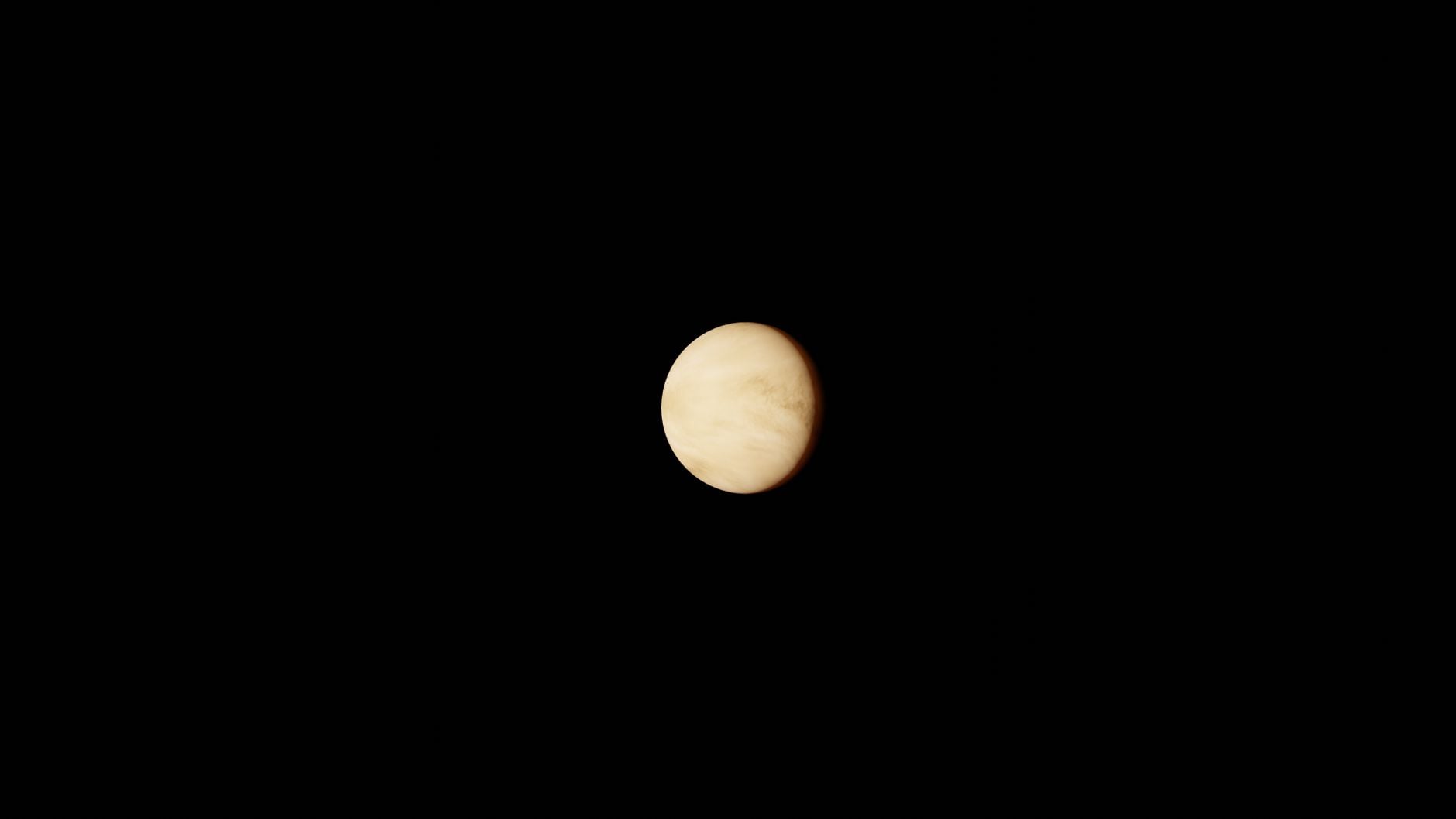
Venus’s brilliant cloud deck has been described for almost half a century as concentrated sulphuric-acid droplets suspended in a carbon-dioxide atmosphere. A 2025 paper asks whether an accidental experiment during a 1978 probe descent recorded something far more chemically complicated.
The peer-reviewed reanalysis in Journal of Geophysical Research: Planets by Rakesh Mogul and colleagues estimates that aerosols captured by NASA’s Pioneer Venus Large Probe contained 62±8 percent water by mass, 16±3 percent ferric sulphate and 22±4 percent sulphuric acid.
Those figures sound as if Venus has been hiding water droplets in plain sight. That is not what the paper says. Almost all the inferred water was released only when material trapped inside the probe reached temperatures associated with the breakdown of hydrated salts. The freely mobile, solution-phase share was estimated at just 0.2±0.1 percent.
Water bound into a mineral is still H2O, and it still counts towards mass. It is not a miniature pond. Understanding that distinction is the key to understanding both the importance and the limits of this result.
An unintended aerosol experiment began in 1978
The Pioneer Venus Multiprobe mission carried one large and three small atmospheric probes to Venus. All four entered the atmosphere on 9 December 1978 at widely separated locations. The Large Probe descended on the dayside near the equator.
Its instruments included a neutral mass spectrometer, known as LNMS, and a gas chromatograph, or LGC. They were intended mainly to identify and measure gases in the atmosphere. Neither was designed as the controlled cloud-particle laboratory that researchers would build for the question today.
As the Large Probe crossed the middle and lower clouds, aerosols apparently entered its gas-sampling systems. The LNMS inlets experienced a large but temporary clog around 51 to 48 kilometres altitude. The LGC also appears to have collected material.
Venus then supplied the oven. The probe continued down into an atmosphere that grew steadily hotter, while the gas chromatograph also performed programmed heating steps. Material retained in the plumbing evaporated or decomposed and released compounds into instruments that kept taking measurements.
The original teams noticed the unusual behaviour, including the clog and changing water readings. Mogul’s group reframed the sequence as an improvised thermal and evolved-gas analysis, similar in principle to experiments that heat a sample and identify what comes off at each temperature.
Water emerged in a sequence of temperature peaks
The old data did not simply show one large rise in water. The reanalysis identified water-release peaks near 35, 80, 118, 185, 242, 276 and 414°C. Sulphur dioxide, oxygen, sulphur trioxide and metal-bearing signals appeared in their own related patterns.
A peak near 185°C coincided broadly with products expected when sulphuric acid and less stable hydrates decompose. A much larger water peak near 414°C appeared beside signals the team linked to the breakdown of more heat-resistant materials, particularly hydrated ferric sulphates and other hydrates.
The team also identified a possible magnesium sulphate signal. The word possible matters because old mass spectra contain overlapping species with the same nominal mass. The ferric-sulphate reconstruction draws on several mutually consistent products, but it too is a chemical interpretation rather than a separated grain placed under a modern microscope.
The pattern is the evidence: different compounds appeared as the trapped material passed through a long natural heating programme. The paper argues that an ordinary sample of concentrated sulphuric acid cannot readily account for the full sequence.
What “about 60 percent water” actually measures
The reconstructed bulk composition assigns 62±8 percent by mass to aerosol water. Of that total, 59±8 percentage points came from the high-temperature release attributed to metal sulphates and other hydrates. Intermediate-temperature hydrates contributed an estimated 3.3±1.0 percent. The solution phase contributed only 0.2±0.1 percent.
Hydrates are compounds whose structures incorporate water molecules. Familiar terrestrial minerals such as gypsum contain water in this way. Heating can drive it off as vapour even though the original solid does not pour, splash or offer the same chemistry as liquid water.
The 62 percent figure also has a narrower denominator than headlines can suggest. It describes the team’s reconstructed composition of aerosols captured over a short part of one descent, based on compounds that produced detectable gases as they heated. It does not mean that 60 percent of Venus’s atmosphere is water, nor that every cloud particle at every altitude has the same composition.
The authors call the percentages maximum values because some aerosol constituents may not have decomposed into identifiable products. Undetected refractory material would increase the total particle mass and reduce the percentage assigned to the measured components.
The associated mass loading makes the scale clearer. The reconstruction yields about 4.2±0.4 milligrams of water per cubic metre of cloud, within about 6.8±0.5 milligrams per cubic metre of inferred aerosol material. This is a proposal about sparse suspended particles, not a hidden ocean.
The sulphuric-acid model has not simply vanished
The traditional model did not arise from habit. Cloud refractive properties, atmospheric chemistry, remote spectroscopy and measurements by several probes have all been consistent with droplets dominated by sulphuric acid and water. The acid explains much of the cloud deck’s optical and chemical behaviour.
A 2021 analysis in Nature Astronomy used the standard acid-water composition to estimate a water activity no higher than about 0.004 in Venus’s clouds. Water activity measures how available water is for chemical or biological use, not simply how many water molecules a sample contains. The value was far below the approximately 0.585 lower limit then known for terrestrial organisms.
The new paper does not eliminate sulphuric acid. It assigns the acid 22±4 percent of the reconstructed bulk aerosol, and the more volatile material released during the inlet clog was itself estimated to contain 86±17 percent sulphuric acid and 14±4 percent water.
What changes is the proposed remainder. Instead of treating the cloud particles as only an acid-and-water solution, the reinterpretation adds ferric sulphate, possible magnesium sulphate and other hydrated material. If those components are genuinely widespread, models of particle density, acidity, water activity, cloud formation and ultraviolet absorption may need to be recalculated.
The probe may have changed the sample it caught
The largest uncertainty is inseparable from the discovery. Pioneer Venus did not deliberately collect a particle, seal it at cloud temperature and analyse its original structure. Aerosols entered plumbing, clogged an inlet, experienced changing pressure and heat, and probably evaporated, concentrated, precipitated and reacted before all their products were measured.
Mogul and colleagues explicitly say that many of the hydrates probably formed after capture as aerosol material thermally evaporated inside the inlet. The incoming particles could still have supplied the water, sulphates and metals needed to make those hydrated compounds. But the measurement does not prove that identical crystals floated intact through the clouds.
There is also only one Large Probe trajectory in the calculation. Venus’s atmosphere circulates rapidly and contains several cloud layers with different particle sizes. One accidental sample cannot establish how the proposed composition varies with altitude, latitude, local time or season.
These limitations do not erase the temperature-ordered signals. They define the question a future mission must answer: did the instrument reveal a neglected reservoir that was present in the clouds, or did its unusual plumbing and descent transform a smaller amount of water and salt into a misleadingly large reconstruction?
Bound water does not make a habitable cloud
Venusian cloud chemistry attracts attention partly because temperatures and pressures around 50 to 60 kilometres altitude are less extreme than those at the surface. That physical resemblance to Earth says nothing by itself about whether a cell could acquire water or survive the chemistry.
SpaceDaily’s recent review of the disputed phosphine signal in Venus’s atmosphere separated three questions that are often collapsed: is the signal real, is the proposed molecule responsible, and does that molecule have a biological source? The same discipline belongs here.
The Pioneer Venus reanalysis proposes a chemical inventory. It reports no organism, biosignature or biological reaction. Even if the total H2O mass is correct, a cell cannot necessarily extract water locked tightly into a crystal. Acidity, temperature, nutrient supply and the microscopic physical state of each particle remain decisive.
Hydrated salts could nevertheless make the environment less simple than the standard concentrated-acid droplet. The earlier water-activity calculation assumes a particular acid-water mixture. A salt-rich particle might have a different water activity and pH, but those values must be measured or modelled for the proposed composition rather than inferred from bulk water mass.
Iron and magnesium need a delivery route
If the aerosols contain substantial ferric and magnesium sulphates, the metals must come from somewhere. The paper suggests incoming cosmic material as one source. Micrometeorites and cometary dust continually enter planetary atmospheres, and concentrated acid could alter the grains as they pass through Venus’s clouds.
The team compared its projected iron loading, about 0.3±0.1 milligrams per cubic metre, with earlier Soviet probe measurements and found them broadly compatible. It also considered whether cosmic delivery over time could supply enough material. The route is plausible, but the paper does not trace an individual cloud grain back to a meteorite.
Iron-bearing compounds are especially interesting because an unidentified substance absorbs ultraviolet sunlight in the Venusian clouds. SpaceDaily’s earlier report on the water-and-iron reanalysis noted that ferric sulphate could contribute to that absorption. Matching one part of a spectrum in a laboratory mixture would still not prove that it is the sole unknown absorber on Venus.
The proposal therefore joins several puzzles rather than solving them at once: cloud composition, delivery of rocky material, ultraviolet absorption and possible chemical energy. That is scientifically useful precisely because each connection creates a test.
The decisive experiment must return to Venus
Archive work can recover a measurement that an original team did not know it had made. It cannot give the 1978 instruments capabilities they lacked. The clean test needs a new probe that collects individual particles at known altitudes, controls their temperature and then measures water, acid, salts and metals without allowing the sample to transform unnoticed.
SpaceDaily has examined the planned Venus Life Finder’s brief plunge through the clouds. Its autofluorescence and scattering measurements could test particles for organic chemistry and shape, but they would not by themselves provide a complete mineral and water inventory.
NASA’s DAVINCI mission is designed to measure atmospheric gases and structure during descent and obtain images below the clouds. It should give researchers a far better environmental context, although it is not a particle-return mission or a full aerosol mineralogy laboratory.
A purpose-built sampler could also distinguish the cloud layers. It could test whether any bound water and iron are widespread, confined to larger lower-cloud particles or variable enough that Pioneer Venus encountered an unusual patch.
Until then, concentrated sulphuric acid remains part of the evidence, not an old model cleanly overturned. The 2025 study offers a serious alternative interpretation of one probe’s records: Venus’s aerosols may contain a much larger reservoir of chemically bound water and altered salts than scientists have allowed. Confirming it will require a spacecraft sent to do deliberately what Pioneer Venus may have done by accident.