

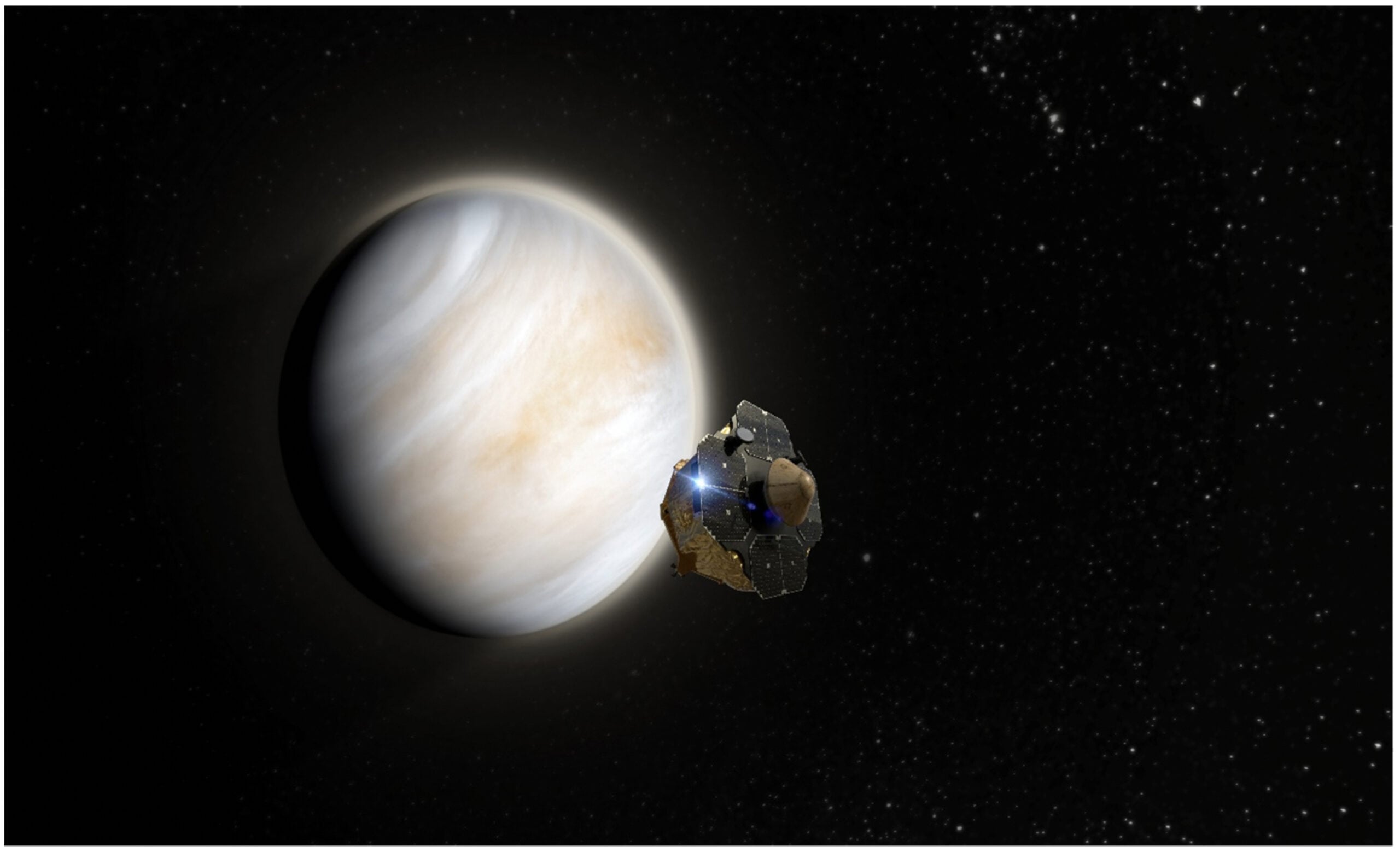
Rocket Lab’s planned Venus probe is built around an uncomfortable trade: the spacecraft can be small and comparatively inexpensive because it will ask one tightly defined question, at one place, for only a few minutes.
The target is the middle cloud deck of Venus, where temperature and pressure are far less hostile than at the surface. A cone-shaped capsule would fall through that region while a laser instrument examined individual aerosol particles for fluorescence and scattered light. Then the probe would continue into denser, hotter air until communication and electronics failed.
The project is real enough to have an instrument, a fitted heat shield and active data-analysis work. It is not yet a dated mission. As of August 21, 2026, Rocket Lab’s launch manifest lists Venus Life Finder as TBC, with no rocket or launch site confirmed.
“Preparing” therefore describes continuing hardware and science work, not a countdown. No publicly announced launch date currently binds the mission to the next Earth-Venus opportunity.
One probe, one instrument and one short descent
The peer-reviewed mission design describes a direct-entry capsule roughly 40 centimetres across, with a mass of about 17 kilograms and space for a single instrument weighing approximately one kilogram. Earlier versions paired an Electron rocket with Rocket Lab’s high-energy Photon spacecraft. Photon would carry the probe across interplanetary space and release it about 30 minutes before atmospheric entry.
That original architecture should not be confused with a settled launch plan. Rocket Lab’s current project page still speaks of Electron and a Rocket Lab spacecraft, while its live mission manifest now labels the date TBC, the rocket N/A and the site TBC. Earlier targets of May 2023, January 2025 and summer 2026 have passed or slipped.
The entry probe is ballistic. It has no balloon to keep it in the clouds and no ambition to operate on the ground. The published science profile gives it about 330 seconds, or five and a half minutes, between roughly 60 and 48 kilometres altitude. Georgia Tech’s mission team says the instrument will have about five minutes to collect its primary cloud data and the probe may have another 15 minutes to transmit before conditions become too severe.
The only instrument shines blue light through a window
The payload is called an autofluorescence nephelometer, or AFN. It projects a focused, polarized laser with a wavelength of 440 nanometres through a fused-silica window. As individual droplets and other aerosol particles pass through the beam, the instrument records light scattered back toward the capsule.
That pattern can constrain the concentration, size and shape of the particles. Polarization and refractive index provide indirect information about composition. The AFN also watches at wavelengths from about 470 to 520 nanometres for particles that absorb the blue laser light and re-emit some of the energy as fluorescence.
The instrument paper says some organic molecules should fluoresce under this illumination. That makes a glow a potential clue to organic material, not a molecular identification. The instrument cannot read a fluorescent signal and name the compound that produced it, and it cannot determine from fluorescence alone whether its source is biological.
A 2026 data-retrieval study in Icarus highlights another limit. Different combinations of particle size and refractive index can scatter light in indistinguishable ways. The team is developing a Bayesian method that returns ranges of plausible particle properties instead of pretending one optical measurement has a unique chemical answer.
Why those five minutes occur in the clouds, not near the ground
At the surface, Venus is approximately 465 degrees Celsius under about 90 times Earth’s sea-level atmospheric pressure. Space Daily’s account of Venera 13’s record 127-minute survival shows how much engineering is required for even a brief surface mission.
Higher in the atmosphere, conditions change rapidly. As our earlier examination of Venus at about 50 kilometres altitude explained, pressure and part of the temperature range can resemble Earth’s surface more closely than conditions on Mars do.
That resemblance is only physical. Venusian cloud droplets are dominated by concentrated sulphuric acid, and the atmosphere contains extremely little water available for terrestrial-style biology. The middle clouds are less immediately destructive than the ground, but they are not an Earth-like habitat.
Entry itself presents a different ordeal. In February 2025, NASA Ames reported installing a HEEET heat shield on the probe. The woven thermal-protection material is designed for entry heating as high as 4,500 degrees Fahrenheit. Once the shield has done its job, ambient heat and pressure will rise as the unprotected descent continues.
Testing has continued even while the launch date moved
The absence of a launch date does not mean the science hardware is imaginary. In March 2025, a Georgia Tech-led team flew the AFN through volcanic fog over Hawaii. Sulphur dioxide from Kilauea produces acid-rich droplets, giving researchers a terrestrial environment in which to test the instrument’s response to ash, aerosols and complex chemistry.
Georgia Tech reported that the instrument had been built and integrated with the entry probe for early tests. The field work helps the team learn how real particle mixtures map onto the compact data product that can be transmitted from Venus. The 2026 Icarus analysis is further evidence that preparation continues at the instrument and interpretation level.
The planned communications path is direct to Earth rather than a long-lived Venus relay. That keeps the architecture small but sharply limits how much information can be returned. The retrieval team proposes compact two-dimensional histograms of measured light intensity by altitude, leaving the computationally expensive inference for researchers on Earth.
The “under $10 million” claim needs boundaries
The mission has been widely described as costing less than US$10 million. The Planetary Society repeats that estimate in its mission overview. It captures the project’s central proposition: a commercial launcher, a small spacecraft and one instrument might produce useful interplanetary science for a fraction of a conventional planetary mission.
It is not a current audited total. Rocket Lab has not published a recent line-item budget, and changes to the launcher or schedule can change costs. The label “privately funded” also needs context. Rocket Lab, MIT and philanthropic support are central, but NASA developed and installed the heat shield, has supported instrument field testing and is expected to provide Deep Space Network navigation and communications assistance. “Largely privately funded” is therefore more precise than “entirely private.”
The price buys focus by accepting risk and limited science. There is one instrument, no second sampling site and no opportunity to repair a failure. A null result would apply only to one short track, one set of optical wavelengths and one moment in a rapidly circulating atmosphere.
Organic material would be a clue, not a life detection
Interest in the mission rose after the disputed 2020 report of phosphine in Venus’s atmosphere. Space Daily’s recent review of the phosphine evidence and its unresolved alternatives showed why direct sampling is attractive. Remote spectra must disentangle weak lines, instrument effects and nearby absorbers across an entire atmosphere.
Venus Life Finder will not measure phosphine. Its question is broader and more modest: do individual cloud particles fluoresce in a way consistent with organic chemistry, and do their scattering properties match the sulphuric-acid droplets scientists expect?
Organic molecules can be produced without life, delivered by meteorites or transformed by Venusian chemistry. Conversely, an organism or organic particle could pass outside the probe’s narrow track or fail to fluoresce strongly at the selected wavelength. A positive result would demand a more capable follow-up instrument able to separate and identify molecules. A negative result would not sterilize an entire planet.
Five minutes is enough to replace some inference with direct measurements. It is not enough to settle whether Venus is inhabited, and the mission must first secure a launch before its short clock can begin.