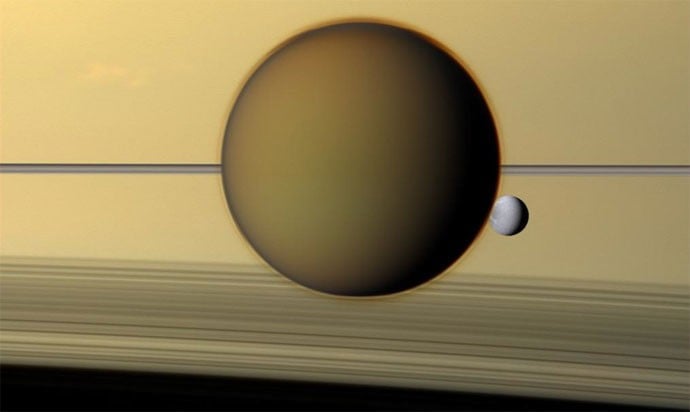
Titan is not staying where Saturn put it.
The giant moon is moving outward by about 11 centimetres each year, a tiny distance on a human scale and a surprisingly large one in the slow accounting of planetary systems. Earth’s Moon recedes from us by about 3.8 centimetres a year. Titan is retreating almost three times faster despite orbiting much farther from its planet than our Moon does from Earth.
The result came from Cassini data and was published in 2020, but the number still carries a useful shock. Standard tidal models had put Titan’s outward drift at no more than roughly 0.1 centimetres a year. The measured value was more than 100 times that expectation.
That does not mean Titan recently accelerated to a constant speed that can be projected cleanly into the past. It means the old picture of how Saturn transfers energy to its moons was missing something important. The leading explanation is resonance locking, a process in which Titan’s gravitational rhythm couples to oscillations inside Saturn and keeps moving outward as the planet itself evolves.
Eleven centimetres is a change in the orbit, not a journey through empty space
Titan is already in constant motion. It travels around Saturn once every 15 days and 22 hours at an average distance of about 1.2 million kilometres from the planet, according to NASA’s Titan overview. The 11-centimetre figure describes the annual increase in the size of that orbit.
At the present rate, the change would add only 110 kilometres in a million years. Planetary history, however, runs for billions of years. If 11 centimetres a year had applied unchanged for the age of the Solar System, the accumulated distance would approach half a million kilometres.
That multiplication is useful for scale, not as a reconstruction of Titan’s exact path. Tidal migration rates can change, and resonance locking specifically ties the rate to the changing internal oscillations of Saturn. The paper’s conclusion is therefore not that Titan began at one easily calculated address. It is that the moon may have formed substantially closer to Saturn and migrated across a much larger part of the system than conventional models allowed.
This is one study, not settled consensus on Titan’s complete orbital history. It measured the present drift and showed that a resonance-locking model fits the broader Saturnian moon data. Turning that result into a birth location requires models of Saturn’s interior and how both planet and moons evolved over time.
Cassini measured the drift in two independent ways
Measuring 11 centimetres against an orbit more than a million kilometres wide sounds implausible until the time span and methods are considered. The team led by Valéry Lainey used two independent records created by Cassini.
The first was astrometry. Researchers mapped background stars in Cassini images and used them as a reference frame for Titan’s position. Tracking where the moon appeared over many years allowed small departures from a fixed orbital model to accumulate into a measurable signal.
The second method used radio science during ten close Titan flybys between 2006 and 2016. Cassini transmitted radio signals to Earth, and researchers measured tiny shifts in frequency connected to the spacecraft’s velocity. Titan’s gravity altered Cassini’s motion during each encounter, so precise radio tracking also constrained the moon’s orbit.
The two analyses used different data and different techniques, yet converged on the same rapid expansion. That agreement is one reason the result carried more weight than a single method would have. NASA’s Jet Propulsion Laboratory summarised the two-track measurement, while the team’s peer-reviewed paper appeared in Nature Astronomy.
Cassini was unusually well suited to this work. Titan was not merely a target; its gravity was the engine of the spacecraft’s tour. Mission navigators repeatedly used close passes by the moon to reshape Cassini’s orbit around Saturn, a history NASA describes in its Cassini navigation account. Every successful flyby required the team to know Titan’s position and gravitational influence with increasing precision.
Saturn’s rotation gives Titan orbital energy
The basic reason moons migrate outward is familiar from the Earth-Moon system. Titan’s gravity raises a tidal bulge in Saturn. Because Saturn rotates much faster than Titan completes an orbit, that bulge is carried slightly ahead of the line connecting planet and moon.
The offset bulge pulls Titan forward. A forward pull gives the moon orbital energy and angular momentum, lifting it into a slightly larger orbit. Saturn loses a corresponding amount of rotational angular momentum. Energy is also dissipated as heat inside the planet.
The difficulty lies in calculating how efficiently a giant planet dissipates that tidal energy. Saturn is not a solid ball with a shallow ocean. It is a rotating, layered world of hydrogen and helium with a complicated interior that remains only partly understood. The answer is often represented by a tidal quality factor called Q. A high Q means weak dissipation; a lower Q means that more tidal energy is lost during each cycle.
Classical calculations also made migration strongly dependent on distance, falling with orbital separation to the power of eleven-halves. Titan is far from Saturn, so the old model predicted almost negligible movement. The new result implied a Saturnian Q near 100 at Titan’s tidal frequency, more than 100 times lower than many earlier expectations.
The surprise was therefore deeper than an incorrect speed estimate. Titan was revealing that Saturn’s tidal response could not be captured by one simple, fixed efficiency applied across the moon system.
Resonance locking gives the moon a moving target inside Saturn
Resonance locking begins with the fact that Saturn can oscillate internally. A moon’s gravity tugs on the planet at a repeating frequency. If that forcing frequency comes close to one of Saturn’s natural oscillation modes, the response can become much stronger, rather like a repeated push delivered at the right point in a swing’s motion.
The complication is that Saturn’s natural frequencies are not permanent. The planet cools and slowly changes internally. Its oscillation modes shift. Under the resonance-locking theory, Titan’s orbit migrates in a way that keeps its tidal forcing coupled to one of those evolving modes.
Jim Fuller, Jiming Luan and Eliot Quataert laid out the theory for giant-planet moon systems in a 2016 Monthly Notices of the Royal Astronomical Society paper. The later Cassini measurement supplied a demanding observational test. Lainey and colleagues found that Titan and five other Saturnian moons were consistent with the model, with inertial waves inside Saturn contributing to the dissipation.
Consistent is the careful word. Cassini did not photograph an oscillation mode holding Titan in place, and Saturn’s deep interior remains uncertain. The theory succeeds because it explains why outer moons can migrate much faster than the classical distance rule predicted and why several moons can share broadly similar migration timescales.
What I find most interesting is that the changing object is not only Titan’s orbit. Saturn itself becomes part of the clock. The moon is responding to a planet whose internal structure and frequencies have been evolving beneath the clouds.
A closer birthplace would rewrite more than one orbit
Titan’s current migration timescale is roughly ten billion years, meaning its orbital distance divided by its present expansion rate is of that order. That is longer than the age of the Solar System but close enough for substantial movement to have accumulated, especially if the rate changed over time.
If Titan formed much closer to Saturn, it would have crossed a changing landscape of gravitational relationships with the planet’s other moons. Migration can place moons into orbital resonances, where their periods become linked by simple ratios. Those resonances can increase orbital eccentricity or inclination and drive tidal heating inside the moons.
The implications therefore reach beyond Titan. Models for the formation of Saturn’s moons and rings depend on where bodies began, how quickly they spread out and which resonances they crossed. A system once treated as broadly settled near its present arrangement may have undergone a much more active rearrangement.
The result does not prove that Titan was assembled intact beside Saturn and then rode one unbroken resonance outward. NASA notes that the moon’s nitrogen isotopes may preserve information about very cold building blocks from the early Solar System, while the details of its assembly remain uncertain. “Formed closer” describes an orbital conclusion from the migration model, not a complete account of how every part of Titan came together.
The moving moon is also the world Cassini found beneath the haze
Orbital history can feel abstract beside Titan’s surface. This is the moon with a thick nitrogen atmosphere, dunes of organic material and a methane weather cycle. In an earlier article, I looked at how Titan can have rain, rivers and lakes without liquid water on its surface.
Cassini’s radar made those landscapes tangible, but it also left puzzles. Titan has long river systems and surprisingly few obvious deltas. A 2025 analysis I covered found deltas at only about 1.3 per cent of mapped river mouths. Another Cassini analysis found the three largest seas exceptionally smooth during four flybys, while rougher estuaries hinted at compositional differences where rivers entered them. I explored that result in a separate piece on Titan’s mirror-smooth seas and methane-rich inflow.
The 11-centimetre drift does not solve either surface puzzle. It changes the long background against which Titan evolved. A moon born closer to Saturn would have experienced different tidal relationships and a different resonance history before arriving at the orbit where Cassini met it.
There is a similar timescale problem in Titan’s atmosphere. Methane is destroyed by sunlight far faster than the age of the moon, so something must replenish it or we happen to be observing a temporary era. Recent impact modelling did not close that gap, as I discussed in an article on why the source of Titan’s methane remains unresolved.
These questions sit at different levels, but they share one warning. Titan’s present appearance is not necessarily a faithful picture of its whole past. The rivers, atmosphere, internal ocean and orbit all carry histories that can change on very different clocks.
Cassini measured an annual movement shorter than a handspan and used it to challenge the architecture of an entire moon system. Titan is still only 11 centimetres farther out after a year. The important change is in our reconstruction of where it may once have been.