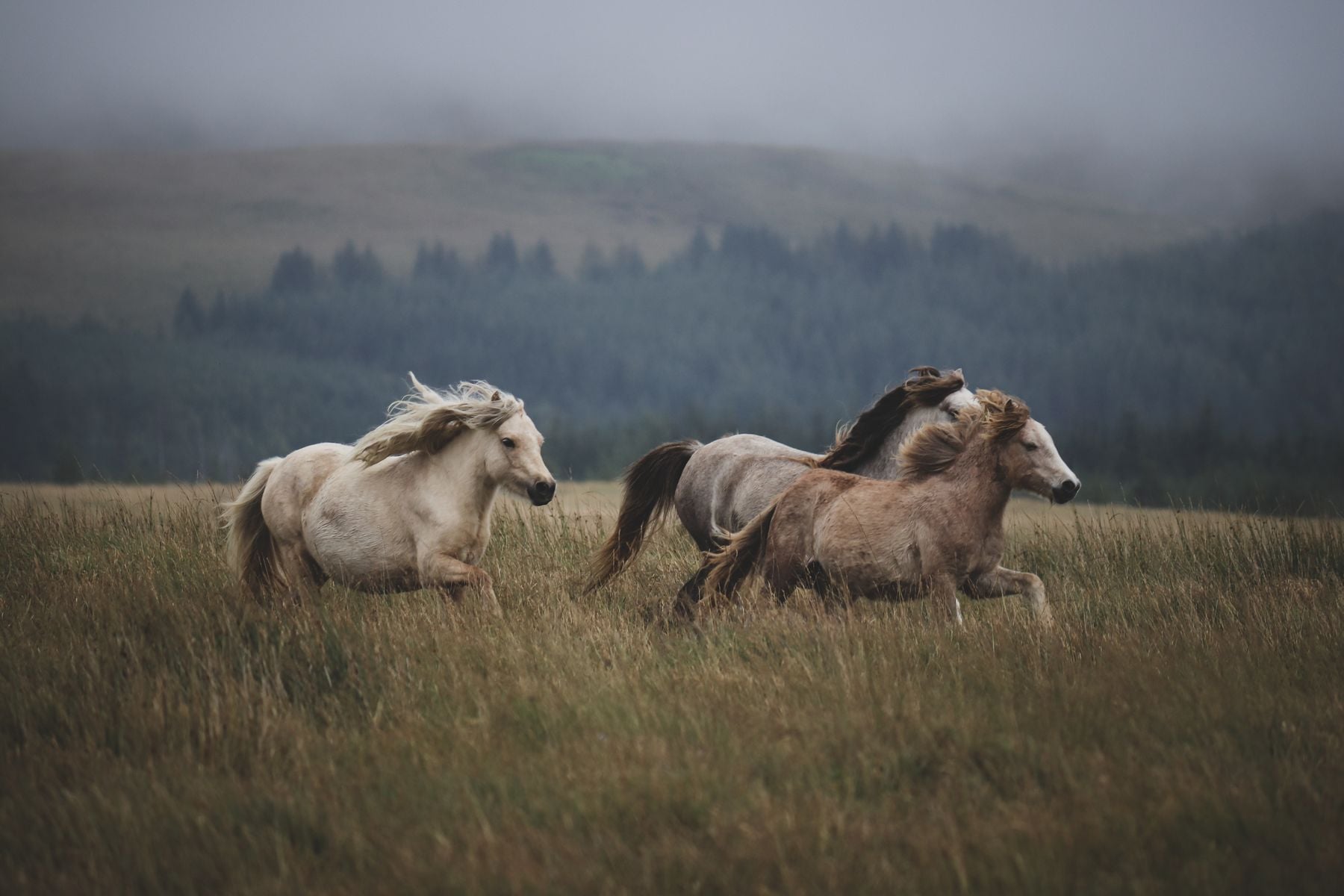
Forty years after the reactor explosion that emptied towns and farms around Chernobyl, the exclusion zone supports wolves, lynx, deer, wild boar and herds of introduced Przewalski’s horses. The landscape is still contaminated. It is also one of the most arresting large-mammal refuges in Europe.
The number that gives this story its force comes from a 2015 paper in Current Biology. In the Belarusian part of the zone, the researchers found that moose, roe deer, red deer and wild boar were about as abundant as they were in four uncontaminated nature reserves. Wolves were more than seven times as abundant.
That result deserves the attention it received. It also needs to be read precisely. This is one influential study, not a verdict that radiation is harmless, and the seven-times comparison applies to wolves rather than every species named in the headline.
What the seven-times figure actually measured
The study was led by Tatiana Deryabina and drew on monitoring in the Polessye State Radioecological Reserve, the Belarusian section of the wider 4,200-square-kilometre exclusion zone. Staff counted tracks along 35 winter survey routes from 2008 to 2010. Together, those routes covered 315 kilometres and were repeated over two or three winters.
The researchers first asked whether mammal abundance fell as radiocaesium contamination rose. After accounting for habitat variation, they found no such relationship for moose, wolves, wild boar, roe deer, foxes or a combined group of other mammals.
They then compared official density estimates from 2005 to 2010 with estimates from four other Belarusian reserves. The same snow-track census method was used in each place. That consistency matters because tracks do not provide a perfect head count, but they can support a useful relative comparison. Four large herbivores occurred at broadly similar densities. Wolf density was more than seven times higher in the exclusion zone.
The authors also examined aerial surveys from the decade after the April 1986 accident. Counts of moose, roe deer and wild boar rose rather than fell. Whatever harm radiation may have caused individual animals, it was not visible as a long-term collapse in these large-mammal counts.
Abundance is not the same thing as health
This distinction is the key to the whole story. A population can be numerous while some of its members carry genetic damage, experience shorter lives or reproduce less successfully. A track survey can reveal how heavily animals use a landscape. It cannot run blood tests or follow every pregnancy.
The 2015 researchers acknowledged that boundary. Their conclusion was that the zone held an abundant mammal community despite nearly three decades of chronic exposure, not that exposure had no biological effects.
There is also a genuine scientific dispute. A 2020 study in Scientific Reports reconstructed absorbed radiation doses for mammals recorded on Ukrainian snow transects and reported lower abundance as estimated dose increased. Its authors argued that an animal’s dose cannot be represented adequately by a single ambient reading at a survey point.
These studies used different data, areas and exposure models. They do not cancel one another out neatly. They show why “Chernobyl wildlife is thriving” is too broad if thriving is meant to cover health, reproduction and every species. The strongest claim is narrower: several large mammals have maintained substantial populations in a landscape with chronic contamination and very little permanent human settlement.
I made a similar distinction in an earlier article about the supposedly universal need for pre-1945 steel in radiation detectors. Nuclear stories collect clean, memorable claims. The underlying measurement usually has more conditions attached.
Lynx and newer camera traps strengthen the refuge case
Snow tracks are no longer the only evidence. A camera-trap study using footage from 2013 to 2018 recorded Eurasian lynx 302 times across almost 30 per cent of the Ukrainian exclusion zone. Researchers identified 50 individuals and estimated a total population of roughly 53 to 68 lynx, with a density comparable to favourable habitats elsewhere in Europe.
The habitat explanation was straightforward. More than 63 per cent of the area was forested. Roe deer and red deer supplied prey. Residential settlement and agriculture were absent, ordinary disturbance was low, and the zone had protected status.
A broader camera-trap analysis published in 2026 examined 11 terrestrial mammal species across northern Ukraine. Using data gathered in 2020 and 2021, the researchers found higher species diversity, occupancy and detection probabilities in the Ukrainian exclusion zone and neighbouring Drevlianskyi Nature Reserve than in the other protected and unprotected areas they sampled. Przewalski’s horses, lynx, moose and red deer had their highest estimated occupancy there.
Occupancy is the probability that a species uses a surveyed area, not a direct population count. Even so, this newer method points in the same general direction as the older censuses. Large, connected protected areas with restrictions on human access can become exceptionally valuable habitat.
The dates matter. Those camera data were collected before Russia’s full-scale invasion of Ukraine in 2022. They cannot tell us exactly how occupation, mines, military activity and disrupted monitoring have affected wildlife since then.
The horses were introduced, then multiplied
Przewalski’s horses make the zone look like a place where a lost wild Europe simply returned on its own. Their history is more deliberate. They were introduced to the Ukrainian exclusion zone in 1998 as part of an effort to establish a free-ranging population.
A 2018 camera-trap survey recorded 137 horses in the Ukrainian sector and at least four more at a remote site in Belarus. The documented population had grown sevenfold over twenty years. Almost all were second generation or later, and the survey recorded 24 foals.
That is a real conservation success, but it should not be turned into evidence that radiation helped the horses. The animals gained space, meadows, low disturbance and protection from ordinary development. Their expansion is evidence that they could adapt to the zone, not that contamination caused them to flourish.
Human absence changed the ecological equation
After 116,000 people were permanently evacuated, farming stopped across much of the zone. Fields moved through scrub towards forest. Traffic and construction largely disappeared. Hunting pressure fell sharply, even if poaching never vanished. Large predators gained prey and territory without the usual proximity to livestock and people.
When I wrote about a bar-tailed godwit’s 13,000-kilometre Pacific migration, the journey looked like an achievement of the bird alone until the chain of feeding grounds at either end came into view. Chernobyl offers the inverse lesson. Remove the farms, roads and settlement from a connected landscape and large mammals respond to the space that remains.
This does not make a nuclear accident a form of rewilding policy. Chernobyl displaced communities, contaminated land and imposed risks that will outlast the people who remember 1986. The zone is a refuge created by a disaster, not an argument for causing one.
Two truths occupy the same landscape
Chernobyl is neither a dead zone nor a pristine wilderness. It is contaminated, partly forested, politically divided and shaped by four decades of unusually limited human activity. Different organisms encounter that landscape at different scales, and abundance alone cannot describe all the consequences of radiation.
But the large mammals are there in numbers that cannot be dismissed as a curiosity. Wolves exceeded the comparison reserves by more than sevenfold in one major census. Lynx established one of Ukraine’s strongest populations. Introduced horses reproduced across generations. Newer cameras continued to record high mammal occupancy before the war.
The conclusion is uncomfortable because it resists a simple moral. Radiation can harm living things, and human withdrawal can release wildlife from pressures that are normally so constant we barely notice them. At Chernobyl, both truths occupy the same ground.