For almost all of human history, nobody had seen the Earth. People saw landscapes, horizons, oceans, the ground under their feet, but no one had ever looked back at the whole planet at once. That changed only about sixty years ago, and the handful of people who have since seen it in person keep coming home saying the same strange thing.
I am a writer with a long interest in this beat, not an astronaut or a psychologist, so treat this as a careful reading of reported experience and research, kept apart where they belong.
The photographs that did it
The shift started with two images. On Christmas Eve 1968, the crew of Apollo 8 became the first humans to orbit the Moon, and the astronaut William Anders photographed the Earth rising over the lunar horizon, a small blue and white world hanging in black. That picture, known as Earthrise, is one of the most reproduced photographs ever taken.
Four years later, the crew of Apollo 17 took the image called the Blue Marble, the whole sunlit planet in a single frame. Neither photograph argued anything. They simply showed the Earth as it is, finite and unbordered, and they are often credited with giving the modern environmental movement its defining picture. The first Earth Day followed Earthrise by less than eighteen months. That link is widely drawn rather than strictly proven, but the timing is hard to ignore.
For the first time, most people could see the thing they lived on.
The overview effect
The people who saw it directly, rather than in a photograph, described something stronger, and the term for it comes from a writer who has never been to space. Frank White, a space philosopher, says the idea took hold on a cross-country flight as he looked out of the window. It came to him that people who one day lived in space would permanently have this vantage, seeing the Earth as a single connected whole, an outgrowth of his earlier work on space settlement with the physicist Gerard O’Neill. He called it the overview effect.
White then tested the hunch by interviewing astronauts, whose accounts largely bore it out, though he found the shift was less automatic than he had assumed. He first used the term publicly in 1985 and gave it its full explanation in his 1987 book, The Overview Effect: Space Exploration and Human Evolution.
The reports are strikingly consistent. Astronauts describe seeing the Earth as a single, small, fragile system, with no visible borders, and coming away with a sudden sense of the connectedness of everything on it and a protective feeling towards it. NASA has catalogued these accounts across decades of spaceflight, and even astronauts who were told about the effect in advance tend to say the actual feeling still caught them off guard.
One detail recurs in these accounts more than any other. Astronauts describe how thin the atmosphere looks from orbit, a faint blue band hugging the edge of the planet, far shallower than most people imagine. The entire breathable layer that keeps everything alive reads, from up there, as an almost dangerously slender skin around the world. It is the kind of observation that lands differently coming from someone who has actually seen it.
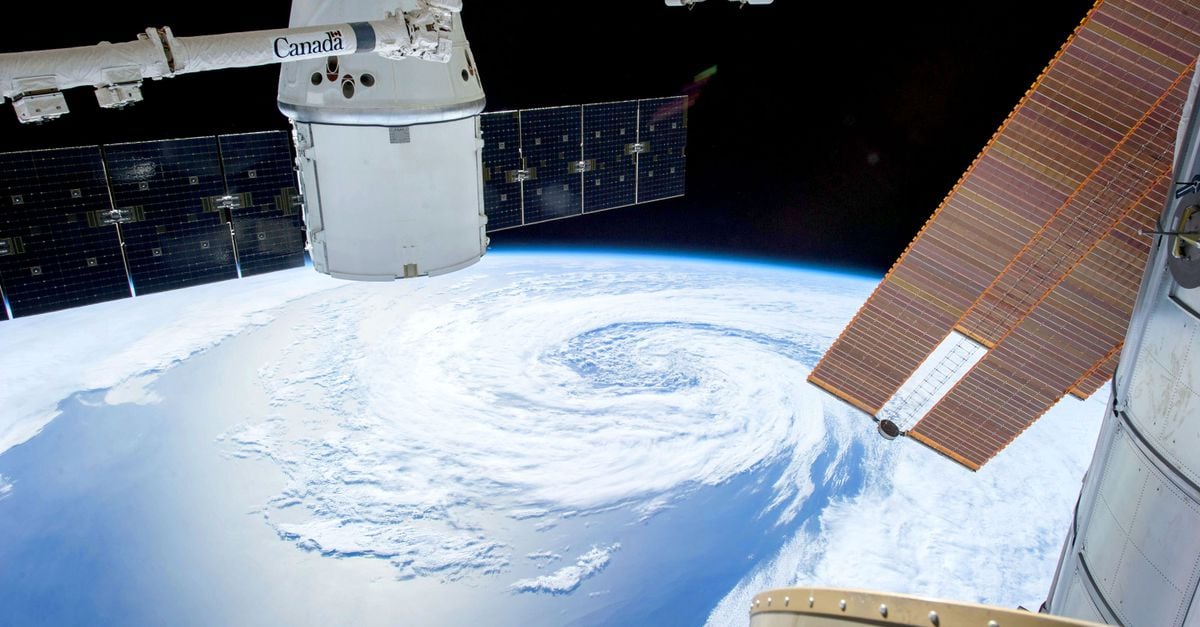
It helps to picture the vantage point. I have written about how the International Space Station laps the planet every 92 minutes, so its crew watches the Earth turn beneath them through sixteen sunrises a day. You spend months looking at nothing but the planet, whole and moving, and something in the way you hold it seems to change.
How seriously to take it
This is where I want to be careful, because it is easy to let a lovely idea outrun the evidence.
The overview effect is, so far, overwhelmingly a matter of testimony. It comes from a small, self-selected group of people who trained for years to get where they were, which is not the sort of sample that settles anything. The accounts are consistent and sincere, but consistent anecdote is not the same as a measured result, and it would be a mistake to present it as one.
Researchers have started trying to study the underlying experience. A 2016 analysis by the psychologist David Yaden and colleagues examined astronaut accounts through the lens of awe and self-transcendent experience, treating the overview effect as a case worth taking seriously rather than dismissing, while being candid about how little hard data exists. Others have gone at it mostly by examining awe as an emotion and by attempting to recreate the view with virtual reality and planetarium domes. Those efforts have produced some interesting hints that a sense of vastness can shift how people feel about themselves and others, but the results are early and modest, and a headset is plainly not the same as the window of a spacecraft. The honest position is that the effect is real as reported experience, and still poorly understood as science.
Why it matters from the ground
Most of us will never see the Earth from orbit. What the photographs did was hand a diluted version of the view to everyone else, which may be the more important legacy.
Before 1968, the image of the whole Earth did not exist in anyone’s mind except as an abstraction. Now it is on flags, phone screens and classroom walls, so familiar that it is easy to forget how recent it is. Whatever you make of the environmental reading, and people draw that conclusion with varying force, the plain fact underneath is that a genuinely new human perspective is only about sixty years old.
What to watch is whether it stays rare. As commercial flights carry more people to the edge of space and into orbit, the overview effect may stop being the preserve of a few hundred astronauts. Whether spreading the experience changes anything, or whether it simply becomes another view people photograph and scroll past, is a genuinely open question, and one we are about to start answering.