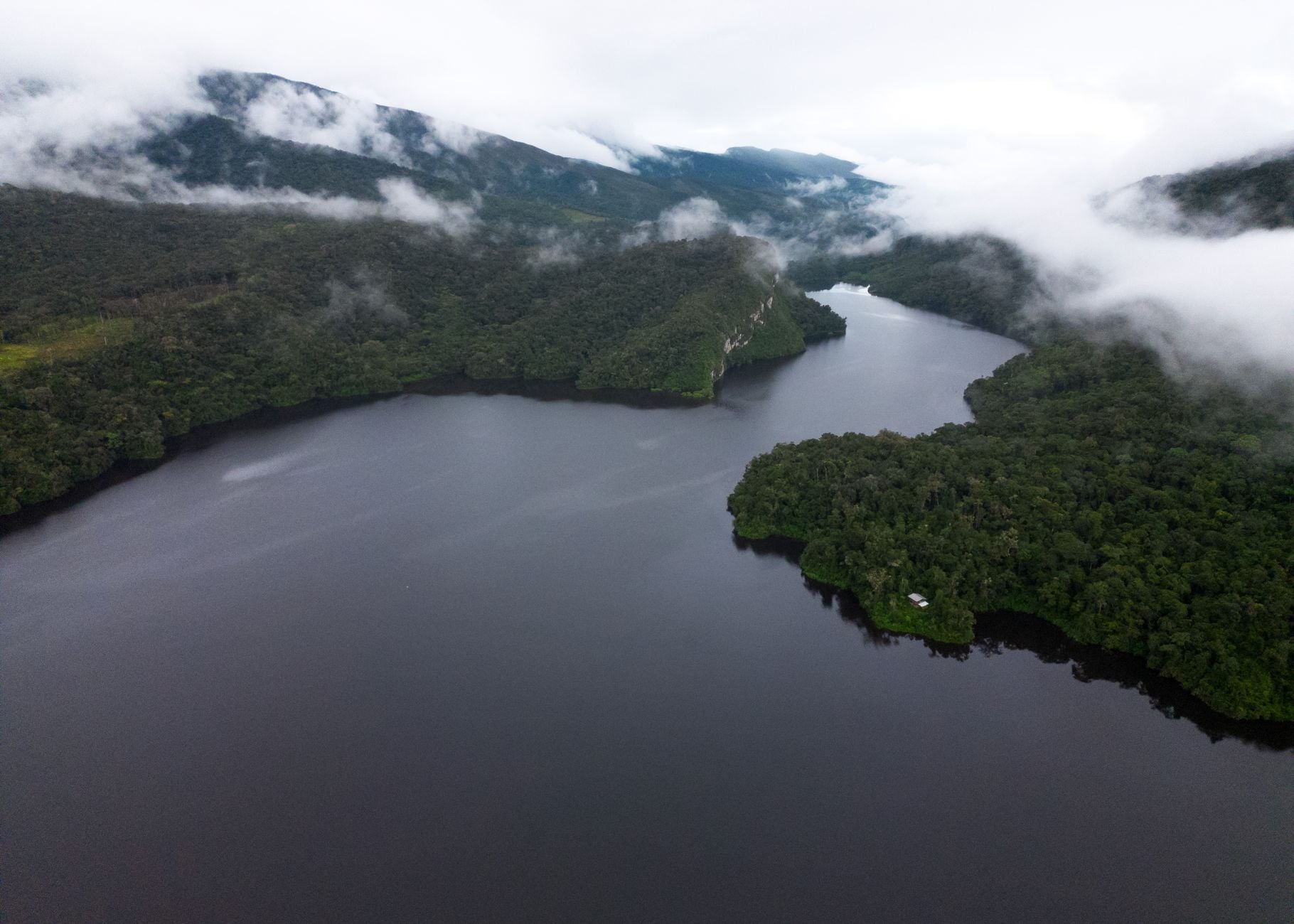
The image is almost too neat.
On one side of the Atlantic sits the Sahara, the largest hot desert on Earth. On the other sits the Amazon, the largest tropical rainforest. One is defined by exposed mineral ground and scarce rain. The other receives so much rain that water is continually carrying material out of its soils.
High above the ocean, those apparent opposites are connected by a moving layer of dust.
The figure most often attached to that connection is 27.7 million tonnes a year. It came from a NASA-led satellite analysis that estimated how much African dust was deposited over the Amazon basin. Mixed into that dust was an estimated 22,000 tonnes of phosphorus, close to the amount researchers calculated that rain and flooding remove from the basin annually.
That makes for a wonderful story about planetary balance. It is also a story whose numbers have been revised and debated. The Sahara really does fertilise parts of the Amazon, but it is not the forest’s only nutrient source, and 27.7 million tonnes should be read as one influential estimate rather than a fixed annual delivery.
A satellite used laser pulses to weigh a continent-spanning dust plume
The headline number came from NASA’s Cloud-Aerosol Lidar and Infrared Pathfinder Satellite Observation, better known as CALIPSO. Its lidar sent pulses of light into the atmosphere and measured what returned after bouncing off particles. The optical signal allowed researchers to distinguish mineral dust from other aerosols and build vertical slices of the plume.
Using observations from 2007 to 2013, the team estimated that wind carried an average of 182 million tonnes of dust each year past the western edge of the Sahara. About 132 million tonnes remained airborne near South America’s eastern coast. Of that flow, NASA reported that 27.7 million tonnes settled over the Amazon basin, while another 43 million tonnes continued towards the Caribbean.
This distinction matters. The 27.7 million tonnes was not the total quantity crossing the Atlantic. It was the estimated portion deposited over the Amazon.
Nor was it the same every year. NASA said dust transport changed by 86 per cent between the high year of 2007 and the low year of 2011. The team found that wetter conditions in the Sahel during one year were associated with less dust transport in the next, possibly because vegetation covered more soil or because rainfall tracked changes in the winds.
“Every year”, then, means a seven-year average across a highly variable atmospheric process.
Watch this video to understand more about this incredible phenomenon:
Why a green forest can live on phosphorus-poor ground
The Amazon looks like the last place on Earth that would need fertiliser. Its canopy contains an extraordinary mass of leaves, wood, fruit and living tissue. But much of that fertility is held in the forest itself rather than waiting in the soil.
Fallen leaves, dead roots and other organic matter decompose, and plants rapidly take the released nutrients back up. This tight recycling does most of the work. Beneath it, many central and eastern Amazon soils are old and deeply weathered. Rain and flooding continue to remove soluble material, while phosphorus can also become chemically bound in forms that roots struggle to access.
Phosphorus is not optional. Plants use it in DNA, cell membranes and the molecules that transfer energy inside cells. In a field experiment published in 2022, researchers found direct evidence that adding phosphorus increased productivity in an old-growth Amazon forest on low-phosphorus soil. Fine-root productivity rose by 29 per cent and canopy productivity by 19 per cent after two years.
The CALIPSO team estimated that Saharan dust brought about 22,000 tonnes of phosphorus to the basin each year, approximately balancing the amount lost through rain and flooding in their nutrient budget. The important idea is replacement, not that the forest grows directly from desert dust. Internal recycling sustains the day-to-day forest, while fresh inputs can compensate for the slow leak.
I recently wrote about why the Amazon should not be described as the source of half the oxygen we breathe. Correcting that slogan does not make the forest less important. The dust story reveals a different role: the Amazon is part of a global exchange of minerals, water, carbon and living material that does not respect continental boundaries.
Some of the journey begins in an ancient lake bed
One of the best-known sources of this dust is the Bodélé Depression in Chad. It is now dry, but it once formed part of a much larger lake. The exposed sediments include minerals associated with the remains of freshwater microorganisms, leaving fine material that contains phosphorus.
When strong surface winds cross the depression and other source regions in the Sahara and Sahel, they lift the smallest particles high enough to join westward-moving air. These are not intact grains of beach sand sailing thousands of kilometres. They are fine mineral aerosols light enough to remain suspended while winds carry them across the Atlantic.
Some particles fall into the ocean. Some are washed from the air by rain. Some reach South America and settle onto leaves, water and soil. The path and destination depend on altitude, particle size, clouds and changing circulation.
Dust is often written about only as damage. In my article on the planet-wide storm that ended Opportunity’s Mars mission, airborne dust blocked sunlight until a solar-powered rover could no longer keep itself alive. On Earth, Saharan dust can also worsen air quality and alter radiation and clouds. Yet the same material can deliver nutrients to an ocean or forest. Dust has no single ecological meaning.
The 27-million-tonne estimate is not the last word
Satellite lidar gave scientists a three-dimensional view over a vast area, but turning optical measurements into tonnes of deposited dust requires assumptions about particle properties and how material falls from the atmosphere.
A later study used daily measurements from Cayenne in French Guiana between 2002 and 2017, combined with NASA’s MERRA-2 atmospheric model. It estimated annual African dust deposition over Amazonia at roughly eight to ten million tonnes, substantially below the CALIPSO estimate. The authors found the greatest deposition in northern and north-eastern South America, with much less reaching central Amazonia.
There is also more than mineral dust in the air. A 2019 study identified African biomass-burning aerosol as another substantial source of phosphorus reaching the Amazon and Atlantic. More recently, a 2026 Nature Geoscience analysis linked phosphorus carried from South American fires with patterns of forest productivity.
That last finding comes with an uncomfortable distinction. Nutrients in smoke can help vegetation at a distance, but the fires producing them also release carbon and can destroy forests. A nutrient subsidy does not make burning beneficial overall.
Together, these studies replace a tidy one-source story with a more realistic atmospheric budget. Saharan mineral dust matters, especially in the north and east. Its quantity remains uncertain. Smoke, biological particles, local soils and sediments from the Andes also contribute, and the balance differs across a basin nearly as large as Australia.
The real discovery is the connection, not the perfect number
If the true long-term average is closer to ten million tonnes than 27.7 million, the transatlantic link does not disappear. Millions of tonnes of African material still cross an ocean and reach South American ecosystems. The argument shifts from a perfect replacement mechanism to the size, location and biological availability of that input.
It would also be too strong to say the Amazon would simply exhaust itself if the Sahara stopped sending dust. The forest recycles nutrients efficiently, different Amazon soils have different histories, western regions receive younger sediments from the Andes, and atmospheric phosphorus arrives from other sources.
What the evidence supports is more measured and, to me, more interesting. Old tropical soils lose phosphorus. Forest growth can be phosphorus-limited. Saharan dust supplies new phosphorus from outside the basin, and the amount may be large enough to offset a meaningful part of that long-term loss.
The flow is sensitive to rainfall, vegetation and winds in Africa, so it may change as climate patterns change. Researchers cannot infer a simple future trend from seven years of CALIPSO data, but they can say that conditions on one continent influence the nutrient economy of another.
The Sahara and Amazon are not partners in any intentional sense. One does not exist to maintain the other. They are connected because Earth’s atmosphere turns local erosion into a planetary transport system.
A dry lake bed in Chad can become a trace of phosphorus in an Amazon leaf. The precise tonnage is still being narrowed down. The journey itself is no longer in doubt.